5 Key Signals from PM Modi’s Virtual ASEAN Summit Appearance amid growing tensions with the US. Two of the world’s most influential leaders — Prime Minister Narendra Modi and US President Donald Trump — appear to be engaged in a subtle diplomatic dance of avoidance.
As leaders gathered in Kuala Lumpur for the 47th ASEAN Summit and the 22nd ASEAN-India Summit, Modi’s decision to address the event virtually has prompted speculation about India’s evolving diplomatic posture. An empty chair in Kuala Lumpur’s convention centre became a quiet symbol of strategic restraint.
Modi, who has spent the past decade cultivating India’s image as a confident global player, opted to participate from New Delhi. His absence from the physical summit, where Trump made an appearance, suggests a careful calibration rather than coincidence.
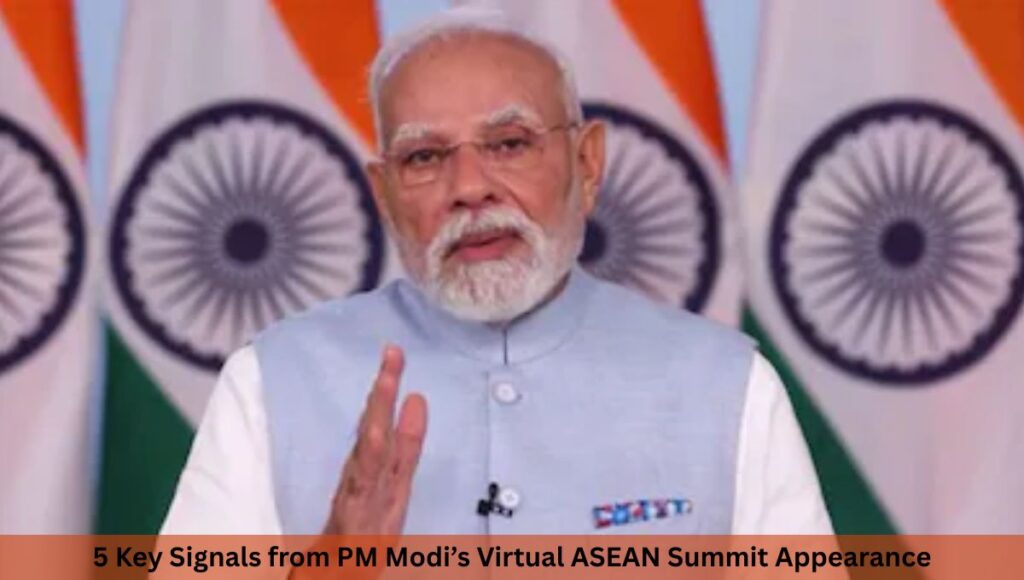
5 Key Signals from PM Modi’s Virtual ASEAN Summit Appearance
A Calculated Absence in a High-Stakes Arena
Prime Minister Modi’s virtual presence has raised questions about India’s motives. Officially, New Delhi cited the Prime Minister’s packed domestic schedule, including the Bihar state elections and post-Diwali engagements. However, observers believe the decision was more strategic than logistical.
The timing of Modi’s absence coincides with heightened friction in India-US relations. Trump’s renewed focus on Asia — coupled with his outspoken criticism of India’s trade and energy policies — has created a delicate environment for New Delhi.
By attending virtually, Modi avoided a potential confrontation or offhand remark that could have dominated global headlines. Diplomats in New Delhi describe this as “cautious diplomacy” — an attempt to maintain India’s voice at the summit while minimizing the risk of public discord with Washington.
ASEAN: A Cornerstone of India’s Act East Policy
Since assuming office in 2014, Prime Minister Modi has made ASEAN central to India’s “Act East Policy.” His consistent participation in ASEAN-India and East Asia Summits, either physically or virtually, underscores India’s commitment to regional integration.
The ASEAN bloc — comprising Indonesia, Malaysia, Singapore, Thailand, Vietnam, the Philippines, Brunei, Cambodia, Laos, and Myanmar — represents one of India’s most significant trade and strategic partners. Annual trade between India and ASEAN currently stands at an estimated $120–130 billion.
Under Modi, India has strengthened cooperation across areas such as maritime security, digital integration, disaster management, and the blue economy. Yet, the same platforms have also become arenas where political sensitivities and great-power competition play out — particularly between the US and China.
Kuala Lumpur’s Summit: Context and Themes
The 47th ASEAN Summit, hosted by Malaysian Prime Minister Anwar Ibrahim, focused on the theme “Connectivity and Resilience.” The discussions revolved around economic recovery, regional stability, and digital cooperation — key priorities for post-pandemic Southeast Asia.
Alongside ASEAN’s ten member states, dialogue partners including India, the US, China, Japan, and Australia participated in the summit. The event also marked the inclusion of East Timor as ASEAN’s newest member, a milestone acknowledged by Prime Minister Modi during his address.
Modi congratulated Anwar Ibrahim on Malaysia’s ASEAN chairmanship and expressed solidarity with the region. “India and ASEAN together represent almost a quarter of the world’s population,” Modi said. “We are connected by deep historical ties and shared values. We are fellow travellers of the Global South.”
PM Modi’s Virtual Address: ‘The 21st Century Is Ours’
In his speech, Prime Minister Modi projected optimism and partnership, calling the 21st century “the century of India and ASEAN.” His tone reflected continuity in India’s foreign policy — cooperative, inclusive, and forward-looking.
“The 21st century is our century. It is India and ASEAN’s century,” he declared. “I am confident that the aims of ASEAN Community Vision 2045 and Viksit Bharat 2047 will create a bright future for humanity.”
He announced 2026 as the “Year of ASEAN-India Maritime Cooperation,” highlighting India’s interest in deepening ties across the Indian Ocean. He also emphasized collaboration in areas such as education, green energy, cybersecurity, and cultural heritage.
“The India-ASEAN Comprehensive Strategic Partnership has continued to make steady progress even amid global uncertainty,” Modi said, underscoring India’s role as a reliable and responsible partner in the Indo-Pacific.
A Diplomatic Balancing Act with Washington
Behind the optimistic rhetoric lies a more complex reality. Relations between New Delhi and Washington have cooled since early 2025, following an awkward meeting between Modi and Trump in Washington that ended without a joint statement or trade breakthrough.
Since returning to the White House, President Trump has adopted an assertive stance on global trade, targeting nations he accuses of “unfair economic practices.” India has not been spared. The US has raised tariffs on Indian exports — in some categories by as much as 50 percent — citing protectionist concerns.
In the energy sector, tensions have intensified. India’s continued purchase of discounted Russian crude oil has collided with Washington’s sanctions regime. Trump’s decision to impose penalties on major Russian energy firms such as Rosneft and Lukoil has complicated payment and insurance channels for Indian refiners.
Trump’s public remarks have further strained ties. His claim that he personally “stopped an India-Pakistan war” drew criticism in New Delhi, while his statements suggesting that Modi had agreed to cut Russian oil imports were pointedly ignored by Indian officials.
Why Modi Chose the Virtual Route
For a leader who thrives on high-visibility diplomacy, Modi’s decision to stay away from Kuala Lumpur was not taken lightly. Analysts interpret it as a tactical move to avoid unnecessary friction with Washington, especially in a multilateral setting where Trump’s unpredictable remarks could overshadow the event.
“By participating virtually, Modi ensures India’s engagement without inviting unnecessary drama,” said a senior Indian diplomat familiar with ASEAN proceedings. “It’s a form of controlled participation — present, but not vulnerable.”
This approach, however, comes with trade-offs. Modi’s absence meant fewer opportunities for informal bilateral interactions — often the most productive moments during summits. Leaders such as Anwar Ibrahim of Malaysia and Ferdinand Marcos Jr. of the Philippines were expected to hold sideline discussions with the Indian Prime Minister.
Opposition Reactions and Domestic Optics
Domestically, Modi’s absence has sparked criticism from opposition leaders, who accuse him of avoiding confrontation with Trump. They argue that the Prime Minister’s cautious approach contrasts with his earlier projection of bold, assertive global leadership.
Critics point to Modi’s history of high-profile summits — from the G20 to the BRICS and Quad meetings — where he positioned India as a decisive global voice. His virtual participation in Kuala Lumpur, they suggest, signals a retreat from that image.
However, officials within the Ministry of External Affairs have defended the move as “pragmatic,” noting that diplomacy must balance optics with outcomes. “The Prime Minister’s message was clear, comprehensive, and well-received. Physical presence is not the only measure of engagement,” one senior official said.
India’s Broader ASEAN Strategy
Despite the political speculation, India’s long-term commitment to ASEAN remains steady. Since its formal engagement began in 1992, India has consistently deepened ties with Southeast Asia through trade, defense cooperation, and cultural exchange.
At the 2018 Commemorative Summit in New Delhi, all 10 ASEAN leaders attended India’s Republic Day celebrations — a testament to the relationship’s significance. Over the past decade, India has expanded its partnerships in areas such as digital connectivity, supply chain resilience, and maritime security.
India’s “Act East Policy” — now often described as “Act Indo-Pacific” — places ASEAN at the core of its strategic outreach. The region’s geographic and economic importance aligns closely with India’s vision of a free, open, and rules-based Indo-Pacific.
Trump’s Return and India’s Cautious Response
President Trump’s renewed focus on Asia has been accompanied by fiery rhetoric and a transactional approach to diplomacy. His emphasis on trade surpluses, tariff leverage, and energy sanctions has unsettled allies and rivals alike.
For India, maintaining engagement with the US while preserving its strategic autonomy is a delicate balancing act. Modi’s government continues to emphasize cooperation on technology, defense, and counterterrorism — but without compromising its independent energy and foreign policy choices.
Experts note that India’s decision to skip a face-to-face meeting may be temporary. “This is tactical restraint, not disengagement,” said former diplomat Rajiv Bhatia. “Modi is signaling that India will engage on its own terms, not on the timelines or optics dictated by others.”
A Test of Leadership and Perception
In foreign policy, presence carries symbolic weight. Modi’s virtual appearance has been read both as a sign of prudence and as a missed opportunity. While he successfully avoided a potential diplomatic flashpoint, critics argue that absence can also weaken influence.
For a leader whose brand rests on global visibility, the decision invites scrutiny. Yet, it also demonstrates India’s growing confidence in choosing the timing and format of its engagements based on national interest rather than external expectations.
“The Prime Minister has built a reputation for being everywhere,” said international relations expert Dr. Meera Shankar. “In this case, his absence was deliberate — a reminder that silence and distance can also be tools of diplomacy.”
Looking Ahead: The Road to Recalibration
As global politics shift toward uncertainty, India’s approach to the US and ASEAN will continue to evolve. With Trump’s policies emphasizing economic nationalism and India’s focus on self-reliance through “Atmanirbhar Bharat,” both sides will need to rebuild trust.
Future interactions — including the next East Asia Summit and the G20 meetings — may provide opportunities for Modi and Trump to reset their working relationship. Until then, New Delhi appears intent on maintaining strategic restraint.
For ASEAN nations, India remains a valuable partner, particularly in balancing China’s growing influence. Modi’s emphasis on connectivity, sustainability, and maritime cooperation resonates deeply with regional priorities.
Conclusion: Diplomacy Behind the Digital Curtain
Prime Minister Narendra Modi’s virtual participation in the 47th ASEAN Summit symbolizes more than a scheduling choice. It reflects a nuanced phase in India’s diplomacy — one defined by caution, calculation, and quiet assertion.
As India navigates an unpredictable international landscape shaped by Trump’s return and China’s assertiveness, every diplomatic gesture carries meaning. Modi’s decision to stay behind the digital curtain may have kept him out of Trump’s reach — but it also kept India’s message firmly on the global stage.
In the end, diplomacy is not only about being seen, but about being understood. Modi’s virtual appearance served that purpose — reinforcing India’s voice while reminding the world that strategic silence can sometimes speak the loudest.
Also Read: Modi skipping ASEAN meet to avoid being cornered by Trump: Congress
Also Read: BRICS Leaders to Hold Virtual Summit on Trump Tariffs and Multilateralism