

5 Stunning Facts about Russia’s New Missile Test and its strategic implications for the escalating war. In a major escalation of both strategic and tactical warfare, Vladimir Putin announced that Russia has “successfully” tested the nuclear-powered cruise missile known as 9M730 Burevestnik (NATO reporting name SSC-X-9 “Skyfall”) and is preparing for its deployment. Simultaneously, Ukraine has been hit by renewed drone and missile strikes, including on its capital Kyiv. This article explores both developments – the weapon test and the attacks – their implications, and how they intersect.
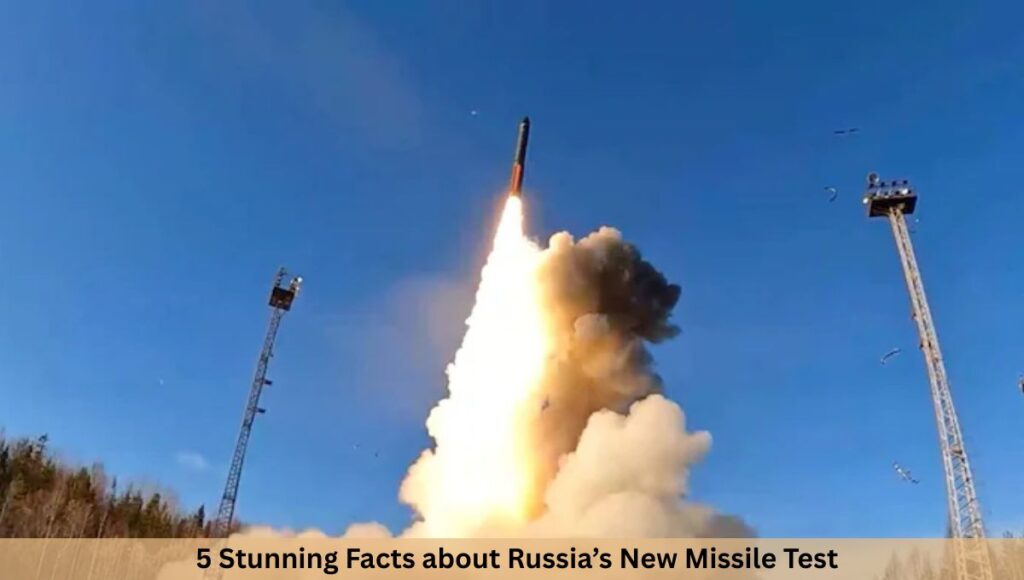
5 Stunning Facts about Russia’s New Missile Test
1. What is the Burevestnik missile?
1.1 Basic description
The Burevestnik is a ground-launched cruise missile with a claimed nuclear propulsion system, designed to carry a nuclear warhead. According to Russian announcements, it is essentially a “global-reach” weapon with very long range and the capability to evade current missile defences.
1.2 Claimed performance
In the most recent Russian announcement:
- It flew for about 15 hours, covering a distance of approximately 14,000 km (≈8,700 miles).
- President Putin described it as a “unique weapon that no one else in the world has.”
1.3 Technical features and challenges
- The missile is claimed to fly at very low altitude (50-100 m) to evade radar.
- It uses a nuclear reactor (or nuclear power unit) to heat incoming air and propel the missile, giving it theoretically unlimited range.
- Experts are sceptical: issues raised include its subsonic speed (making it more detectable), a poor test record, radiation risks, and the very high technical barrier to building such a weapon.
2. Russia’s claim of a successful test and deployment plans
2.1 What Russia says
Russia’s military chief, Valery Gerasimov, claimed the missile remained airborne for ~15 hours and travelled ~14,000 km, and “that’s not the limit.” President Putin directed the military to “determine the possible ways of using it and start preparing the infrastructure for deploying this weapon.”
2.2 Independent expert views
- The non-profit Nuclear Threat Initiative (NTI) notes that the Burevestnik has had at least 13 known tests with only two partial successes.
- Analysts argue that while the concept is alarming, its actual combat value may be limited until reliability and safety issues are resolved.
2.3 Strategic implications
If fully operational, a nuclear-powered cruise missile with global reach could:
- Circumvent or complicate current missile defence systems due to long loiter time and low-altitude flight paths.
- Influence arms control dynamics, especially as the New START Treaty between Russia and the U.S. is set to expire in February 2026.
3. The context: Russia’s strikes on Ukraine
3.1 Recent attacks on Kyiv and other regions
In tandem with the missile announcement, Russia launched another wave of drone and missile attacks on Ukraine, including on the capital Kyiv. In one overnight strike, three people were killed and 31 wounded (including six children). The Ukrainian interior minister reported high-rise buildings struck, windows shattered, and residents escaping fires.
3.2 Impact on civilians and infrastructure
- A fire broke out at a nine-storey residential building in the Desnianskyi region of Kyiv, with rescue crews saving 13 people from upper floors.
- Mayor Vitali Klitschko said residents “had to climb down the fire-escape… we almost suffocated, we almost burned to death.”
3.3 Ukrainian response and needs
Ukraine’s President Volodymyr Zelenskyy renewed appeals for advanced air-defence systems (such as Patriot missile batteries) to protect against the barrage of drones and missiles.
4. Why this matters: strategic and humanitarian stakes
4.1 Strategic stakes
- The successful deployment of the Burevestnik (or even credible progress) would signal a significant shift in strategic deterrence and nuclear-capable weapons.
- It adds pressure to arms-control frameworks, and raises questions about escalation and stability in nuclear-armed states.
4.2 Humanitarian and regional stakes
- The ongoing attacks on Ukrainian civilians and infrastructure highlight the deteriorating security and humanitarian situation.
- Use of advanced or novel weapons raises the risk of unintended escalation, miscalculation, or collateral damage.
4.3 Risk of misperception
- When novel weapons are announced or tested, adversaries may assume full operational status even if capability is limited — raising danger of mis-judgement.
- The radiation risk from nuclear-powered cruise missiles (even if not nuclear-armed) is non-trivial: independent analyses reference the 2019 accident in Russia’s White Sea region where nuclear specialists were killed.
5. What’s next and what to watch
5.1 Indicators to monitor
- Independent verification of the Burevestnik’s operational status (deployment site, number of missiles, launch capability).
- Russian official infrastructure build-up (launch sites, warhead storage, training). For example, observers have pointed to the Vologda-20 site.
- Ukraine’s capacity to defend against drone and missile barrages, and whether Western allies supply more advanced air-defence systems.
- Any escalation signals, such as use of nuclear-capable weapon systems, or retaliatory strikes on Russian territory.
5.2 Potential outcomes
- If the Burevestnik is operationalised, it could shorten warning-times and complicate NATO/Russia deterrence postures.
- Ukraine may push harder for more Western weapons, and the war may see further intensification of long-range strikes and defences.
- Arms-control frameworks may come under further strain, especially the New START treaty or any successor agreements.
6. Conclusion
The dual developments of Russia announcing a supposedly successful test of its nuclear-powered cruise missile and a renewed wave of drone/missile strikes on Ukraine present a stark picture: one of escalating strategic weapons development and intensifying conventional warfare.
While independent experts remain cautious about the missile’s true operational status, the announcement itself has significant signalling value. For Ukraine, the attacks underline a critical need for more defence resources and possibly deeper Western involvement.
For global strategic stability, the trajectory of novel weapons like the Burevestnik, and how they are integrated (or not) into command-and-control and deterrence frameworks, will be crucial.
Also Read: What is Russia’s Burevestnik missile?
Also Read: Trump’s Bold 2025 Move: Tomahawk Missile Warning to Russia
Related Posts:
- Putin Tests ‘Burevestnik’ Nuclear Missile as Trump…
- 5 Major Takeaways from the US Supreme Court's…

- In 8 Moves, EU Targets China-Linked Refineries and…

- 7 Heartbreaking Facts About Venezuela's Earthquake Disaster

- 9 Explosive Claims as Trump Says US Winning Iran War

- 7 Powerful Measures: Trump Sanctions Russian Oil…
