
Putin Tests ‘Burevestnik’ Nuclear Missile as Trump Calls for Renewed U.S.–Russia Arms Talks amid growing geopolitical tensions. Russian President Vladimir Putin has announced the successful test of the Burevestnik, a nuclear-powered cruise missile capable of carrying a nuclear warhead, describing it as a key step in strengthening Russia’s strategic deterrence.
The revelation comes amid rising global concern over the erosion of nuclear arms control agreements and increasing tensions between Moscow and Washington. Former U.S. President Donald Trump responded by urging both nations to return to formal dialogue on nuclear security, calling for a “new era of mutual restraint” following years of strained relations.
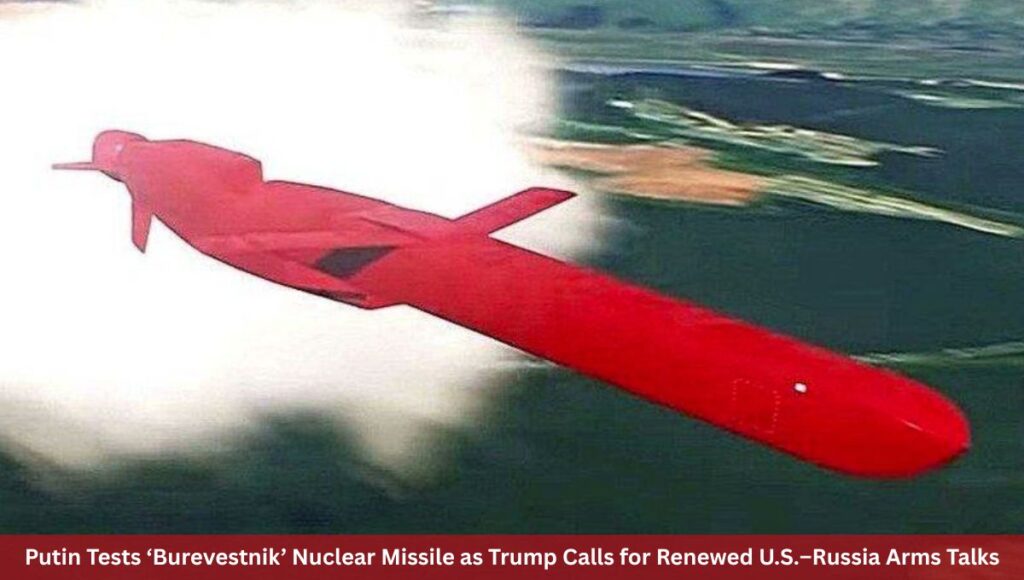
Putin Tests ‘Burevestnik’ Nuclear Missile as Trump Calls for Renewed U.S.–Russia Arms Talks
Putin’s Statement and Strategic Emphasis
Speaking during a defense technology forum in Moscow, President Putin said the Burevestnik missile—officially known as the 9M730—had completed a successful flight test, demonstrating “unique capabilities” and “unlimited range.”
“The Burevestnik has been tested successfully,” Putin said in remarks broadcast by Russian state media. “It is one of the key components of our advanced weapons program, ensuring the strategic balance that protects Russia’s sovereignty.”
The Burevestnik, often referred to in NATO terminology as the SSC-X-9 Skyfall, is designed to remain airborne for extended periods due to its nuclear propulsion system, potentially allowing it to bypass traditional missile defenses. Analysts have long viewed it as one of the Kremlin’s most controversial weapons projects, alongside the Poseidon underwater drone and Avangard hypersonic glide vehicle.
Putin added that Russia’s next-generation deterrent systems were being developed “not for aggression, but to preserve stability,” noting that the West’s expansion of missile defense networks had compelled Moscow to respond.
Background: A New Phase in the Arms Competition
The Burevestnik program, first unveiled by Putin in 2018, was intended to signal Russia’s technological response to U.S. withdrawal from key arms control agreements. Washington exited the Intermediate-Range Nuclear Forces (INF) Treaty in 2019, accusing Moscow of violations, a claim the Kremlin has consistently denied.
Since then, both nations have operated outside most Cold War-era arms control frameworks. The New START Treaty, signed in 2010 and extended until 2026, remains the last bilateral agreement limiting deployed strategic nuclear weapons.
Experts say the test underscores Moscow’s intent to modernize its arsenal while also signaling to Washington that it expects parity in future arms control negotiations. “The Burevestnik’s testing reflects Russia’s strategy of strategic signaling amid deteriorating communication channels with the West,” said Pavel Felgenhauer, a Moscow-based defense analyst. “It’s meant to remind NATO that Russia remains a major nuclear power capable of asymmetric deterrence.”
Trump Reacts: Calls for ‘Nuclear Stability Talks’
In a statement posted on his social media platform, former U.S. President Donald Trump said the latest Russian missile test underscored the need for renewed U.S.–Russia dialogue on nuclear arms control.
“We need to prevent a catastrophic nuclear arms race,” Trump said. “The United States and Russia should immediately resume serious talks to ensure peace and stability. It’s time for leadership and diplomacy, not escalation.”
Trump, who has previously positioned himself as a proponent of direct engagement with Moscow, also criticized the Biden administration for what he called “strategic neglect” of nuclear diplomacy. He added that global security “cannot depend on outdated treaties or political point-scoring.”
While serving as president, Trump withdrew the United States from the INF Treaty and the Open Skies Treaty, citing compliance concerns. His administration proposed a new trilateral framework involving China, but talks failed to materialize before he left office.
White House: ‘Committed to Strategic Stability’
In Washington, the Biden administration said it was aware of reports regarding Russia’s missile test and reiterated its commitment to arms control.
“We continue to monitor Russian strategic developments closely,” a senior U.S. official told reporters on Sunday. “The United States remains committed to strategic stability and to reducing nuclear risks through verifiable arms control arrangements.”
The official, who spoke on condition of anonymity, added that “unconstrained weapons development by any nation poses global risks” and reaffirmed U.S. support for “responsible behavior in the nuclear domain.”
Analysts in Washington said that while the test does not alter the strategic balance immediately, it complicates future negotiations. “Russia is sending a message that it can innovate beyond existing limits,” said Jon Wolfsthal, a former U.S. National Security Council official. “That makes the next round of arms talks, if they happen, far more complex.”
Global Reactions and Security Implications
The confirmation of the Burevestnik test has drawn mixed responses globally. NATO officials said the alliance was “assessing the implications” of the launch, while the European Union called for “transparency and restraint.”
The United Nations Secretary-General’s office issued a statement urging “renewed dialogue to prevent a return to unrestrained nuclear competition.”
In Beijing, China’s Foreign Ministry reiterated its position that “all nuclear powers bear special responsibility for maintaining global strategic balance.” The ministry called on the United States and Russia to “fulfill their disarmament obligations and engage in constructive dialogue.”
India’s Ministry of External Affairs said it was monitoring the situation closely, emphasizing “the importance of global nuclear stability and non-proliferation commitments.”
Arms Control Under Strain
The erosion of global arms control frameworks has accelerated since 2019. With the demise of the INF Treaty and the Open Skies Treaty, and with New START set to expire in 2026, experts warn that the world could face its most precarious nuclear environment in decades.
“Unlike during the Cold War, there are now more nuclear actors, less communication, and fewer guardrails,” said Daryl Kimball, executive director of the Arms Control Association. “That combination increases the risk of miscalculation.”
Russia suspended its participation in the New START verification regime earlier this year, citing U.S. sanctions and restrictions on Russian inspectors. The United States has since halted reciprocal data exchanges, deepening uncertainty about each side’s arsenal.
“Without transparency and mutual verification, mistrust will grow,” Kimball added. “That’s why renewed diplomacy is crucial.”
Technical Overview: What Is the Burevestnik?
The 9M730 Burevestnik is a nuclear-powered, nuclear-armed cruise missile developed by Russia’s defense industry under the supervision of the state-owned enterprise Rosatom and the Ministry of Defence.
According to Russian defense briefings, the missile can theoretically maintain flight for extended periods, following unpredictable trajectories to evade detection. Western intelligence agencies have questioned the missile’s practicality, citing safety risks and technical challenges.
In 2019, an explosion during testing at a site near Nyonoksa, in northern Russia, killed several scientists, an incident believed to be linked to the Burevestnik project. The Kremlin did not confirm the connection but later honored the victims as “heroes of national defense.”
Russian Domestic Context
Domestically, the Kremlin has presented the Burevestnik’s progress as evidence of Russia’s resilience amid Western sanctions and military pressure related to the ongoing conflict in Ukraine. Russian state media hailed the test as “a triumph of national science and defense innovation.”
“Russia’s deterrent capability remains unmatched,” said Russian Defense Minister Sergei Shoigu, who attended the test briefing. “This system ensures that no adversary can consider aggression without facing inevitable consequences.”
Analysts say such messaging is designed both to reassure the Russian public and to reinforce the Kremlin’s image of technological parity with the West.
Trump’s Broader Position on U.S.–Russia Relations
Trump’s comments on the missile test mark his first major foreign policy statement in weeks and reflect a familiar emphasis on diplomacy through strength. During his presidency, he repeatedly suggested that his personal rapport with Putin could be leveraged to achieve “historic” nuclear reductions.
In his latest statement, Trump said he believed the United States could “achieve peace through negotiation and leadership,” arguing that “no one benefits from nuclear brinkmanship.”
Trump’s aides have hinted that if he were to return to the White House, a priority would be “comprehensive arms control talks with both Russia and China.” The Biden administration, meanwhile, has said that it remains open to talks but that Russia must first return to compliance with existing treaties.
European Security Outlook
The missile test has reignited debate within Europe about defense preparedness and deterrence policy. Several NATO member states, including Poland and the Baltic nations, expressed concern over what they called “escalatory actions” by Moscow.
Britain’s Foreign Office said in a statement that “Russia’s pursuit of destabilizing weapons systems threatens European and global security.” Germany’s Foreign Ministry called for “renewed efforts toward disarmament and dialogue.”
At the same time, European officials stressed the importance of maintaining communication channels with Moscow. “Even during the darkest moments of the Cold War, dialogue on arms control never stopped,” said Josep Borrell, the EU’s foreign policy chief. “It must not stop now.”
Expert Views: Risk and Realism
Security experts note that despite its advanced design, the Burevestnik remains largely symbolic. “It’s about political messaging more than operational readiness,” said Dr. Katarzyna Zysk, a professor at the Norwegian Institute for Defence Studies. “The system is meant to showcase Russia’s strategic innovation rather than immediately alter the nuclear balance.”
Still, others caution that symbolism can itself heighten risks. “When new nuclear systems are announced, tested, or paraded, it increases uncertainty,” said William Alberque of the International Institute for Strategic Studies. “That’s dangerous in an already tense global environment.”
The Road Ahead
As both Moscow and Washington prepare for the possible expiration of New START in 2026, the international community faces the challenge of preventing a renewed arms race involving not only the United States and Russia but also emerging powers such as China, India, and North Korea.
“The fundamental problem,” said UN disarmament researcher Renata Dwan, “is that political will for disarmament has eroded faster than the weapons themselves. Rebuilding trust will take years.”
Putin’s confirmation of the Burevestnik test, coupled with Trump’s call for renewed negotiations, may yet open a window—however narrow—for diplomacy. But for now, the world’s two largest nuclear powers remain locked in strategic rivalry, with global stability hanging in the balance.
Also Read: Trump Urges EU to Slap 100% Tariffs on China and India to Pressure Russia Amid Ukraine War