5 Explosive Global Implications of Trump’s Nuclear Testing Push — and the big opening it creates for India. U.S. President Donald Trump’s decision to lift America’s 33-year moratorium on nuclear weapons testing has sent shockwaves across global capitals.
Thank you for reading this post, don't forget to subscribe!Speaking after a summit in South Korea, Trump declared, “You’ll find out very soon,” when asked about the timeline for U.S. nuclear tests, hinting at imminent underground detonations. His order came days after Russia tested its nuclear-powered underwater drone Poseidon and cruise missile Burevestnik, both capable of carrying atomic warheads.
The timing couldn’t have been more consequential — it has effectively reopened the Pandora’s box of global nuclear testing, which had remained shut since 1992. For India, the move is more than symbolic. It reopens an uncomfortable question: Should New Delhi revisit its voluntary moratorium on nuclear testing, in light of emerging threats from China and Pakistan?
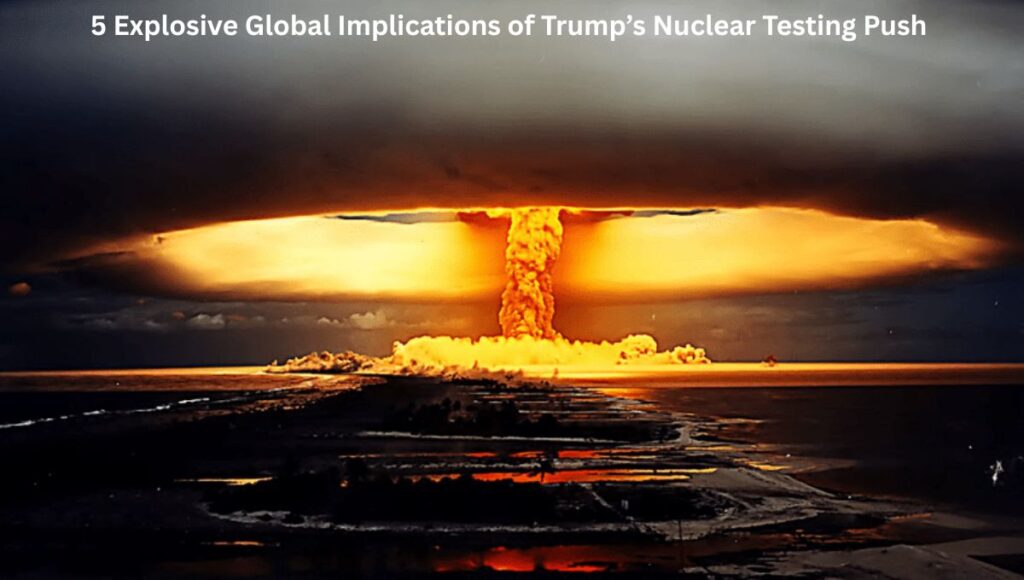
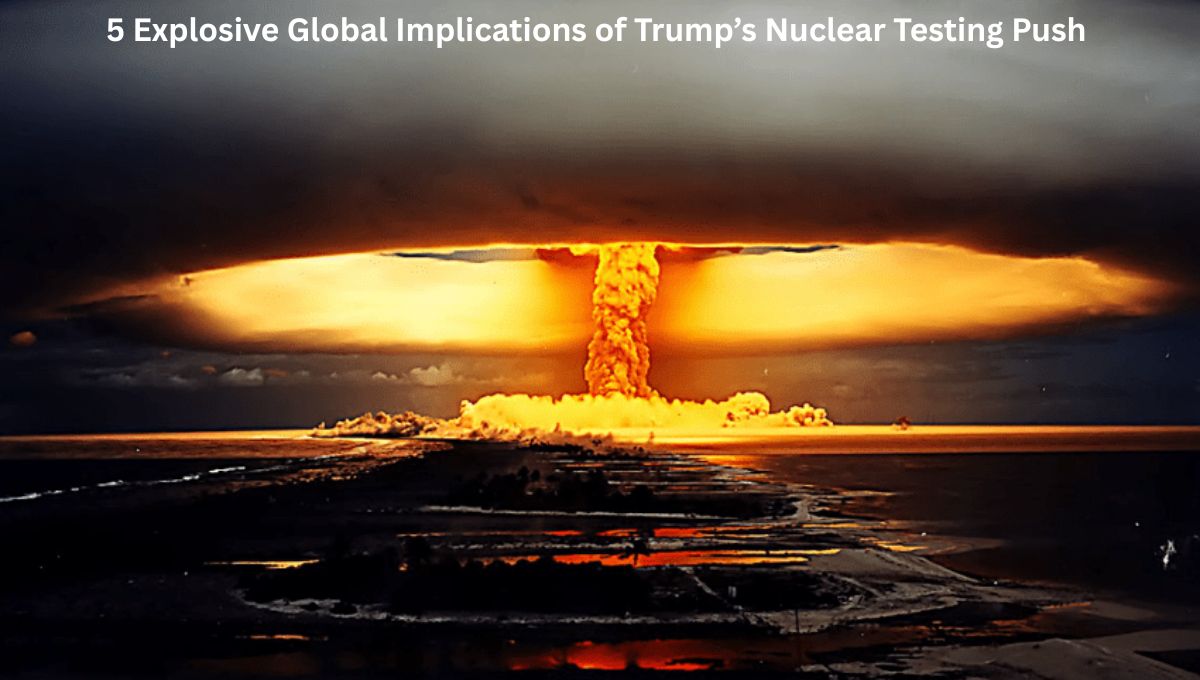
5 Explosive Global Implications of Trump’s Nuclear Testing Push
1. The U.S. Trigger: Trump Ends a 33-Year Pause
Trump’s directive to the Pentagon to “prepare nuclear tests on an equal basis with rivals” marks the most dramatic shift in U.S. nuclear posture since the Cold War.
The move comes amid rising tensions with both Moscow and Beijing, and signals what analysts are calling the start of a “Second Nuclear Age.”
During an interview on CBS’s 60 Minutes, Trump justified his decision:
“Russia’s testing, and China’s testing — but they don’t talk about it. I don’t want to be the only country that doesn’t test.”
Trump’s comments were swiftly followed by confusion within his own administration. U.S. Energy Secretary Chris Wright later clarified that the planned activities were “non-critical explosions”, not full-scale nuclear blasts.
“These are not nuclear explosions,” Wright said on Fox News. “They are system tests to ensure weapons reliability.”
But the mixed messaging failed to reassure global observers. To many, Trump’s words represented a strategic escalation — an attempt to reassert American dominance amid a weakening arms control framework.
Also Read: Resuming nuclear testing is not as easy as you think
2. The Global Fallout: Russia, China, and a Collapsing CTBT
The Comprehensive Nuclear-Test-Ban Treaty (CTBT), signed in 1996, bans all nuclear explosions, whether for military or civilian purposes. Yet nearly three decades later, the treaty remains unratified by eight key states — including the U.S., China, India, and Pakistan.
Trump’s order threatens to completely erode what remains of the CTBT’s moral authority. Russia responded sharply. Kremlin spokesman Dmitry Peskov called Trump’s move “escalatory,” while insisting Moscow’s recent weapons demonstrations were not nuclear tests.
China’s Foreign Ministry, meanwhile, denied any secret nuclear activity, calling Beijing a “responsible nuclear-weapons state” that abides by its moratorium. However, analysts warn that the global non-proliferation regime is under severe strain.
Russia withdrew its CTBT ratification in 2023, citing “strategic imbalances,” while China has been conducting subcritical nuclear simulations. North Korea, for its part, continues periodic nuclear detonations despite a self-imposed moratorium in 2018.
If the U.S. resumes testing, experts fear a domino effect — an arms race reminiscent of the mid-20th century, with the world’s major powers openly competing for thermonuclear supremacy.
3. India’s Nuclear Dilemma: To Test or Not to Test
For India, Trump’s decision presents both an opportunity and a dilemma.
Since the 1998 Pokhran-II tests, India has adhered to a voluntary moratorium, upholding its “credible minimum deterrence” doctrine under a no-first-use policy. Yet questions have long persisted about the efficacy of India’s thermonuclear or hydrogen bomb test from that year.
The Thermonuclear ‘Fizzle’ Debate
In 2009, DRDO scientist K. Santhanam, who coordinated the 1998 tests, publicly declared that the thermonuclear test was a “fizzle” — producing only 10–15 kilotons (kt) of yield instead of the intended 200 kt.
However, Dr. R. Chidambaram, then Chairman of the Department of Atomic Energy (DAE), rejected the claim, asserting that India’s data and simulations were sufficient to validate the weapon design.
Seismic data from global monitoring stations, however, suggested total yields lower than India’s official figures. Critics like Bharat Karnad, a strategic affairs analyst, argue that India’s arsenal remains “decades behind China’s megaton-class weapons.”
4. China and Pakistan: India’s Two-Front Nuclear Shadow
India today finds itself sandwiched between two nuclear-armed adversaries: Pakistan and China.
Pakistan’s nuclear stockpile stands at roughly 170 warheads, with Islamabad actively developing tactical nuclear weapons for battlefield use. China’s arsenal, estimated at 600 warheads, is projected to grow to 1,000 by 2030, according to the U.S. Department of Defense.
What concerns Indian analysts most, however, is China’s Fractional Orbital Bombardment System (FOBS) — tested in 2021 — which can evade conventional missile defense by approaching targets from unpredictable directions.
“A system like FOBS could be catastrophic for us,” warns journalist and defence expert Sandeep Unnithan, citing India’s still-developing Prithvi Defence Vehicle (PDV) interceptor system.
Such advancements, experts say, weaken India’s ability to retaliate after a first strike — a cornerstone of its no-first-use policy.
5. Expert Voices: The Case for a Pokhran-III
On social media and in policy circles, calls are growing louder for India to re-evaluate its nuclear strategy.
Retired Indian Army Lieutenant General Raj Shukla asked on X:
“Trump announces resumption of nuclear testing. Putin fires Poseidon. Does India’s nuclear posture need a re-visit or restructuring?”
Echoing this sentiment, Professor Happymon Jacob, founder of the Centre for Security and Development Research, argued:
“Should the U.S. resume nuclear testing, India must seize the opportunity to conduct its own thermonuclear tests, validating its deterrent and putting to rest doubts from 1998.”
Former Indian diplomat Ambassador Rakesh Sood offered a nuanced view, emphasizing that India has walked a fine line between promoting disarmament and protecting national security. Over time, he noted, India has earned respect as a “responsible nuclear power” despite not signing the Non-Proliferation Treaty (NPT).
Yet voices like Bharat Karnad and Happymon Jacob insist that without hot testing, India cannot confidently miniaturize warheads for new systems like Agni-VI ICBMs or K-5 submarine-launched missiles (SLBMs) — both critical to maintaining credible deterrence.
Global Chain Reaction: The Return of the Arms Race
Trump’s decision comes at a time when global nuclear competition is intensifying:
- Russia is testing new delivery systems, including nuclear-powered cruise missiles and torpedoes.
- China is building missile silos at record speed and expanding its nuclear submarine fleet.
- North Korea continues underground tests, defying UN sanctions.
- Pakistan is fielding tactical nukes, integrated with Chinese missile technology.
Experts say the U.S.-China-Russia dynamic could soon mirror the Cold War’s bipolar structure — only this time with India as a significant swing power.
As Unnithan notes, “This is a moment of recalibration. If the U.S., Russia, and China resume nuclear testing, the moral argument against India doing so disappears.”
Trump’s Geopolitical Calculus: Cold War 2.0
Trump’s nuclear gambit also fits within his larger strategic pattern: undermining multilateralism in favor of bilateral deal-making.
At the recent South Korea summit, Trump met Chinese President Xi Jinping, securing a promise to lift export controls on rare earth minerals — vital for U.S. industries. Soon after, he announced his nuclear testing order, claiming “parity” with rivals.
This new “G2 dynamic” — direct U.S.-China negotiation outside forums like the Quad or APEC — leaves allies like India, Japan, and Australia in uncertain terrain.
For Washington, the message is clear: America can handle China alone — and expects its allies to manage their own regions. For India, that may mean bolstering its independent deterrent capabilities.
Arms Control in Disarray: The End of Restraint?
The New START treaty — the last remaining arms control pact between the U.S. and Russia — expires soon, removing limits on deployed strategic weapons. With no replacement in sight, both superpowers are free to expand their arsenals.
The Federation of American Scientists (FAS) estimates:
- Russia: ~5,459 warheads
- U.S.: ~5,177
- China: ~600
- India: ~180
- Pakistan: ~170
- France: 290
- U.K.: 225
- Israel: 90
- North Korea: 50
Without a binding global treaty, the incentive to test and modernize nuclear stockpiles only grows stronger.
India’s Strategic Options: Balancing Deterrence and Diplomacy
India faces a delicate balancing act. Conducting new tests risks reigniting sanctions similar to those imposed after Pokhran-II. Yet abstaining may leave India technologically behind in the next phase of nuclear miniaturization and missile integration.
Option 1: Continue the Moratorium
Supporters of restraint argue that India’s current stockpile and simulation-based testing suffice. Dr. Chidambaram and the DAE maintain that “cold tests” — computer-based simulations using 1998 data — provide reliable modernization paths without provoking global backlash.
Option 2: Resume Limited Testing
Advocates for new tests — like Jacob and Karnad — believe India should conduct a Pokhran-III, validating thermonuclear yields and ensuring credible megaton-range deterrence. With the CTBT already weakened, they argue, the geopolitical costs may now be manageable.
Option 3: Strategic Ambiguity
A third approach involves maintaining silence while enhancing readiness. India could expand subcritical testing and simulation, keeping adversaries uncertain while avoiding overt treaty violations.
Geopolitical Consequences: The Indo-Pacific Equation
Trump’s nuclear rhetoric also has far-reaching implications for Asia’s strategic architecture.
The Quad alliance — once central to Indo-Pacific deterrence — appears sidelined in Washington’s calculus. Trump’s bilateral pivot toward China and transactional diplomacy may reduce the collective leverage India once enjoyed.
However, India’s ability to stand independently as a nuclear power could reinforce its status as a key regional stabilizer. A renewed Indian testing program, though controversial, might strengthen deterrence across the Indo-Pacific — from the Himalayas to the South China Sea.
Ethical and Environmental Concerns
Beyond strategy, nuclear testing carries grave humanitarian and ecological implications. Underground detonations can cause seismic disturbances, groundwater contamination, and long-term radiation exposure.
Internationally, such actions would undermine decades of advocacy for nuclear disarmament — a cause India itself has historically championed.
As Ambassador Sood reminds, “India has always sought to balance moral leadership with national interest. That balance must not be lost.”
Conclusion: The Nuclear Crossroads
Donald Trump’s decision to restart U.S. nuclear testing has cracked open a global fault line. What began as an attempt to project strength against Russia and China has now spiraled into a worldwide debate over deterrence, sovereignty, and the future of nuclear order.
For India, the challenge is profound. Trump’s move presents a rare strategic window — an opportunity to validate its hydrogen bomb capability and modernize deterrence. Yet the moral, diplomatic, and ecological stakes remain immense.
As the world inches toward a Second Nuclear Age, the real test for India will not be underground — but in the choices it makes above ground.
Key Takeaways
- Trump’s testing order ends a 33-year pause, reigniting global arms race fears.
- CTBT’s erosion could normalize nuclear testing worldwide.
- India faces pressure to revisit its 1998 moratorium amid Chinese and Pakistani advances.
- Experts are divided between restraint and revalidation through Pokhran-III.
- The global nuclear balance may tilt toward a new, multi-polar Cold War.
Also Read: US Warns Iran After Ceasefire: “Don’t Even Think About Nuclear Weapons Again” – VP JD Vance