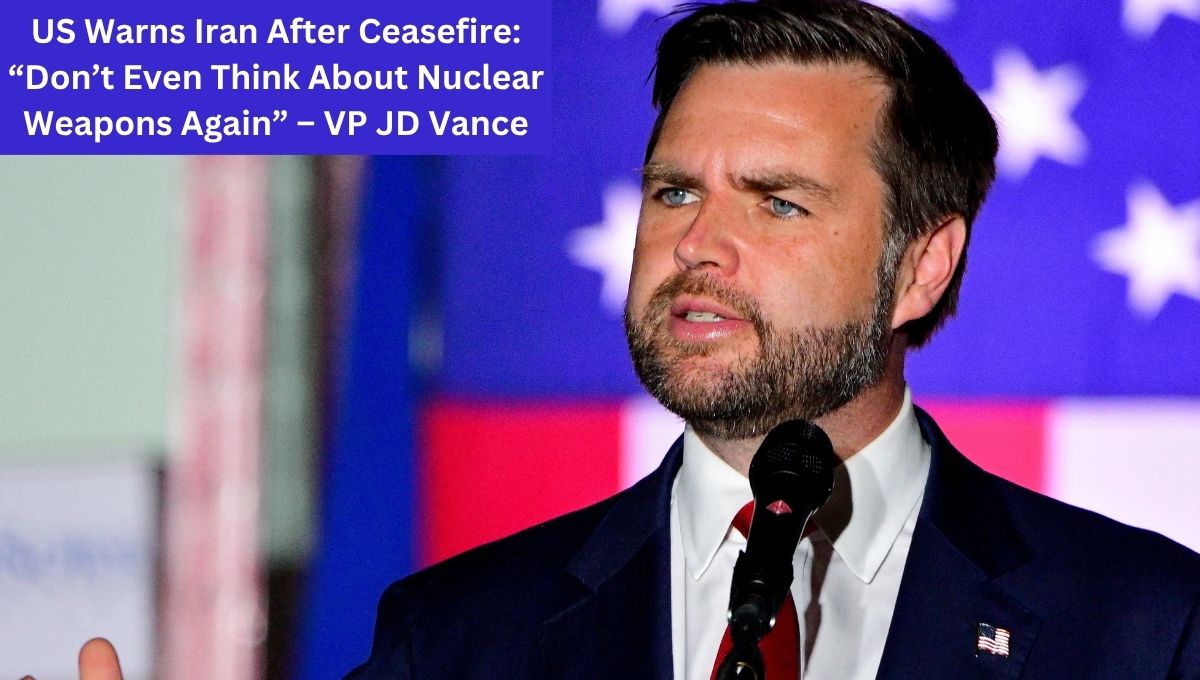
Apart from dismantling Iran’s nuclear infrastructure US Warns Iran After Ceasefire: “Don’t Even Think About Nuclear Weapons Again” – VP JD Vance. Just days after a dramatic and unexpected ceasefire between Israel and Iran, U.S. Vice President JD Vance issued a strong warning to Tehran, making it clear that any future attempt to rebuild a nuclear weapon program would invite a devastating American military response.
Speaking to Fox News in the wake of Operation Midnight Hammer, the surprise U.S. airstrikes that crippled Iran’s key nuclear facilities, Vance declared, “If Iran wants to build a nuclear weapon in the future, they’re going to have to deal with a very, very powerful American military again.”
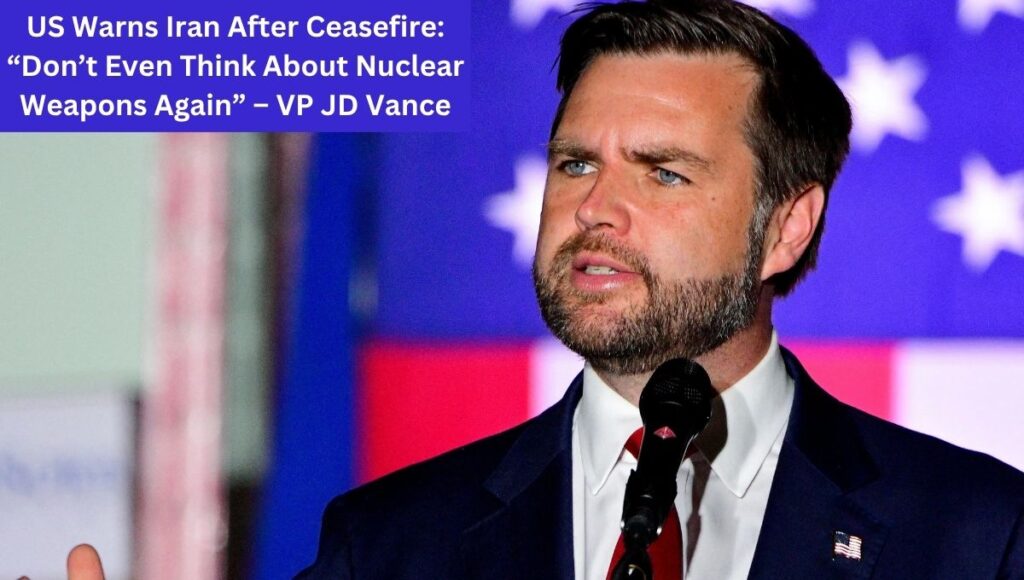
US Warns Iran After Ceasefire: “Don’t Even Think About Nuclear Weapons Again” – VP JD Vance
Operation Midnight Hammer: Destruction Without a Single U.S. Casualty
The U.S. military operation, launched on June 21, targeted Iran’s most fortified nuclear facilities at Fordow, Natanz, and Isfahan.
Using GBU-57 bunker-buster bombs and Tomahawk missiles, the U.S. carried out what officials described as precise and overwhelming strikes, effectively crippling Iran’s ability to produce weapons-grade uranium.
“The president, without, knock on wood, having a single American casualty, obliterated the Iranian nuclear program,” JD Vance said in his interview.
The strikes reportedly hit underground facilities believed to be central to Iran’s uranium enrichment efforts. While full damage assessments are pending, Vice President Vance confidently asserted that Iran’s nuclear program is no longer viable:
“We know that we set the Iranian nuclear program back substantially… It’s going to be a very long time before Iran can even build a nuclear weapon if they want to.”
Ceasefire Brokered After U.S. Strikes
The 12-day Israel-Iran conflict reached its boiling point when President Donald Trump ordered the surprise airstrikes. Iran responded with missile attacks on U.S. bases in Qatar and Iraq, but no casualties were reported.
Trump’s administration then swiftly moved to broker a phased ceasefire, announced via Truth Social. “CONGRATULATIONS TO EVERYONE! It has been fully agreed… that there will be a Complete and Total CEASEFIRE,” Trump posted.
The agreement called for Iran to initiate the ceasefire, followed by Israel, and then a formal end to the war after 24 hours. The ceasefire has held, marking a sudden and significant shift in regional dynamics.
JD Vance: This Is a “Reset Moment” for the Middle East
In his Fox News interview, Vance framed the conflict and its conclusion as an opportunity for regional reset. “I think the president really hit the reset button and said, let’s actually produce long-term peace for the region.”
Vance emphasized that the U.S. airstrikes were not only a response to Iran’s nuclear ambitions but also a warning for the future. “Our hope is that the Iranians have learned their lesson… We can fly a bunker-buster bomb from Missouri to Iran completely undetected and destroy whatever they build.”
Trump’s Doctrine: Peace Through Power
The Trump administration has framed Operation Midnight Hammer and the resulting ceasefire as a foreign policy success, leveraging overwhelming military strength to neutralize a strategic threat without entering a prolonged ground war.
“This is a great thing especially for Israel,” said Vance, who credited the strikes with also diminishing Iran’s conventional missile threat to Israel.
Trump’s foreign policy team, including Secretary of State Marco Rubio and Special Envoy Steve Witkoff, reportedly played key roles in back-channel diplomacy with Iranian intermediaries to facilitate the ceasefire.
According to a senior White House official, Trump personally called Israeli Prime Minister Netanyahu to finalize the deal.
Iranian Retaliation Seen as Symbolic
Following the U.S. strikes, Iran fired missiles at U.S. bases in Qatar, the region’s central hub for American operations. However, the response was widely seen as symbolic.
The missiles were intercepted, and the bases had already been evacuated, with Qatar having shut its airspace in advance.
Analysts suggest Iran’s leadership was seeking to save face without provoking a deeper military confrontation with the United States.
IAEA Yet to Verify Damage
The International Atomic Energy Agency (IAEA) has not yet been granted access to inspect the targeted facilities.
On Monday, IAEA chief Rafael Grossi expressed concern over the lack of independent verification: “At this time, no one, including the IAEA, is in a position to have fully assessed the underground damage at Fordow.”
This ambiguity has led some experts to question how deeply the strikes affected Iran’s actual uranium stockpiles, and whether those materials were moved prior to the bombing.
JD Vance: “This Is About Long-Term Peace”
Despite the military success, Vice President Vance stressed that the U.S. prefers diplomacy over further escalation: “The president is still intent on negotiating a long-term deal. Our hope and expectation is that Iran will not attempt to rebuild what has already been destroyed.”
He noted that military action is a deterrent, not a policy, saying: “Even though we have destroyed Iran’s nuclear program, we want peace. But if they try again, they’ll face consequences.”
Iran’s Capabilities “Set Back for Years”
When pressed on whether Iran could still eventually rebuild, Vance declined to discuss classified intelligence, but said: “They are much further away than 24 hours ago.
Whether it’s years or beyond, it’s going to be a long, long time before Iran can build a nuclear weapon again.”
“It Would Be the Stupidest Thing in the World”
Vance also delivered a stern warning regarding any potential Iranian retaliation against U.S. forces:
“If the Iranians want to enlarge this by attacking American troops, I think that would be a catastrophic mistake. It would be the stupidest thing in the world.”
His remarks reflect a White House confident in its military edge, but also cautious of wider conflict in the already fragile Middle East.
Trump Administration Eyes Permanent Nuclear Freeze
With the nuclear facilities destroyed and Iran diplomatically cornered, the Trump administration is now working on a new long-term agreement to ensure Iran cannot rebuild its nuclear program.
“The president is looking to build a stable, lasting deal that will ensure the safety of our regional allies and the American people,” said Vance. Such a deal would likely include strict verification measures, regional security arrangements, and a permanent end to uranium enrichment in Iran.
Global Reaction Mixed but Watching Closely
The international community has largely welcomed the halt in hostilities, but concerns remain about the legal and humanitarian implications of the U.S. strikes.
European officials are urging Washington to work with international bodies to formalize the ceasefire into a broader diplomatic framework. China and Russia have so far remained cautious in their responses, waiting to assess the new balance of power in the region.
Meanwhile, Middle East allies like Saudi Arabia and the UAE have praised Trump’s actions, with several officials calling it a “decisive moment” in deterring Iranian aggression.
Conclusion: A Fragile Peace, A Loud Warning
The 12-day war between Israel and Iran, capped by U.S. strikes under Operation Midnight Hammer, may be over for now, but the geopolitical consequences will linger.
The U.S. has sent a clear message: nuclear ambitions in the Middle East will not be tolerated. With Iran’s nuclear program reportedly crippled, and its leadership warned, the path to peace depends on whether Tehran learns from the destruction or chooses confrontation.
As JD Vance put it: “If they want to try again, they’ll have to deal with us again. And it won’t end well for them.”
Also Read: US Intel: Iran’s Nuclear Program Survived Strikes, Setback Temporary
Also Read: ‘Do not drop those bombs’: Trump warns Israel after ceasefire breach, says both sides violated truce
Related Posts:
- 7 Alarming Facts About Super Typhoon Fung-wong

- Trump’s 20-Point Gaza Peace Plan Gains Urgent Global…

- Afghanistan–Pakistan War 2025: Inside the 48-Hour Ceasefire

- Trump Brokers Iran-Israel Ceasefire After Alarming…
- 11 Explosive Warnings as Trump Vows to ‘Knock the…

- Israel-Iran War Escalates: Cluster Bombs, Missile…