Fearing tariff refunds, Donald Trump Warns of Trade Deal Unwinding as Tariff Battle Heads to U.S. Supreme Court. U.S. President Donald Trump has issued a stark warning that the country could be forced to unwind trade deals with the European Union, Japan, South Korea, and other nations if the Supreme Court upholds a ruling striking down many of his tariffs. Speaking at the White House, Trump said a defeat in the ongoing legal battle over tariffs would cause the U.S. “to suffer so greatly.”
The case, now heading to the Supreme Court, will decide whether Trump exceeded his authority by using the International Emergency Economic Powers Act (IEEPA) to impose sweeping tariffs across dozens of countries. The outcome could reshape U.S. trade policy, unsettle global markets, and potentially force the government to refund more than $200 billion in tariff payments to American businesses.
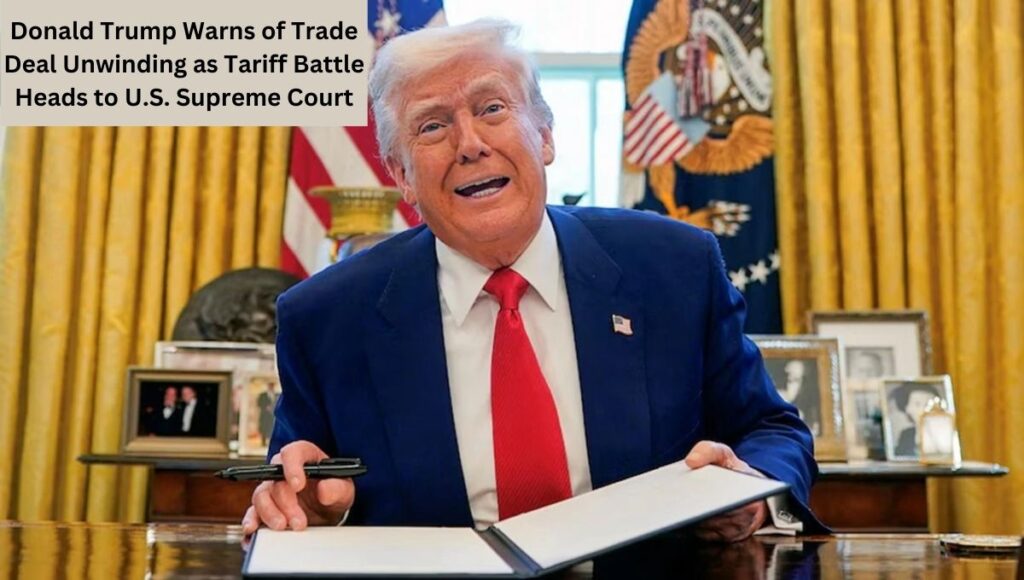
Donald Trump Warns of Trade Deal Unwinding as Tariff Battle Heads to U.S. Supreme Court
The Legal Showdown: Trump’s Tariff Authority Under Question
The tariff dispute began when small businesses and state governments challenged Trump’s use of IEEPA to levy broad import taxes.
The law, originally enacted in 1977, was designed to address “unusual and extraordinary threats” by giving presidents emergency powers to regulate international commerce.
Historically, it has been used to impose sanctions or freeze foreign assets not to enact wide-ranging tariffs. A 7-4 decision by the U.S. Court of Appeals for the Federal Circuit ruled that Trump’s actions overstepped presidential authority.
The judges found that tariffs fall under Congress’s constitutional power to impose taxes and duties, and that IEEPA does not explicitly authorize presidents to impose blanket tariffs.
While the appeals court declared many of Trump’s tariffs unlawful, it delayed the ruling from taking effect until October 14, 2025, giving the administration time to appeal to the Supreme Court. Trump’s legal team has now asked for an expedited hearing in November, hoping to secure a ruling before the year ends.
Trump’s Warning: “We’d Have to Unwind the Deals”
In his remarks, Trump emphasized the stakes of the case, noting that his tariffs formed the foundation of new trade frameworks with several major partners.
“We made a deal with the European Union where they’re paying us almost a trillion dollars. And you know what? They’re happy. It’s done. These deals are all done. I guess we’d have to unwind them,” Trump told reporters.
For the first time, Trump explicitly linked the survival of his trade agreements with the legality of his tariffs. Trade experts argue that the so-called “deals” were more like framework agreements rather than fully binding treaties, but Trump’s comments suggest he sees them as inseparable from his tariff strategy.
If the tariffs are invalidated, Trump argues, the U.S. economy would be devastated.
“Our country has a chance to be unbelievably rich again. It could also be unbelievably poor again. If we don’t win that case, our country is going to suffer so greatly, so greatly,” Trump said.
The Financial Stakes: $200 Billion on the Line
One of the most immediate consequences of a loss at the Supreme Court would be the issue of refunds. Since Trump first imposed his sweeping tariffs in 2023, American businesses have paid over $210 billion to cover the costs.
If the tariffs are struck down, importers could be eligible for refunds. But trade lawyers caution that the refund process may be long, complicated, and uneven.
- Some businesses may automatically receive refunds.
- Others may need to file administrative claims.
- In many cases, companies would have to pursue separate legal action to recover payments.
Trade attorney Ted Murphy suggested the government might establish an administrative refund program, requiring businesses to apply for reimbursements rather than issuing blanket refunds.
Meanwhile, investment firms have reportedly approached businesses to purchase stakes in potential refunds, essentially gambling on the outcome of the Supreme Court case.
Economic Risks: Inflation, Bonds, and Borrowing Costs
While American businesses might celebrate the possibility of refunds, economists warn that mass reimbursements could destabilize the broader economy.
Refunding more than $200 billion would mean the U.S. Treasury, which has used tariff revenues to reduce borrowing needs, would suddenly face a major shortfall. That could force the government to sell more Treasury bonds, pushing yields higher.
Higher yields, in turn, mean rising borrowing costs across the economy from mortgages to corporate loans.
Already, markets have reacted to the legal uncertainty. The yield on the 30-year Treasury bond briefly hit 5%, its highest level in months, as investors demanded greater compensation for holding U.S. debt.
Gary Hufbauer, a trade expert at the Peterson Institute for International Economics, warned that a wave of tariff refunds, combined with Trump’s pressure on the Federal Reserve to cut interest rates, could revive inflation fears.
The Supreme Court: Conservative Majority, Uncertain Outcome
Trump’s legal team is banking on the 6-3 conservative majority on the Supreme Court to deliver a favorable outcome. The Court has, in recent years, shown a willingness to expand presidential power in certain areas.
However, legal scholars note that the Court has also been increasingly strict in applying the “major questions doctrine” which requires Congress to be explicit when delegating powers of major economic and political significance to the president.
Since IEEPA does not specifically mention tariffs, and since the Constitution grants tariff power to Congress, the Court could well side with the lower courts.
Ryan Majerus, a former senior U.S. trade official, suggested Trump’s rhetoric about unwinding trade deals was less about legal reality and more about “maximizing leverage” in both courts and negotiations.
The Global Trade Dimension
The case has major international implications. Trump’s tariffs targeted more than 90 countries, with rates as high as 145% on China, 50% on Brazil and India, and 10–25% on allies like Canada and Mexico.
These measures triggered retaliatory tariffs, inflamed trade tensions, and reshaped supply chains worldwide.
If the Supreme Court rules against Trump, global partners may see it as a reset moment in U.S. trade relations. Countries like China and the EU would gain new leverage in negotiations, while allies burned by Trump’s tariffs may seek to restore more cooperative trade frameworks.
Domestic Political Impact
The case is unfolding just as Trump seeks to solidify his economic agenda heading into the second half of his presidency.
Tariffs have been a cornerstone of his policy, which he argues protects American jobs, boosts domestic manufacturing, and strengthens national security.
Opponents, however, say tariffs function as a tax on U.S. businesses and consumers, driving up costs and inflation.
If the Court strikes down his tariffs, Trump may frame the decision as an attack on his administration’s “America First” economic strategy a message that could resonate with his political base.
Possible Outcomes
The Supreme Court could resolve the case in several ways:
- Uphold the tariffs entirely – granting Trump broad authority to impose tariffs under IEEPA.
- Strike down the tariffs fully – affirming Congress’s sole authority and forcing refunds.
- Partially uphold tariffs – allowing some levies to remain while limiting scope.
- Dismiss the appeal – letting the lower court’s ruling take effect on October 14.
Even if Trump loses, his administration may attempt to reimpose tariffs under other laws, such as Section 232 (national security tariffs on steel and aluminum).
Conclusion: A Defining Moment for U.S. Trade Policy
The Supreme Court case represents one of the most consequential tests of presidential power in decades. The outcome will not only determine the fate of Trump’s tariffs but could also redefine the balance of power between Congress and the presidency in economic policy.
With hundreds of billions of dollars, international trade relations, and the stability of financial markets at stake, all eyes are now on the Supreme Court’s upcoming decision.
As Trump himself put it: “The stakes in this case could not be higher. If they make the wrong decision, it will be devastation for our country.”
Also Read: California Governor Gavin Newsom Mocks Donald Trump with PM Modi, Putin, Xi Jinping SCO Summit Video