Hinting at talks with Zelensky in Moscow, Putin Warns Ukraine: Peace Talks or Full Military Offensive Amid Trump’s Mediation Efforts. Russian President Vladimir Putin has issued his starkest warning yet: Ukraine must agree to a negotiated peace or face the full weight of Russia’s military machine.
Speaking at a press conference in Beijing, following his visit to China for the SCO Summit and a massive military parade, Putin stressed that while diplomacy remained his preference, Moscow was prepared to fight until all its objectives were achieved.
His remarks, made against a backdrop of intensified battlefield strikes, underline a hardening stance as the war grinds on past two and a half years.
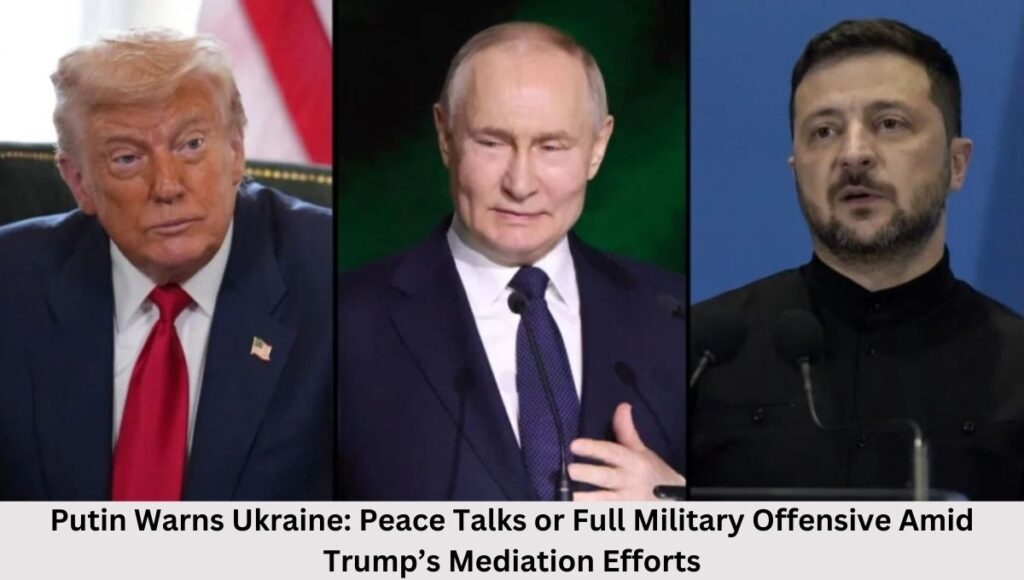
Putin Warns Ukraine: Peace Talks or Full Military Offensive Amid Trump’s Mediation Efforts
Putin’s Message: Diplomacy or Force
Putin told journalists that he still saw a “light at the end of the tunnel” when it came to resolving the war. But his optimism was laced with a clear threat:
“It seems to me that if common sense prevails, it will be possible to agree on an acceptable solution to end this conflict. If not, then we will have to resolve all our tasks militarily.”
The Russian leader reiterated that Moscow would not abandon its core demands:
- Ukraine must not join NATO
- Kyiv must end what Moscow calls discrimination against Russian speakers
- The Donbas region, seized and annexed, will not be returned
For Ukraine and its Western allies, these demands amount to a non-starter, given that NATO membership and sovereignty remain at the core of Kyiv’s long-term security vision.
The Zelensky Meeting Dilemma
In a notable development, Putin claimed he was open to meeting Ukrainian President Volodymyr Zelensky but only in Moscow, and only if the talks were “well-prepared” and yielded tangible results.
“If meeting with Zelensky is well prepared, then I am ready to meet. Let Zelensky come to Moscow and the meeting will happen.”
This proposal was immediately dismissed by Ukraine’s Foreign Ministry as “knowingly unacceptable.” Officials in Kyiv stressed that Zelensky could not meet Putin on Russian soil, calling instead for neutral venues such as Turkey, Austria, Switzerland, or the Vatican.
Zelensky, for his part, has repeatedly pushed for direct talks with Putin, but insists they must take place in a neutral country and not under Moscow’s terms.
Trump’s Mediation: A Fragile Bridge
The timing of Putin’s comments is significant. US President Donald Trump has been trying to position himself as the chief broker of peace between Moscow and Kyiv.
- Last month, Trump hosted a high-profile summit with Putin in Alaska, lifting the Kremlin chief out of international isolation.
- He has also spoken with Zelensky and other European leaders, hinting that both sides should prepare for direct negotiations.
- Trump has warned of potential “phase two and phase three” sanctions on Russia, while also keeping communication channels with Putin open.
Speaking at the White House alongside Polish President Karol Nawrocki, Trump said:
“I have no message to President Putin. He knows where I stand. He’ll make a decision one way or the other.”
Trump has been criticized for not taking strong enough measures against Moscow, but the White House points to secondary sanctions on India over Russian oil purchases as evidence of pressure.
Western Response: Sanctions and Aid
In contrast to Trump’s cautious balancing act, UK Defence Secretary John Healey struck a more hawkish tone during a visit to Kyiv. He told the BBC that London and other allies were ready to increase economic pressure on Moscow and boost military support for Ukraine:
“We’re determined to make sure we don’t jeopardise peace by forgetting about the war. That’s why we’re stepping up military aid to Ukraine.”
The UK announced that £1 billion ($1.24bn) of seized Russian assets would be redirected into Ukrainian military equipment a move Healey described as “Putin’s dirty money returned with interest.”
Meanwhile, French President Emmanuel Macron is preparing to host a meeting of the Coalition of the Willing, a group of Ukraine’s allies pressing for stronger security guarantees.
Paris is seeking Washington’s backing to push Russia toward at least a ceasefire, but Putin has so far rejected such calls.
Escalation on the Battlefield
Even as diplomacy stalls, the battlefield is witnessing increased violence. Ukrainian officials reported that over 500 drones and 24 cruise missiles were launched by Russia in a single night of attacks.
Civilian infrastructure, including energy facilities, was targeted, further straining Ukraine’s already fragile power grid.
Putin, however, insisted that Russia was advancing steadily:
“Ukraine is not capable of conducting a large-scale offensive. It means that Ukraine has fewer military reserves. The enemy is trying to plug the holes by regrouping its forces.”
His remarks are intended to project confidence, but Western intelligence suggests Russia is also under strain, with sanctions biting into its economy and casualties mounting.
Also Read: Russia warns Trump’s new pledge of aid to Ukraine could hinder any peace deal
Xi Jinping and the China Factor
Putin’s latest statements were made during his trip to China, where he attended a spectacular military parade marking the 80th anniversary of the end of World War II.
The event, attended by Chinese President Xi Jinping, was widely interpreted as a display of solidarity and a challenge to the US-dominated world order.
During his visit, Putin signed a new gas pipeline agreement with Beijing, further cementing Russia’s pivot eastward as Western sanctions cut off access to European markets.
Xi and Putin also highlighted their “unprecedented” strategic partnership, emphasizing cooperation in energy, technology, and military sectors.
North Korea’s “Fraternal Duty”
In a striking show of support, Putin also met North Korean leader Kim Jong Un in Beijing. According to North Korean state media, Kim pledged to “fully support Russia’s army as a fraternal duty.”
Putin reportedly thanked Kim for sending troops to support Russia’s war effort in Ukraine, though Western officials have questioned the scale of Pyongyang’s involvement.
The Kremlin described its ties with North Korea as “special ones of trust, friendship, and alliance” an alignment that raises alarms in Washington, Seoul, and Tokyo.
Ukraine’s Strategy: Pressure on Trump
Ukraine’s leadership has sought to leverage Putin’s refusal to engage meaningfully in talks as a way of urging Trump to tighten sanctions and provide stronger security guarantees.
Foreign Minister Andriy Sybiha dismissed Putin’s Moscow meeting offer, saying it was a tactic to divide Ukraine’s allies:
“These are unserious proposals. Only increased pressure can force Russia to get serious about peace.”
Zelensky has proposed neutral venues for talks multiple times, but Russia continues to stall, insisting Kyiv must first meet Moscow’s demands.
Russia’s Long-Term Goals
Putin framed the war not as a land grab, but as a mission to defend the “rights of Russian-speaking populations.” He also hinted that any Western security guarantees offered to Ukraine after a peace deal would not extend to Donbas, which Russia considers permanently absorbed following disputed referendums.
This effectively cements Russia’s annexation claims, making any compromise with Ukraine exceedingly difficult.
Global Stakes
The war in Ukraine has become more than just a European conflict it is a test of global power alignments:
- Russia leans on China and North Korea for strategic support.
- The US, under Trump, is trying to balance pressure with diplomacy.
- Europe pushes for harder sanctions and stronger military guarantees.
- Developing nations watch closely, concerned about food and energy supplies disrupted by the war.
The stakes could not be higher, as the outcome will shape the future of NATO, European security, and the global order.
Conclusion: Peace Deal or Prolonged War?
Putin’s message from Beijing was unmistakable: Russia will not back down unless Ukraine and the West accept its conditions. While he left the door open for talks with Zelensky, his insistence on Moscow as the venue and on NATO’s exclusion makes any near-term progress unlikely.
For now, Trump’s mediation remains the only active diplomatic channel, but it is fragile and fraught with mistrust. With Western allies ramping up sanctions and military aid, and with Russia intensifying strikes, the war appears set to escalate before any real peace takes shape.
As Putin put it bluntly:
“If common sense prevails, we can find a solution. If not, we will resolve all tasks militarily.” The world now watches to see whether diplomacy or force will decide the fate of Ukraine.