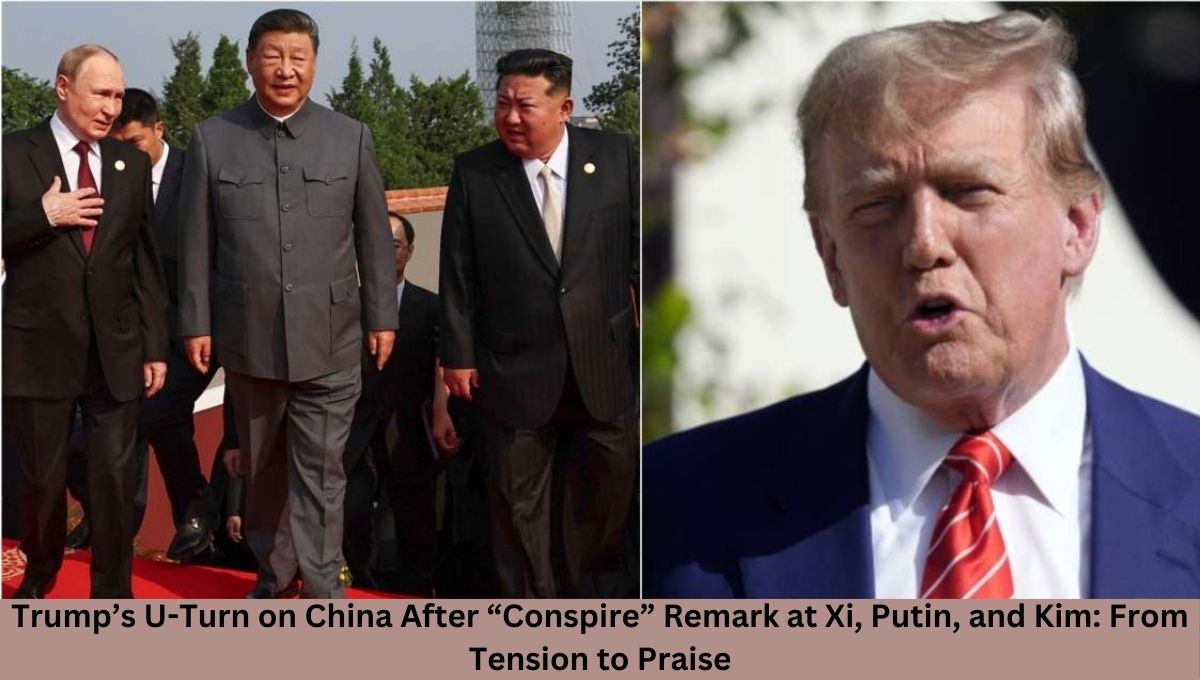
Praising the event as a “beautiful ceremony,” Trump’s U-Turn on China After “Conspire” Remark at Xi, Putin, and Kim: From Tension to Praise. In one of his most striking rhetorical pivots, U.S. President Donald Trump accused Chinese President Xi Jinping, Russian President Vladimir Putin, and North Korean leader Kim Jong Un of “conspiring against the United States.”
But within hours, Trump shifted tone dramatically. By the end of the day, he was praising China’s grand military parade in Beijing as a “beautiful ceremony” and insisting he had a “very good relationship with all of them.” This dramatic U-turn highlights not just Trump’s mercurial political style but also the fragile dynamics shaping today’s U.S.-China-Russia-North Korea triangle.
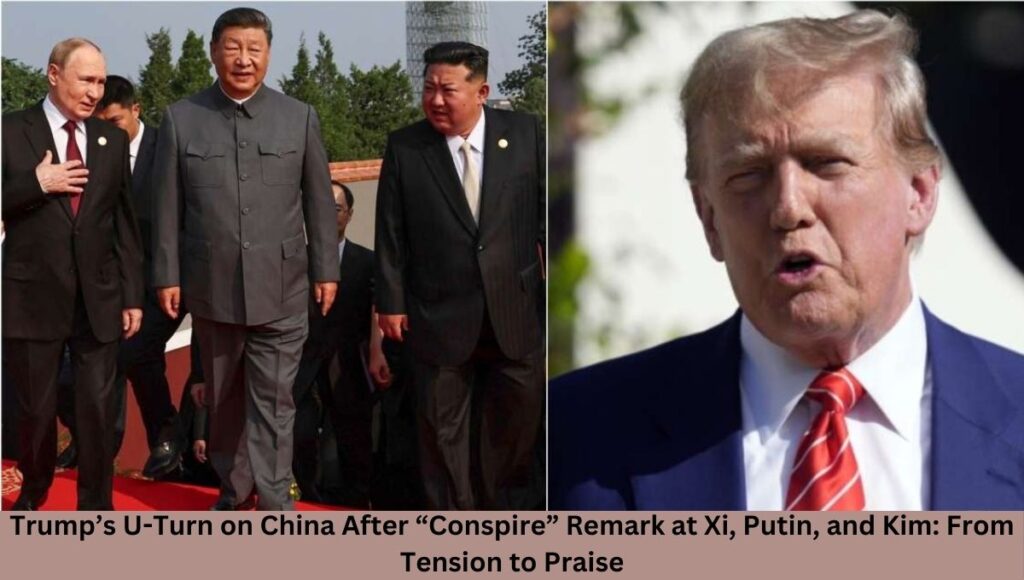
Trump’s U-Turn on China After “Conspire” Remark at Xi, Putin, and Kim: From Tension to Praise
Trump’s First Reaction: “They Conspire Against the United States”
On September 3, China staged its largest-ever military parade to mark the 80th anniversary of Japan’s defeat in World War II.
The event was laden with symbolism. Xi Jinping presided over an elaborate display of hypersonic missiles, stealth drones, and precision weaponry, flanked by Putin and Kim Jong Un.
For global audiences, the optics were unmistakable: three of America’s chief adversaries standing together, projecting solidarity.
Trump reacted with fury on his social media platform, Truth Social. His post quickly went viral:
“Please give my warmest regards to Vladimir Putin, and Kim Jong Un, as you conspire against The United States of America.”
In a follow-up, Trump added:
“The big question to be answered is whether or not President Xi of China will mention the massive amount of support and blood that the United States of America gave to China in order to help it to secure its FREEDOM. Many Americans died in China’s quest for Victory and Glory.”
The sharp tone was interpreted as a warning against a possible China-Russia-North Korea bloc forming in opposition to Washington.
Also Read: Trump calls out Xi for hosting Kim, Putin: ‘You conspire against US’
Kremlin’s Response: “We Hope He Was Ironical”
Moscow swiftly sought to cool the temperature. Russian foreign policy aide Yuri Ushakov brushed off Trump’s accusation:
“We hope he was ironical… no one has been conspiring, no one has been plotting anything, no conspiracies.”
The Kremlin emphasized that Trump remained an important global player and insisted that the gathering in Beijing was not directed against Washington.
This carefully worded response allowed Russia to avoid escalation while still underscoring its partnership with China and North Korea.
Trump’s U-Turn: “Very Good Relationship with All of Them”
Only hours later, Trump adopted a dramatically softer tone. Speaking from the Oval Office, he praised China’s parade in glowing terms:
“When they did what they did, I thought it was a beautiful ceremony; it was very impressive. They were hoping I was watching, and I was watching.”
He added:
“My relationship with all of them is very good, and we are going to find out how good it is over the next week or two.”
The U-turn reflected Trump’s dual diplomatic style: fiery rhetoric one moment, conciliatory praise the next.
Trump’s Complaint: “The US Should Have Been Mentioned”
Even while complimenting the parade, Trump expressed irritation at one detail: Xi Jinping’s speech made no mention of U.S. contributions to WWII.
“I think we helped China very much when they talk about freedom, and I don’t believe the US was acknowledged for helping China to gain its freedom,” Trump told reporters.
This omission touched a nerve. For Trump, recognition both personal and national is central to his worldview.
Inside Beijing’s Victory Parade
The Beijing parade was as much a geopolitical statement as a commemoration. Key highlights included:
- Over 50,000 spectators gathered in Tiananmen Square.
- Warplanes and helicopters in tight formation.
- 80,000 doves and “peace birds” released as symbols of harmony.
- Troops marching in perfect synchronicity.
- Unveiling of new strategic weapons, including hypersonic systems and advanced drones.
Xi Jinping, dressed in a Mao-style tunic, framed the spectacle as proof of China’s growing military might and its “unstoppable rejuvenation.”
Xi Jinping’s Speech: “Unstoppable China”
Xi declared confidently:
“China will adhere to the path of peaceful development. The rejuvenation of the Chinese nation is unstoppable, and humanity’s cause of peace and development will prevail.”
He warned that the world faced a stark choice between peace and war, dialogue and confrontation.
At the same time, he urged the People’s Liberation Army (PLA) to continue evolving into “world-class forces” capable of defending sovereignty.
By thanking “foreign governments and international friends” while omitting the U.S., Xi signaled a deliberate reframing of history to highlight China’s resilience over America’s role.
Pentagon Reacts: Preparing for Deterrence
While Trump’s tone shifted, the U.S. military response was clear. Defense Secretary Pete Hegseth announced enhanced deterrence measures.
“Demonstrations and parades are good, but the United States hopes they will not manifest themselves in the form of a real military conflict.”
Hegseth emphasized American superiority across all domains land, sea, air, space, and cyber stressing that “being prepared prevents conflict.”
He blamed the “weakness of the previous administration” for drawing Russia and China closer together.
Putin: Trump Has “Sense of Humour”
For his part, Vladimir Putin dismissed Trump’s comments with a touch of irony. Speaking at a press conference in Beijing, he told journalists:
“The President of the United States is not without a sense of humour.”
Putin underscored that in four days of meetings in China including talks with Xi, Kim, and other leaders no one expressed hostility toward the U.S.
The Russian leader also revealed that multiple leaders supported the Trump-Putin meeting in Anchorage, Alaska on August 15, viewing it as a step toward resolving the Ukraine conflict.
Trump: “They Hoped I Was Watching”
Trump’s remarks also reflected his belief that the Beijing parade was aimed partly at him.
“They were hoping I was watching and I was watching.”
Asked whether he had been invited, Trump admitted:
“It wouldn’t have been my place.”
The comments reinforced his perception that global spectacles are choreographed with him at the center.
Trump Downplays Fears of an “Axis”
Despite initial warnings of conspiracy, Trump later dismissed the notion of a formal anti-U.S. axis.
“I am not concerned at all… We have the strongest military in the world, by far. They would never use their military on us. Believe me.”
This contradiction encapsulated Trump’s mixed messaging: sounding alarmist one moment, dismissive the next.
Global Implications: Is Trump Undermining U.S. Power?
Experts argue that Trump’s inconsistency weakens America’s global standing. Jackie S.H. Wong, an assistant professor of international studies, noted:
“China is leveraging the mistakes the U.S. is making.”
By alienating allies, slashing foreign aid, and cozying up to autocrats, Trump may be accelerating the shift of power eastward ironically undercutting his own “America First” doctrine.
Why Trump Feels Snubbed: WWII and Historical Memory
Trump’s frustration lies partly in how history is remembered.
- For China: WWII is framed as a story of national sacrifice and resilience.
- For the U.S.: WWII is remembered as a decisive moment where American forces helped defeat Japan and liberate Asia.
By omitting U.S. contributions, Beijing asserts its independence and challenges American centrality something Trump interprets as both a diplomatic and personal insult.
The Bigger Picture: China’s Global Strategy
The Shanghai Cooperation Organisation (SCO) Summit in Tianjin, held alongside the parade, projected a vision of alternative global leadership.
By standing with Putin and Kim, Xi showcased China’s ability to convene a bloc of nations dissatisfied with U.S. dominance.
While the SCO is not a military alliance like NATO, it nevertheless signals Beijing’s growing ambition to reshape the global system.
Trump’s Balancing Act: Diplomacy and Deterrence
Trump’s U-turn reflects his dual strategy:
- Military deterrence to counter adversaries.
- Personal diplomacy with authoritarian leaders he believes he can charm.
This balancing act, however, becomes increasingly difficult as China, Russia, and North Korea deepen cooperation.
Conclusion: Foreign Policy at the Speed of Social Media
Trump’s flip-flop from accusing Xi, Putin, and Kim of conspiring against the U.S. to praising their ceremony captures the volatility of his foreign policy.
His demand for recognition, combined with erratic messaging, leaves allies uncertain and adversaries emboldened. In a world where history and symbolism are weaponized, Trump’s words carry real consequences. And as his latest U-turn shows, global diplomacy now moves at the pace of his social media posts.
Also Read: Trump Backtracks on ‘Lost India to China’ Remark, Calls Modi a Great PM Amid Tariff Dispute