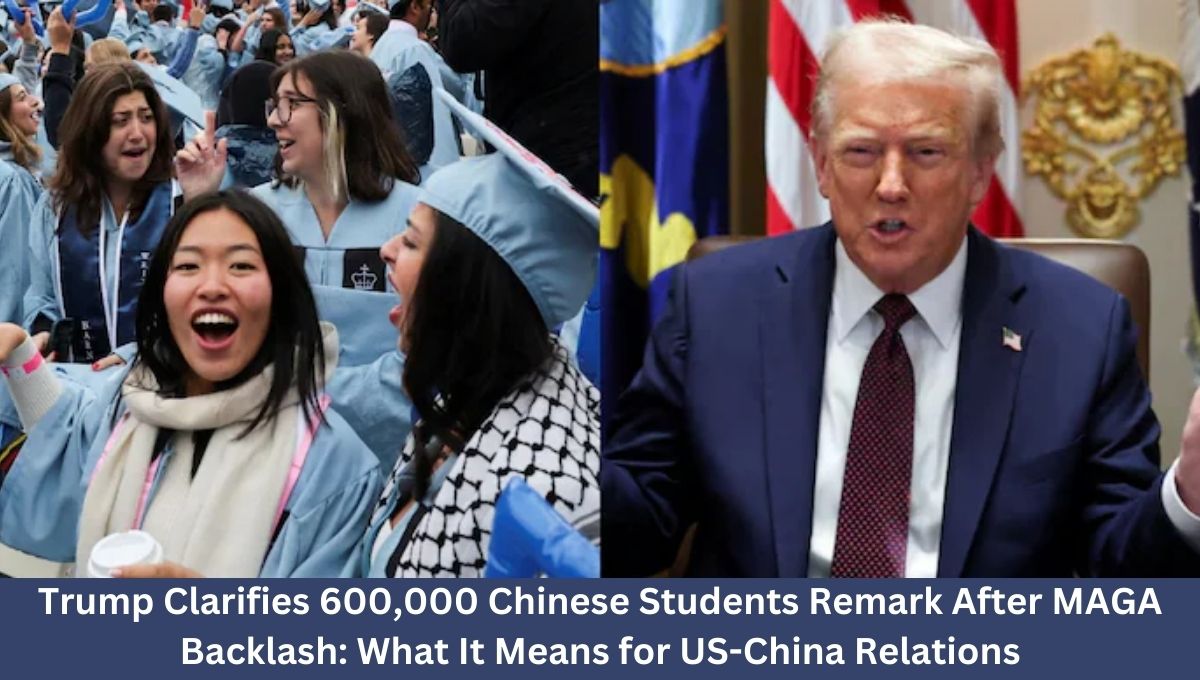
In his latest press briefing, Trump Clarifies 600,000 Chinese Students Remark After MAGA Backlash: What It Means for US-China Relations. The political storm around Donald Trump’s remark about 600,000 Chinese students studying in the United States shows just how tense the intersection of trade, education, and politics has become.
Within hours of Trump’s statement, conservative allies and MAGA loyalists erupted with criticism, accusing the president of betraying his “America First” agenda. The White House quickly clarified that the number Trump cited was not a new visa expansion, but rather a two-year cumulative figure of the approximately 300,000 Chinese students already in the US annually. Still, the damage was done.
For many Trump supporters, the idea of welcoming more Chinese students was a step too far. This article unpacks what happened, why the MAGA movement reacted so fiercely, how the White House tried to walk it back, and what it all means for the future of US-China relations, higher education, and Trump’s political base.
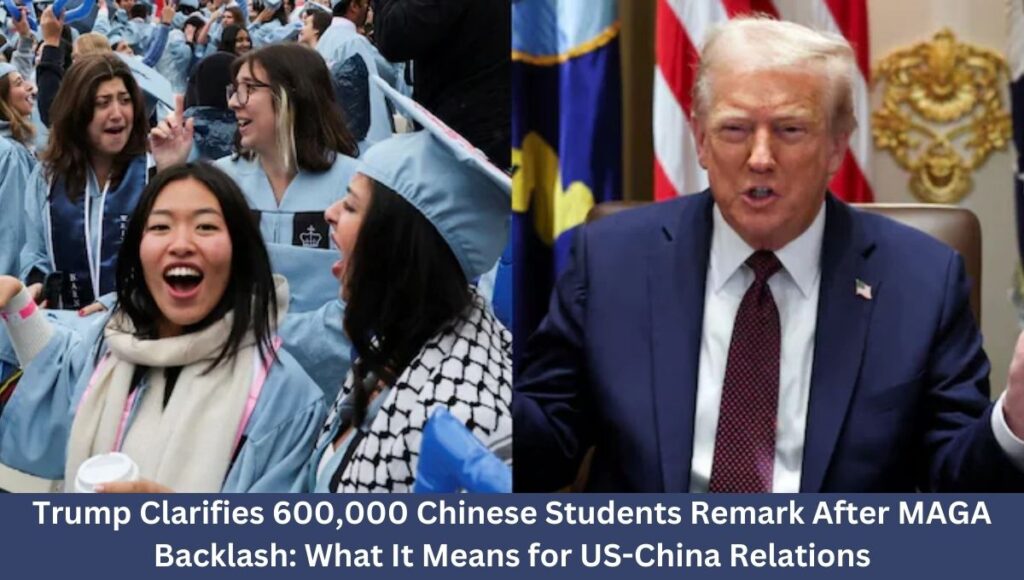
Trump Clarifies 600,000 Chinese Students Remark After MAGA Backlash: What It Means for US-China Relations
The Origin of the 600,000 Figure
During a Cabinet meeting earlier this week, Trump said:
“I hear so many stories that we’re not going to allow their students. We’re going to allow their students to come in. It’s very important, 600,000 students. It’s very important. But we’re going to get along with China.”
The 600,000 figure immediately raised eyebrows. Currently, about 277,000 Chinese students are enrolled in US universities, down from a peak of 372,000 in 2019–2020. So, 600,000 sounded like a dramatic expansion.
But according to the White House clarification, Trump was referring to the number of visas issued over a two-year period, not to an influx of 600,000 new students at once.
A spokesperson explained:
“President Trump isn’t proposing an increase in student visas for Chinese students. The 600,000 references two years’ worth of visas. It’s simply a continuation of existing policy.”
This nuance, however, was lost on many in the conservative media ecosystem.
MAGA Backlash: “We Didn’t Vote for This”
The MAGA base exploded in anger at the idea of admitting what they believed to be 600,000 new Chinese students.
- Laura Loomer, a far-right activist, wrote on X:
“I didn’t vote for more Muslims and Chinese people to be imported to my country. Please don’t Make America China. MAGA doesn’t want more immigrants.”
- Rep. Marjorie Taylor Greene blasted Trump’s comment, saying:
“Why are we allowing 600,000 students from China to replace our American students’ opportunities? We should never allow that.”
- Steve Bannon, Trump’s former adviser, added:
“Any foreign student that does come here ought to have an exit visa stapled to his or her diploma to leave immediately. Give them 30 days.”
These reactions reflect the deep suspicion among Trump’s base that Chinese students are potential “CCP spies” and economic competitors.
The nationalist right sees foreign student programs not as an economic asset but as a direct threat to American jobs, security, and culture.
Why Universities Depend on Chinese Students
While MAGA sees foreign students as a problem, US universities see them as a lifeline.
- Chinese students pay full tuition with little financial aid.
- The Cato Institute estimated their contribution to the US economy at $32.1 billion annually.
- About 186,600 attend private schools at an average cost of $62,990 per year.
- Around 413,400 attend public universities at $49,080 per year.
Trump’s own Commerce Secretary, Howard Lutnick, defended the policy on Fox News:
“What would happen if you didn’t have those 600,000 students is that you’d empty them from the top, all the students would go up to better schools, and the bottom 15 percent of universities and colleges would go out of business in America.”
For many schools, losing Chinese students could mean financial collapse.
The Contradiction in Trump’s Messaging
Trump’s comments created an awkward contradiction.
- On one hand, the administration has attacked universities as “woke,” cut funding, and encouraged American students to pursue trades over college degrees.
- On the other hand, Trump framed Chinese students as necessary to keep universities afloat.
Critics say this creates a two-tier message: Americans should go into blue-collar work, while elite universities rely on foreign talent.
As one conservative commentator wrote:
“It tells Americans one thing and foreigners another: as a young American, you’re supposed to do blue-collar work, while elite schools and white-collar jobs are for foreigners.”
This inconsistency is fueling anger among Trump’s base, who already view universities with hostility.
National Security Concerns: Espionage or Exaggeration?
Another major flashpoint is national security.
For years, the Trump administration and lawmakers have raised concerns about Chinese students engaging in espionage or IP theft.
Several students and researchers have been charged with attempting to pass sensitive technology to the Chinese Communist Party.
In response, the administration has proposed visa restrictions:
- F and J visas (students and exchange visitors) limited to four years.
- I visas (journalists) limited to 240 days.
- For Chinese nationals with I visas, the limit would be just 90 days.
Supporters argue these measures will allow tighter oversight. Critics warn they will discourage legitimate students and push talent to other countries like Canada, the UK, and Australia.
The Economic Argument for Chinese Students
Despite the backlash, there are strong economic reasons why Trump or any president would defend foreign students.
- They contribute tens of billions of dollars annually.
- They bolster STEM fields, where American students are in short supply.
- Many stay after graduation, contributing to innovation and entrepreneurship.
A pro-student perspective argues that Chinese students are not “spies” but rather talent pipelines for America’s universities, research labs, and companies.
In fact, during the Cold War, the US welcomed foreign students from rival nations. Many stayed, became Americans, and strengthened US science and technology.
Trump’s Political Balancing Act
This controversy highlights Trump’s balancing act:
- On one side, his MAGA base wants restrictions, fewer immigrants, and a crackdown on China.
- On the other, universities, businesses, and trade negotiators want Chinese students for economic and diplomatic reasons.
Trump also tied the issue to his trade negotiations with Beijing, hinting that allowing Chinese students was part of a “deal sweetener” in exchange for better trade terms.
But this transactional approach only inflamed his supporters, who view concessions to China as betrayal.
The Bigger Picture: US-China Relations
At its core, this debate isn’t just about student visas. It’s about how the US chooses to engage with China.
- Should America welcome Chinese students as a way of building bridges and harnessing talent?
- Or should it restrict visas, viewing every student as a potential threat?
Both sides present compelling arguments:
- MAGA: More students mean more espionage, fewer opportunities for Americans, and a growing dependence on foreign money.
- Universities & businesses: Students bring revenue, talent, and long-term strategic advantages.
Trump’s remark and the White House walk-back show just how polarizing this question has become.
Conclusion: A Policy Caught Between Two Worlds
Trump’s 600,000 Chinese students comment was not a policy shift but a misunderstood clarification. Yet the fallout shows the deep rift inside the conservative movement over how to deal with China.
- To his MAGA supporters, even maintaining current levels of Chinese students feels like betrayal.
- To universities and businesses, those students are vital to financial stability and innovation.
- To the White House, it’s a bargaining chip in trade negotiations.
As the 2024 campaign heats up, this issue may resurface. Trump will need to decide whether to appease his base or prioritize economic realities. Either way, the controversy highlights the complex intersection of trade, education, immigration, and national security in modern US-China relations.
Also Read: US-China Trade Talks in Stockholm: Truce Extension, Fentanyl Tariffs, and Rare Earth Deal in Focus
Also Read: Trump not allowing 600,000 Chinese students, White House clarifies after backlash