9 Explosive Revelations Behind Trump’s ‘Trump-Class’ Golden Fleet in American naval history. In a move that has already sparked intense political, military, and diplomatic debate, United States President Donald Trump has announced the creation of a new class of heavily armed warships named after himself.
Thank you for reading this post, don't forget to subscribe!The proposed “Trump-class” battleships will form the centerpiece of what Trump has branded the US Navy’s “Golden Fleet”, a sweeping naval expansion aimed at restoring American maritime dominance.
Speaking from his Mar-a-Lago residence in Florida, flanked by senior national security officials, Trump described the planned vessels as “the most lethal surface warfare ships ever built” and claimed they would surpass every previous American battleship in size, power, and technological sophistication.
The announcement marks one of the most unconventional moments in modern US military history, as naming a class of warships after a sitting president is a distinction traditionally reserved for leaders long after they have left office.
9 Explosive Revelations Behind Trump’s ‘Trump-Class’ Golden Fleet
What Are Trump-Class Battleships?
According to Trump and senior Pentagon officials present at the announcement, the Trump-class will represent an entirely new category of surface combatant, blending characteristics of traditional battleships with cutting-edge missile platforms.
Key Features Announced
- Displacement: 30,000–40,000 tons
- Armament:
- Hypersonic missiles
- Nuclear-armed sea-launched cruise missiles
- Directed-energy laser systems
- Advanced naval guns
- Rail gun technology (under development)
- Command systems: AI-assisted combat and targeting
- Role: Flagship surface combatant for the US Navy
Trump claimed each vessel would be “100 times more powerful” than historic American battleships, though he did not provide technical benchmarks to support the claim.
A President Naming Warships After Himself
The decision to label the vessels “Trump-class” immediately drew attention, as US naval tradition typically names ship classes after the first vessel commissioned or after historical themes, not sitting presidents.
Historically:
- The Nimitz-class carriers were named after Admiral Chester Nimitz.
- The Arleigh Burke-class destroyers honored a World War II admiral.
- Presidents are usually commemorated posthumously or long after their terms.
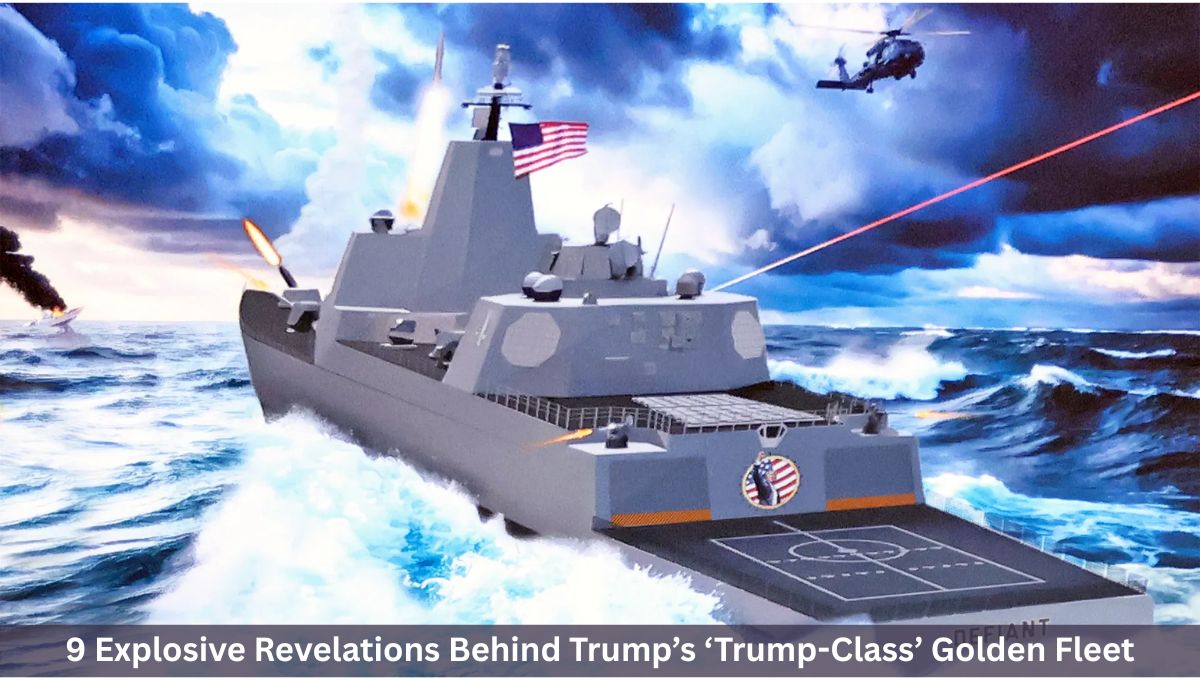
If the Navy follows convention, naming the class after Trump could eventually result in an actual vessel bearing his name, though renderings at the event showed the first ship named USS Defiant.
Trump framed the Trump-class announcement as part of a much larger effort to overhaul the US Navy, referring repeatedly to the “Golden Fleet” — a term evoking historical naval expansion eras.
Golden Fleet Objectives
- Expand surface combatant numbers
- Revive domestic shipbuilding
- Reduce reliance on foreign supply chains
- Restore US naval dominance
- Accelerate weapons deployment timelines
Trump said the Golden Fleet would include:
- Trump-class battleships
- New frigate classes (FF(X))
- Modernized aircraft carriers
- Manned and unmanned support vessels
Who Was Present at the Announcement
Trump made the announcement at Mar-a-Lago alongside:
- Pete Hegseth, Secretary of Defense
- Marco Rubio, Secretary of State and National Security Adviser
- John Phelan, Secretary of the Navy
Large posters showing renderings of the Trump-class warships were displayed during the event, emphasizing the ceremonial nature of the reveal.
Aesthetic Influence: Trump’s Personal Design Role
In one of the more unconventional aspects of the announcement, Trump said he would personally take part in the design process. “The Navy will lead the design of these ships along with me because I’m a very aesthetic person,” Trump said.
Trump has previously criticized the appearance of modern US warships, arguing that stealth designs have come at the cost of visual appeal. He has repeatedly stated that “ugly ships are not stealthy”, signaling that aesthetics will play a role alongside combat capability.
How Trump-Class Ships Compare to Historic Battleships
While Trump repeatedly referred to the vessels as battleships, naval historians note important distinctions.
Iowa-Class Battleships (Retired)
- Displacement: ~60,000 tons
- Main weapons: Massive naval guns
- Crew size: Over 2,700 sailors
Trump-Class (Proposed)
- Displacement: ~35,000 tons
- Main weapons: Missiles, lasers, AI-guided systems
- Crew size: 650–850 sailors
Unlike traditional battleships designed for gunnery duels, the Trump-class appears to prioritize missile warfare and electronic dominance.
Hypersonic and Nuclear Capabilities
Trump confirmed that the Trump-class ships will be capable of carrying nuclear-armed sea-launched cruise missiles, a capability that significantly raises their strategic profile.
He also highlighted:
- Hypersonic strike capabilities
- Directed-energy weapons
- AI-controlled targeting systems
Many of these technologies remain under active development by the US Navy, raising questions about timelines and feasibility.
Is China the Target? Trump Says No
Asked directly whether the Trump-class ships were intended to counter China, Trump downplayed the suggestion.
“It’s a counter to everybody. It’s not China. We get along great with China,” he said.
However, US defense officials have repeatedly warned that China has overtaken the United States in overall naval ship numbers, with more than 60% of global shipbuilding orders currently going to Chinese yards.
Shipbuilding and Jobs: A Domestic Push
Trump emphasized that all Trump-class vessels will be built in the United States, framing the program as an industrial revival initiative.
Key Economic Claims
- Thousands of shipyard jobs
- Components built across all US states
- Pressure on defense contractors to accelerate timelines
- Crackdown on cost overruns
Trump said he will meet major defense contractors to scrutinize executive compensation, dividends, and stock buybacks.
“We don’t want executives making $50 million a year while production is delayed,” he said.
Frigates, Cancellations, and Fleet Restructuring
The Trump-class announcement follows a turbulent period in US naval planning.
Recent developments include:
- Cancellation of four Constellation-class frigates
- Review of two additional Constellation ships
- Announcement of a new FF(X) frigate class
- First FF(X) expected by 2028
Secretary Phelan said the new frigates will be based on existing Coast Guard designs to reduce delays.
Pressure Campaign in the Caribbean
The naval announcement comes amid heightened US military activity in the Caribbean, particularly targeting Venezuela.
Recent Actions
- Interdiction of sanctioned oil tankers
- Seizure of vessels accused of sanction evasion
- Declared “blockade” of Venezuelan oil shipments
Trump has repeatedly said Venezuelan President Nicolás Maduro’s days in power are numbered.
Russia and Venezuela: Growing Tensions
According to European intelligence officials, Russia has begun evacuating diplomats’ families from Venezuela, citing deteriorating security conditions.
Venezuela’s foreign minister accused the US of:
- Piracy
- Extrajudicial killings
- Violations of international law
Russia has publicly expressed support for Venezuela amid the escalating standoff.
Since September, US strikes on vessels accused of drug trafficking have reportedly killed more than 100 people.
Human rights organizations and lawmakers have raised concerns about:
- Evidence standards
- Civilian casualties
- Extrajudicial actions
The administration maintains the strikes are necessary to combat drug smuggling.
Strategic Messaging and Global Reaction
The Trump-class announcement is widely seen as a strategic signal — not only to rivals but also to domestic audiences.
Key messages include:
- Military strength as deterrence
- Industrial revival
- Personal presidential leadership
- Rejection of perceived naval decline
Allies and adversaries alike are closely watching how much of the plan materializes.
Criticism and Skepticism
Defense analysts have raised several concerns:
- Cost overruns
- Overlapping capabilities with existing ships
- Viability of battleships in modern warfare
- Integration of still-developing technologies
Others argue that missile-centric platforms already exist in the form of cruisers and destroyers.
Supporters See a Bold Reset
Supporters argue the Trump-class represents:
- A psychological deterrent
- A break from incrementalism
- A reassertion of maritime dominance
- A morale boost for shipbuilding communities
They liken it to Theodore Roosevelt’s Great White Fleet, which symbolized American emergence as a global naval power.
Timeline: How Soon Could These Ships Sail?
Trump said:
- Construction of the first two ships will begin “immediately”
- The first Trump-class vessel could be operational within 2.5 years
- The fleet could eventually expand to 20–25 ships
Naval experts caution that such timelines are extremely ambitious.
Conclusion: Power, Symbolism, and Uncertainty
The unveiling of the Trump-class battleships marks one of the most ambitious — and controversial — naval proposals in modern US history.
Blending military strategy, industrial policy, personal branding, and geopolitical signaling, the Golden Fleet concept is as much about symbolism as it is about hardware.
Whether the Trump-class becomes a transformative leap in naval warfare or an emblem of overreach will depend on funding, execution, and global realities. What is certain is that the announcement has already reshaped the conversation about America’s future at sea.
As Trump put it:
“We’re going to ensure the USA has the most powerful fleet anywhere in the world — long into the future.”
Also Read: 7 Explosive Impacts of Trump Declaring Fentanyl a Weapon of Mass Destruction
Also Read: What We Know About The Trump Class “Battleship”