In an interview with Israeli broadcaster Kan, Prime Minister Netanyahu: Iran Regime Collapse “Not a Goal,” But Still Possible. Netanyahu Says Regime Change in Iran Not Official Goal but a Likely Outcome as War Escalates. The ongoing war between Israel and Iran has crossed a dangerous threshold, with Prime Minister Benjamin Netanyahu clarifying that regime change in Tehran is not a formal Israeli objective, yet it may be the natural consequence of Israel’s expanding military campaign.
Amid nuclear site bombings, retaliatory missile strikes, and the first confirmed use of cluster munitions in the conflict, both nations appear locked in a cycle of destruction with few escape routes. Meanwhile, all eyes are now on U.S. President Donald Trump, who has said he will decide within two weeks whether the U.S. will join the war.
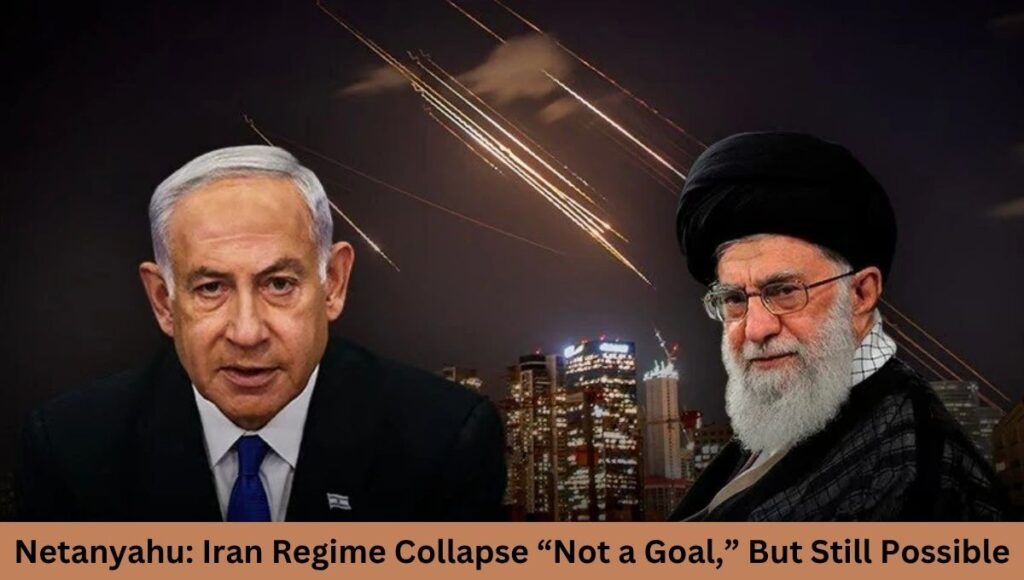
Netanyahu: Iran Regime Collapse “Not a Goal,” But Still Possible
Netanyahu: Regime Change “Up to the Iranian People”
In an interview with Israeli broadcaster Kan, Netanyahu stated that the fall of Iran’s regime could happen but only through the will of its own people.
“The matter of changing the regime is first and foremost a matter for the Iranian people. It could be a result, but it’s not a stated or formal goal that we have,” he said during a visit to Soroka Medical Center, recently hit in an Iranian strike.
Nevertheless, he added that Israel’s military pressure could help create the conditions for a popular uprising against the Islamic Republic. “Freedom is never cheap,” Netanyahu said.
Israeli Strikes Have Destroyed Over Half of Iran’s Missile Launchers
During his hospital visit, Netanyahu claimed that more than 50% of Iran’s missile launchers have been destroyed by Israeli airstrikes. He emphasized that Israeli forces are targeting nuclear and missile infrastructure not civilians.
“We accurately hit nuclear targets and missile targets. They [Iran] hit a hospital where people can’t even run,” Netanyahu said.
The Israeli Prime Minister accused Iran of “state-sponsored terrorism,” drawing a moral distinction between Israel’s precision strikes and Iran’s retaliatory attacks.
Iran Fires Cluster Munitions at Israeli Hospital
Iran’s retaliation has been fierce and controversial. According to Israeli military sources, Iran used cluster munitions for the first time in this conflict when it struck Soroka Medical Center in Beersheba.
The munitions exploded midair, scattering bomblets over a five-mile radius, making them nearly impossible for Israel’s missile defense to intercept.
“This is state-sponsored terror,” said Brigadier General Effie Defrin, adding that Iran deliberately targeted a civilian medical facility.
Israel Hits Iran’s Nuclear Sites in Natanz, Isfahan, and Arak
In response, Israel launched airstrikes on Iran’s nuclear infrastructure, hitting key facilities in Natanz, Isfahan, and Arak (Khondab):
- Natanz: Iran’s primary uranium enrichment site.
- Isfahan: Central to nuclear processing operations.
- Arak/Khondab: A heavy-water reactor capable of producing plutonium.
Satellite imagery revealed major structural damage at the Arak site, including a collapsed roof and destroyed distillation towers.
“Israel hit Arak because Iran planned to start it up next year,” said David Albright, former UN nuclear inspector. “They play games. Israel stopped it.”
Trump Undecided on U.S. Role But Signals Are Mixed
As the conflict escalates, President Donald Trump faces mounting pressure to clarify the U.S. position. He has not authorized military strikes but has said a decision will come “within two weeks.”
“The Wall Street Journal has no idea what my thoughts are concerning Iran!” Trump wrote on Truth Social, denying reports that he had signed off on a military plan.
However, Trump’s envoy, Steve Witkoff, has reportedly held multiple backchannel talks with Iranian Foreign Minister Abbas Araqchi, hinting at ongoing diplomatic efforts even as tensions rise.
Netanyahu: Israel Can Hit All Nuclear Sites—Even Without U.S. Help
Netanyahu insisted that Israel has the capability to destroy all of Iran’s nuclear infrastructure, including the deeply buried Fordow site near Qom.
“We have the power to remove all their nuclear facilities. If President Trump decides to help, that’s his decision. I will do what’s right for Israel.”
Military analysts, however, note that only the U.S. possesses the 30,000-pound “bunker buster” bomb required to reach Fordow’s underground chambers.
Iran Threatens Hormuz Closure, Launches Drone Strikes
Iran’s Revolutionary Guards claimed responsibility for launching missile and drone strikes on Israeli targets in Haifa and Tel Aviv.
A senior Iranian MP also warned that Iran may close the Strait of Hormuz if “a third party” (implying the U.S.) enters the war. The strait is a strategic chokepoint for 20% of global oil shipments.
“If they join, we will close the strait. Let the world see what war really means,” the MP said.
Inside Iran: Internet Blackouts and Rising Fear
Inside Iran, the situation is increasingly opaque. The government has imposed a near-total internet blackout, and citizens are banned from filming damage or military activity. Still, eyewitness accounts paint a grim picture.
“Three children and two women died in the building next to mine,” said Arash, a Tehran resident. “Is this Netanyahu’s idea of liberation?”
Iran’s state media has shifted to a propaganda-heavy strategy, emphasizing national unity and military readiness while suppressing dissent.
Gaza, Hezbollah, and Regional Flashpoints
The war’s impact is not limited to Iran and Israel. Since Hamas’ October 2023 attack, Israel has been engaged in multi-front fighting:
- Lebanon: Ongoing strikes against Hezbollah positions.
- Yemen: Airstrikes on Houthi rebel bases aligned with Iran.
These developments raise concerns that a full-scale regional war may soon erupt.
Israel’s Strategic Goals: Crippling Iran’s Power
According to military analysts and Western intelligence, Israel’s broader goals include:
- Destroying Iran’s nuclear capabilities.
- Disrupting ballistic missile production.
- Severing Iran’s ties with proxy militias like Hezbollah, Hamas, and the Houthis.
The ultimate objective may not be outright regime change, but rather debilitating Iran’s ability to threaten Israel or influence the region.
Escalate to De-escalate? Iran’s Shrinking Options
Despite fiery rhetoric, Tehran’s strategic options are limited. Analysts say Iran cannot afford to surrender but also cannot sustain prolonged warfare.
“Iran has no good options,” said Hamidreza Aziz. “They’re caught between appearing weak or risking collapse.”
Trump has demanded total suspension of uranium enrichment, which Iran sees as violating its rights under the Nuclear Non-Proliferation Treaty (NPT).
Meanwhile, Iran’s traditional deterrents Hezbollah, Syrian support, and economic leverage have eroded.
Could Regime Change Backfire?
Though Netanyahu and others suggest that regime change could be a result, not a goal, foreign-imposed pressure may unintentionally strengthen Iran’s ruling elite.
“The Islamic Republic has survived for decades by pointing to external threats,” said Barbara Slavin. “A U.S.-Israel campaign could unify the regime, not destroy it.”
Iran’s internal discontent remains real, especially among the youth. But opposition groups are fragmented, and no cohesive movement has emerged to replace the current leadership.
Conclusion: A Region on the Edge
With cluster bombs falling, nuclear facilities in ruins, and Trump’s decision looming, the Middle East stands at the precipice of a much wider war. Whether the outcome is regime collapse, a new nuclear agreement, or a dangerous regional conflagration may depend on the choices made in the next two weeks.
For now, both Iran and Israel appear locked in a brutal contest with no clear endgame and the world watches, holding its breath.
Also Read: Khamenei Warns of “Irreparable Damage” as Trump Demands Iran’s Surrender
Also Read: Israel hits nuclear sites, Iran strikes hospital as war escalates
Related Posts:
- Israel-Iran War Escalates: Cluster Bombs, Missile…
- 3 Explosive Conditions Iran Sets to End War with US…

- Iran Uses Cluster Bombs as Israel Strikes Nuclear…
- 10 Explosive Warnings as Donald Trump Calls Iran…
- 11 Explosive Warnings as Trump Vows to ‘Knock the…

- 7 Explosive Signs Russia Is Quietly Backing Iran in…