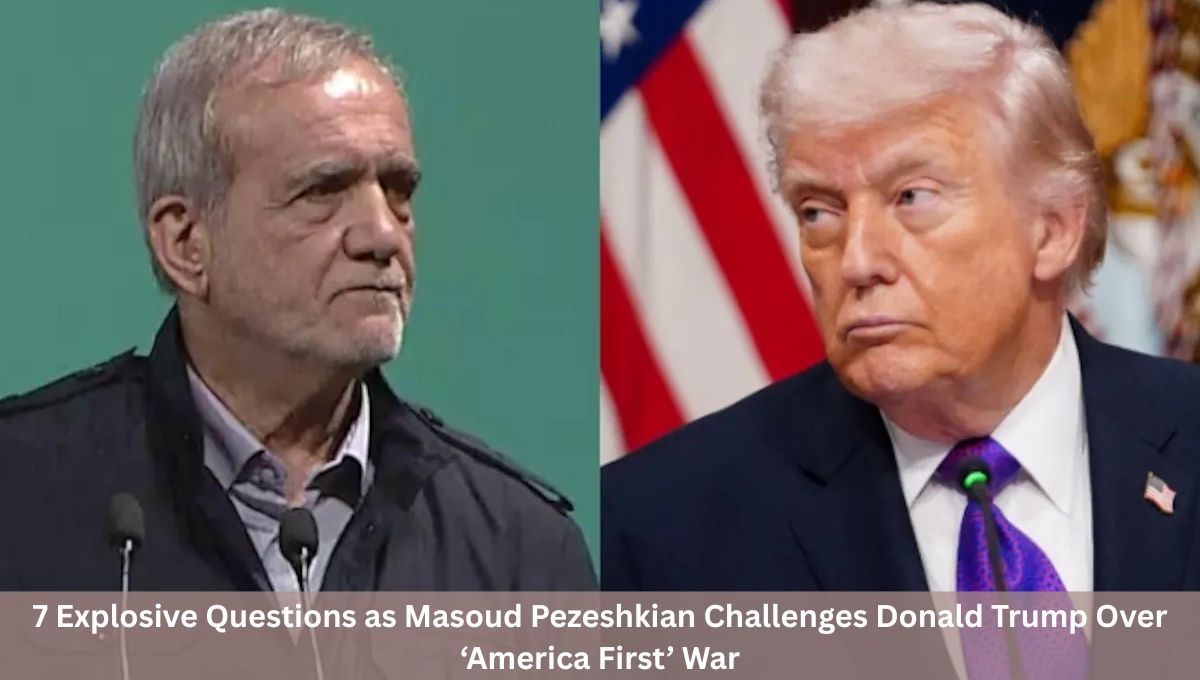
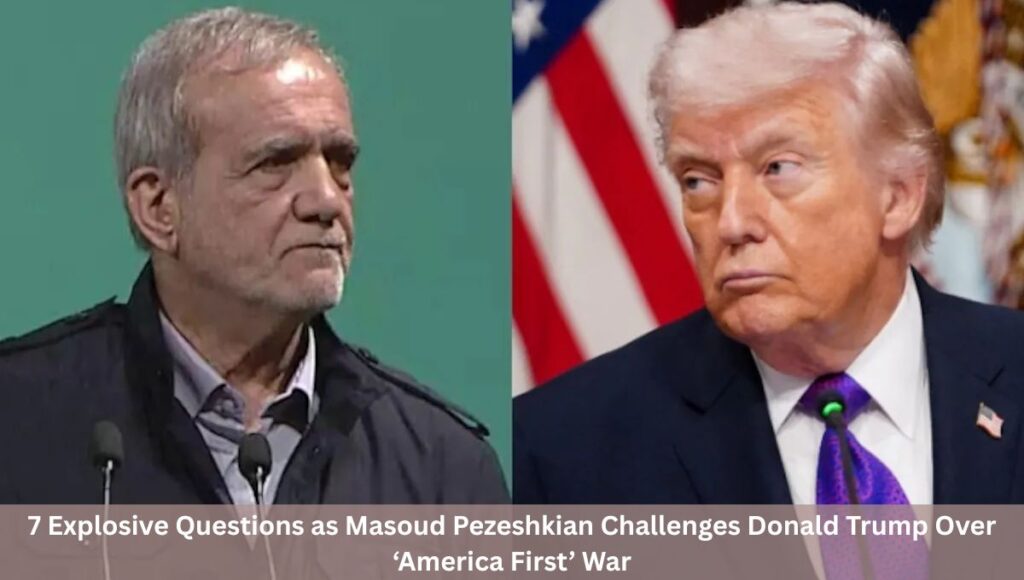
7 Explosive Questions as Masoud Pezeshkian Challenges Donald Trump Over ‘America First’ War in open letter to Americans. In a dramatic escalation of rhetoric amid an already volatile geopolitical environment, Masoud Pezeshkian has taken the unusual step of directly addressing the American public.
His message:
question whether the ongoing war with Iran truly aligns with the “America First” doctrine championed by Donald Trump.
The letter, released just hours before Trump’s high-stakes national address, represents a strategic attempt by Tehran to shape global opinion—not through military escalation, but through narrative warfare.
More than a month into the conflict triggered on February 28, the stakes have expanded far beyond the Middle East.
Energy markets, diplomatic alliances, and domestic political dynamics across multiple continents are now deeply entangled in what analysts are calling one of the most consequential geopolitical crises of the decade.
7 Explosive Questions as Masoud Pezeshkian Challenges Donald Trump Over ‘America First’ War
A Direct Appeal to the American People
“Whose Interests Are Being Served?”
In his open letter, Pezeshkian bypassed traditional diplomatic channels and addressed ordinary Americans directly—a rare move in international relations.
He posed a series of pointed questions:
- “Exactly which of the American people’s interests are truly being served by this war?”
- “Is ‘America First’ truly among the priorities of the U.S. government today?”
These questions strike at the heart of Trump’s political identity, which has long been anchored in prioritizing domestic interests over foreign entanglements.
By framing the war as potentially contradictory to that doctrine, Pezeshkian sought to introduce doubt among American voters already grappling with economic and political uncertainty.
War Narrative vs Reality
Competing Claims Over Aggression
The Iranian president used the letter to strongly reject claims that Iran initiated or escalated the conflict.
According to Pezeshkian:
- Iran has “never initiated a war” in modern history
- Its actions are framed as “legitimate self-defense”
- Western portrayals of Iran as a threat are “distorted”
This narrative directly contrasts with statements from Donald Trump, who has described Iran’s leadership as dangerous and framed military action as necessary to neutralize long-term threats, including nuclear ambitions.
The divergence highlights a broader “war of narratives,” where both sides are attempting to win not just on the battlefield, but in global public opinion.
Accusations of War Crimes and Strategic Fallout
Infrastructure Attacks Under Scrutiny
One of the most serious allegations in the letter is the accusation that US-led strikes on Iranian infrastructure amount to war crimes.
Pezeshkian specifically cited attacks on:
- Energy facilities
- Industrial infrastructure
- Civilian-linked systems
He argued that these actions:
- Increase human suffering
- Destabilize global markets
- Create long-term resentment
“Such actions carry consequences far beyond Iran’s borders,” he warned, emphasizing the ripple effects already visible in global energy and financial systems.
The Israel Factor in the Conflict
Proxy War Allegations
A central theme in the letter is the suggestion that the United States may be acting not independently, but as a proxy for Israel.
Pezeshkian questioned:
- Whether Washington is being “influenced and manipulated”
- If the conflict serves Israeli strategic objectives more than American ones
This claim aligns with longstanding geopolitical debates about US-Israel relations and their influence on Middle East policy.
While Washington has consistently framed its actions as aligned with its own national security interests, critics globally have raised similar concerns about overlapping strategic agendas.
Economic Shockwaves Across the Globe
War Impact Beyond the Battlefield
The Iran war has triggered significant economic disruptions worldwide, particularly due to instability around the Strait of Hormuz.
This narrow maritime corridor:
- Handles nearly 20% of global oil shipments
- Has been effectively disrupted since the conflict began
- Remains central to energy security concerns
The consequences have been immediate:
- Oil prices have surged past $100 per barrel
- Global stock markets have experienced volatility
- Inflation fears have intensified
Pezeshkian referenced these effects in his letter, arguing that the war imposes economic costs not just on Iran, but on ordinary people worldwide—including Americans.
Distinguishing Governments from People
“No Enmity Toward Americans”
A notable aspect of the letter is its effort to separate the American public from US government actions.
Pezeshkian emphasized:
- Iran harbors “no enmity” toward ordinary Americans
- Cultural principles support distinguishing people from governments
- Hostility is directed at policies, not populations
This rhetorical approach mirrors historical diplomatic strategies aimed at reducing public support for foreign interventions by appealing directly to citizens.
Historical Context and Deep-Rooted Distrust
The Legacy of 1953 and Beyond
The letter also revisits historical grievances, particularly:
- The 1953 coup against Iran’s government
- US support for the Shah
- Backing of Iraq during the Iran-Iraq war
- Decades of sanctions
According to Pezeshkian, these events have shaped Iranian perceptions of the United States and contributed to long-standing mistrust.
Understanding this historical context is critical for global audiences trying to interpret current tensions beyond immediate headlines.
Trump’s Response and Strategic Messaging
Mixed Signals from Washington
In contrast to the conciliatory tone toward American citizens, Donald Trump has maintained a hardline stance toward Iran’s leadership.
Key elements of his recent messaging include:
- Threats to hit Iran “extremely hard”
- Claims that the war is nearing completion
- Assertions that Iran sought a ceasefire (denied by Tehran)
This dual messaging—declaring near victory while signaling further escalation—has created uncertainty in global markets and diplomatic circles.
A World at a Crossroads
Confrontation vs Engagement
Perhaps the most significant line in Pezeshkian’s letter is his framing of the current moment:
“The world stands at a crossroads.”
He presented two possible paths:
- Continued confrontation
- Higher economic costs
- Greater instability
- Long-term geopolitical fragmentation
- Diplomatic engagement
- Potential de-escalation
- Economic recovery
- Stabilized global relations
This framing reflects broader concerns among international observers that the conflict could either be contained—or spiral into a wider regional or even global crisis.
Power Dynamics Inside Iran
Limits of Presidential Authority
While the letter carries significant symbolic weight, its practical impact remains uncertain.
In Iran’s political system:
- The president does not hold ultimate authority
- Key decisions rest with the Supreme Leader
- Military and strategic policies involve multiple power centers
This raises important questions:
- Does the letter represent official policy?
- Or is it a diplomatic signal aimed at external audiences?
Analysts remain divided on how much influence Pezeshkian has over the trajectory of the conflict.
Global Diplomatic Fallout
Strained Alliances and New Alignments
The war has not only affected US-Iran relations but also reshaped global diplomacy:
- European allies have shown hesitation
- Middle Eastern states are divided in their responses
- Emerging powers are exploring mediation roles
The resulting landscape is increasingly complex, with traditional alliances under strain and new geopolitical calculations emerging.
Information Warfare and Public Opinion
Competing Narratives
The open letter underscores a broader trend:
modern conflicts are fought as much in the information domain as on the battlefield.
Key elements include:
- Direct communication with foreign populations
- Social media amplification
- Strategic framing of events
By addressing Americans directly, Pezeshkian is engaging in a calculated effort to influence public opinion—an increasingly critical factor in democratic societies.
What Comes Next?
Uncertain Path Forward
As the war continues, several key variables will shape its trajectory:
- Whether the Strait of Hormuz reopens
- The extent of further military escalation
- Potential diplomatic breakthroughs
- Domestic political pressures in the United States
For now, uncertainty remains the defining feature.
Conclusion
The open letter from Masoud Pezeshkian marks a significant moment in the ongoing Iran war—not because it changes military realities, but because it shifts the narrative battlefield.
By directly questioning Donald Trump’s “America First” policy, the Iranian president has reframed the debate in terms that resonate beyond geopolitics—touching on economic costs, moral considerations, and democratic accountability.
As global tensions persist, the question posed in the letter continues to echo:
Who truly benefits from this war—and at what cost?
Also Read: Iran’s President Accuses Israel of Assassination Attempt, says US Dialogue Still Possible
Also Read: Iran’s Mojtaba Khamenei vows to fight in first statement as supreme leader