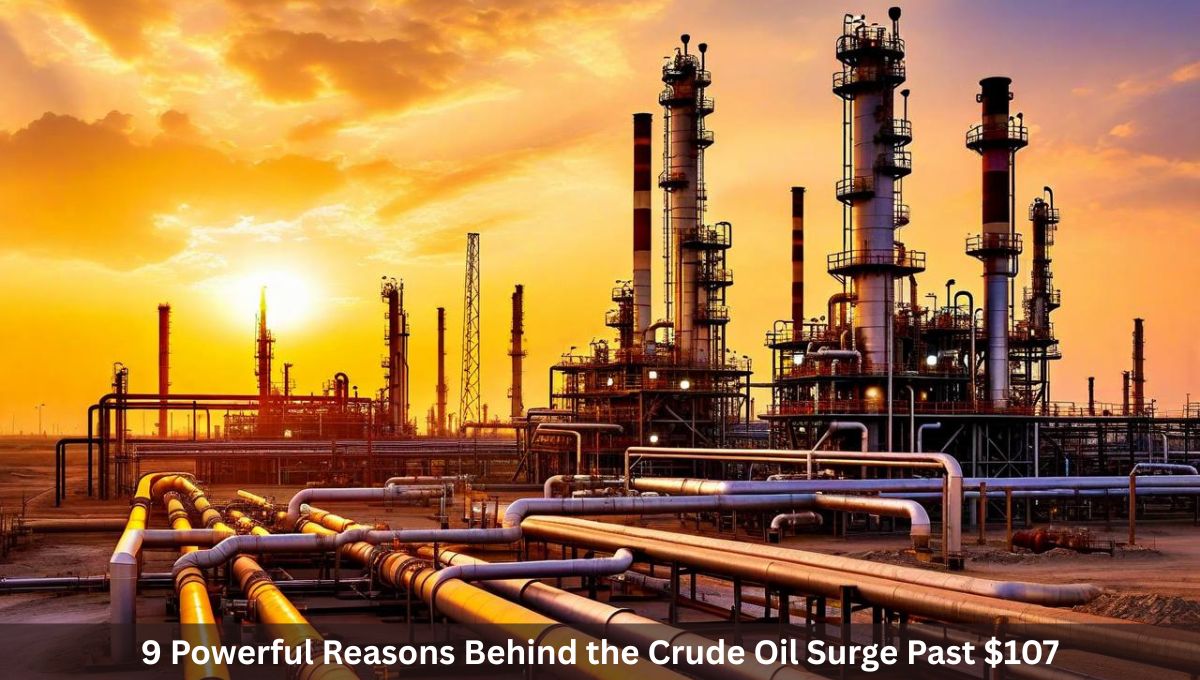
9 Powerful Reasons Behind the Crude Oil Surge Past $107, raising inflation risks. Global energy markets have entered a period of extreme volatility as crude oil prices surged sharply following escalating tensions between the United States and Iran. Brent crude, the international benchmark, climbed more than 6% to cross $107 per barrel, marking one of the most significant single-day jumps in recent weeks.
The surge came in response to heightened geopolitical risks, particularly around the Strait of Hormuz—a critical oil transit chokepoint that has been severely disrupted since the conflict began on February 28.
Despite expectations that recent political developments might calm markets, fresh warnings of military escalation have instead intensified fears of prolonged supply disruptions.
This article breaks down the key drivers behind the crude oil rally, its global economic implications, and what could happen next.
9 Powerful Reasons Behind the Crude Oil Surge Past $107
1. The Immediate Trigger: Escalating War Rhetoric
The latest spike in oil prices was triggered by strong statements signaling further military escalation.
Markets reacted negatively to:
- Warnings of intensified strikes over the coming weeks
- Lack of clear diplomatic direction
- Threats targeting critical infrastructure
Investors had hoped for a signal of de-escalation. Instead, the messaging suggested that the conflict could deepen, prompting a rapid repricing of risk across energy markets.
2. Brent Crude Breaks the $100 Barrier Again
Before the latest developments, Brent crude had briefly dipped below $100 per barrel on hopes of a potential ceasefire. However, those gains were quickly reversed.
Key price movements:
- Brent surged over 6% to ~$107–$108
- WTI crude climbed above $105
- Daily gains reached nearly 7% at peak levels
This sharp rebound highlights how sensitive oil markets are to geopolitical signals, particularly when supply routes are threatened.
3. Strait of Hormuz: The Core of the Crisis
At the center of the oil price surge lies the Strait of Hormuz, one of the world’s most critical energy chokepoints.
Why it matters:
- Handles ~20% of global oil shipments
- Key route for Middle Eastern exports
- Vital for Asian and European energy security
Since the conflict escalated, the strait has been effectively disrupted, with shipping activity reduced and risks to maritime traffic rising sharply.
4. Rising Threats to Maritime Security
The situation has worsened due to direct threats to oil transportation.
Recent developments:
- An oil tanker linked to QatarEnergy was struck by a missile
- Shipping insurers raised risk premiums
- Some traders halted transactions tied to Hormuz routes
These developments have significantly increased the cost and risk of transporting oil, further tightening global supply.
5. Global Markets React: Stocks Fall, Bonds Sell Off
The oil surge has triggered a broad sell-off across global financial markets.
Market reactions:
- Asian stock indices dropped sharply (Kospi down over 5%)
- European markets opened in negative territory
- US futures fell significantly
- Government bond yields rose globally
This reflects a classic “risk-off” environment, where investors move away from equities and toward safer assets.
6. Currency and Commodity Movements
The ripple effects extended beyond equities into currencies and commodities.
Key trends:
- US dollar strengthened as a safe-haven asset
- Japanese yen and Korean won weakened
- Gold and silver prices declined despite uncertainty
- Bitcoin and cryptocurrencies dropped
These mixed signals highlight the complexity of current market dynamics, where traditional safe havens are not always behaving predictably.
7. Supply Shock Fears Intensify
Energy analysts warn that the situation is evolving into a classic supply shock scenario.
Key concerns:
- Reduced oil output from the region
- Disruption of LNG shipments
- Infrastructure damage delaying recovery
Even if hostilities end soon, restoring normal supply levels could take months due to logistical and physical damage.
8. Impact on Europe and Global Economy
The energy shock is expected to have significant macroeconomic consequences.
Europe’s vulnerability:
- Heavily dependent on imported energy
- Previously cushioned by pre-war stockpiles
- Now facing delayed supply disruptions
Economists warn that prolonged high oil prices could:
- Increase inflation
- Slow economic growth
- Raise recession risks
9. Investor Sentiment: Uncertainty Dominates
Market participants remain deeply uncertain about the future trajectory of the conflict.
Key concerns:
- Lack of clarity on war timeline
- Mixed signals from policymakers
- Continued military buildup
As one analyst put it:
“It’s not over until it’s over.”
This uncertainty is likely to keep markets volatile in the near term.
10. Asian Economies Hit the Hardest
Asia has been particularly vulnerable to the oil price surge.
Reasons:
- Heavy reliance on imported oil
- Limited domestic energy resources
- Sensitivity to price fluctuations
Stock markets across:
- South Korea
- Japan
- China
- Southeast Asia
have all experienced significant declines as energy costs rise.
11. Impact on India: Inflation and Market Pressure
India, as one of the world’s largest oil importers, faces serious challenges.
Key risks:
- Rising import bills
- Pressure on the rupee
- Higher inflation
- Stock market volatility
Benchmark indices like Sensex and Nifty have already seen sharp declines, reflecting investor concerns about the broader economic impact.
12. Oil Infrastructure Damage: A Long-Term Concern
Even in the event of a ceasefire, oil markets may not stabilize quickly.
Why:
- Damaged pipelines and facilities
- Reduced shipping capacity
- Increased insurance costs
These factors suggest that supply constraints could persist well beyond the end of the conflict.
13. OPEC Output and Supply Tightness
Oil supply has already been tightening due to reduced output.
Key data:
- Output dropped significantly compared to previous months
- Export restrictions linked to Hormuz disruption
- Limited spare capacity in global markets
This tightening supply environment amplifies the impact of geopolitical risks.
14. Inflation Shock: A Global Concern
Rising oil prices are a major driver of inflation.
Impact areas:
- Fuel prices
- Transportation costs
- Food prices
- Manufacturing expenses
Central banks may face difficult choices between controlling inflation and supporting economic growth.
15. Market Volatility: A New Normal?
The current situation highlights a broader trend:
increasing volatility in global markets.
Drivers:
- Geopolitical tensions
- Energy dependency
- Rapid information flow
Investors are likely to face continued uncertainty as long as the conflict remains unresolved.
16. Best-Case vs Worst-Case Scenarios
Best-case scenario:
- Ceasefire agreement reached
- Strait of Hormuz reopens
- Oil prices stabilize
Worst-case scenario:
- Escalation of military conflict
- Further disruption to supply
- Oil prices spike beyond $110–$120
17. Long-Term Implications for Energy Markets
The crisis could reshape global energy dynamics.
Possible changes:
- Diversification of supply routes
- Increased investment in alternative energy
- Strategic stockpiling by governments
This may accelerate the transition toward more resilient energy systems.
18. Investor Strategy in a Volatile Environment
Experts suggest cautious approaches for investors.
Recommended strategies:
- Focus on large-cap stocks
- Diversify portfolios
- Avoid high-risk assets
- Monitor geopolitical developments closely
Energy-related sectors may benefit, but risks remain high.
19. The Role of Geopolitics in Modern Markets
This crisis underscores the growing influence of geopolitics on financial markets.
Key takeaway:
Economic fundamentals alone are no longer sufficient to predict market movements—political developments play an equally critical role.
20. Conclusion: A Fragile Energy Landscape
The surge in crude oil prices above $107 is more than just a market reaction—it is a reflection of deep structural vulnerabilities in the global energy system.
With the Strait of Hormuz at the center of the crisis, and no clear resolution in sight, the world faces a period of heightened uncertainty.
Whether through diplomacy or escalation, the outcome of this conflict will have lasting implications for energy markets, global economies, and geopolitical stability.
For now, markets remain on edge, and the path forward is anything but certain.
Final Thought
As the situation evolves, one thing is clear:
energy security is no longer just an economic issue—it is a geopolitical imperative.
Also Read: 7 Powerful Reasons Behind US Move to Unlock Iranian Oil Amid Global Energy Crisis
Also Read: Crude oil rally intensifies: Brent surges over 6% past $107 as Trump escalates Iran warning
Related Posts:
- 7 Explosive Reasons Oil Prices Are Surging as Trump…
- 7 Powerful Reasons the U.S. Is Letting Countries Buy…
- 7 Critical Ways Iran’s Yuan Oil Plan Could Shake the…
- 7 Critical Impacts of the Strait of Hormuz Crisis as…
- 7 Shocking Reasons Trump Says Oil Spike Is “Worth…

- 9 Strategic Reasons the US Allowed India to Buy…