7 Powerful Changes as US Scraps H-1B Lottery for Higher-Paid Talent, effective February 27, 2026. The United States has announced one of the most consequential changes to its employment-based immigration system in decades.
Thank you for reading this post, don't forget to subscribe!The Department of Homeland Security (DHS), under the Donald Trump-led administration, has formally scrapped the long-standing H-1B visa lottery and replaced it with a weighted selection system that prioritises higher-paid and higher-skilled foreign workers.
The move marks a decisive shift away from random selection toward a model that explicitly rewards wage levels and specialised roles. Officials argue the reform will better protect American workers, curb abuse of the programme, and restore the original intent of the H-1B visa.
Critics, however, warn that the overhaul could dramatically reshape global talent flows—especially for Indian professionals, who dominate the H-1B landscape.
With the new rule set to take effect on February 27, 2026, ahead of the FY 2027 cap registration season, employers and applicants alike are reassessing their strategies.
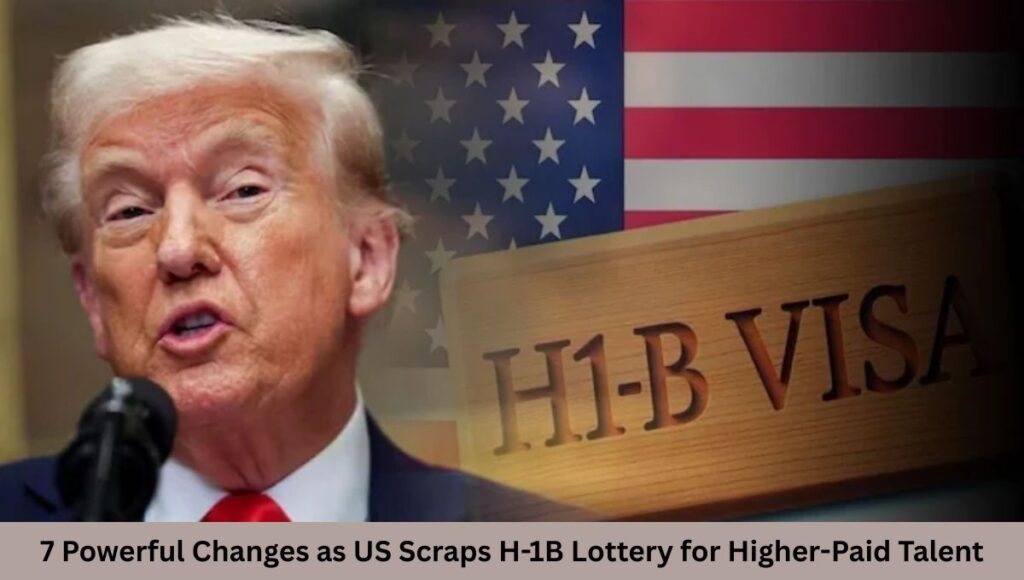
7 Powerful Changes as US Scraps H-1B Lottery for Higher-Paid Talent
What Is the H-1B Visa and Why It Matters
The H-1B visa allows US employers to hire foreign professionals in specialised occupations that require theoretical or technical expertise.
These roles typically span sectors such as technology, engineering, healthcare, education, and finance. For decades, demand for H-1B visas has far exceeded supply.
The programme is capped at 65,000 new visas each year, with an additional 20,000 reserved for applicants holding US master’s degrees or higher.
Once applications exceed the cap, US Citizenship and Immigration Services (USCIS) has relied on a random lottery to select beneficiaries. That lottery system, DHS now argues, became vulnerable to manipulation.
Why the US Scrapped the H-1B Lottery System
According to DHS, the random selection process no longer served the programme’s core objectives. Officials said the lottery allowed unscrupulous employers to flood the system with large volumes of low-wage applications, reducing the odds for genuinely specialised, higher-paid roles.
“The existing random selection process of H-1B registrations was exploited and abused by US employers who were primarily seeking to import foreign workers at lower wages than they would pay American workers,” said Matthew Tragesser, spokesperson for USCIS.
DHS maintained that this dynamic harmed US workers by undercutting wages and distorting hiring incentives.
The new rule, the department said, is designed to:
- Protect American wages and working conditions
- Reduce programme abuse and duplicate filings
- Incentivise employers to offer higher salaries
- Prioritise genuinely specialised roles over volume hiring
How the New Weighted Selection System Works
Under the revised framework, H-1B registrations will no longer be selected purely at random. Instead, USCIS will apply a weighted selection process that increases the probability of selection for higher-paid and higher-skilled applicants.
While DHS has not released a public scoring formula, officials confirmed that wage levels offered by employers will play a central role. Registrations tied to higher salaries will receive stronger odds of selection, while lower-paid roles will remain eligible but face reduced chances.
Crucially, DHS emphasised that the system will still maintain access to H-1B workers at all wage levels, countering criticism that lower-paid sectors would be entirely shut out.
Key Dates and Implementation Timeline
The final rule will come into force on February 27, 2026. It will apply to the FY 2027 H-1B cap registration season, with registrations expected in March 2026 for jobs beginning October 1, 2026.
Importantly, the annual visa caps will remain unchanged:
- 65,000 visas under the regular quota
- 20,000 visas for US advanced degree holders
Who Benefits Most From the New H-1B Rules
High-Skilled, High-Paid Professionals
Foreign professionals offered top-tier salaries in specialised roles—such as senior software engineers, AI researchers, data scientists, physicians, and niche engineers—stand to benefit the most. Their registrations will enjoy significantly improved odds under the weighted model.
Large US Technology and Multinational Firms
Major employers with the financial capacity to offer competitive wages and absorb higher compliance costs are likely to remain strong participants in the H-1B programme. Companies such as Amazon, Microsoft, Google, Apple, and other multinational firms are well positioned under the new regime.
The US Workforce, According to DHS
From the administration’s perspective, the reform strengthens protections for American workers by discouraging wage suppression and ensuring foreign hires complement rather than replace domestic talent.
Who Loses Out Under the New System
Entry-Level and Mid-Career Foreign Workers
Applicants at lower wage levels, including many entry-level and mid-career professionals, will face reduced selection odds. While not excluded, their chances will diminish as higher-paid roles receive priority.
Staffing Firms and Consultancies
Companies that relied on volume-based H-1B filings—particularly staffing agencies and outsourcing firms—may find the new system far less viable. Lower margins and wage constraints could sharply limit participation.
Smaller US Employers
Small and mid-sized businesses that cannot match the wage levels of large corporations may struggle to compete for H-1B talent under the weighted model.
Why Indians Are Likely to Be Hit the Hardest
Indian nationals account for more than 70 percent of all H-1B visas issued annually, forming the backbone of the programme.
An estimated 300,000 Indian professionals currently work in the US on H-1B visas, largely in technology and engineering roles.
Under the new system, Indian professionals employed by top-tier firms and earning high salaries may continue to secure visas.
However, a significant segment of India’s US-bound workforce—particularly those sponsored by IT services firms or smaller consultancies—could see sharply reduced opportunities.
For decades, the H-1B lottery offered at least a statistical chance for lower-paid but qualified professionals. The shift to wage-based prioritisation fundamentally alters that equation.
The $100,000 Fee and Other Trump-Era Measures
The weighted selection system aligns with a broader set of immigration measures introduced by the Trump administration. Among the most controversial is a presidential proclamation requiring certain employers to pay an additional $100,000 per H-1B visa as a condition of eligibility.
While large corporations may absorb the cost, industry experts warn that smaller firms could be priced out entirely. The fee has already triggered legal challenges and widespread concern within the global tech industry.
The administration has also introduced enhanced vetting measures, including expanded social media screening for H-1B and H-4 applicants, contributing to visa delays and rescheduled interviews across countries such as India.
Impact on the US Tech Industry
Supporters argue the reform will push US companies to focus on quality over quantity, rewarding specialised roles and innovation-driven hiring. They say the H-1B programme remains essential for filling talent gaps in areas such as artificial intelligence, cybersecurity, healthcare, and advanced engineering.
Critics counter that the new system may inadvertently reduce flexibility, limit access to emerging talent, and accelerate offshore hiring. Some companies may expand global capability centres outside the US rather than navigate higher costs and tighter rules.
Will the H-1B Programme Still Attract Global Talent?
Despite the tightening, DHS insists the United States remains open to foreign professionals. The department framed the reform as a recalibration rather than a shutdown, aimed at restoring integrity while preserving competitiveness.
However, immigration experts note that the combined impact of wage-based selection, steep fees, and intensified scrutiny could redirect talent toward alternative destinations such as Canada, Europe, and Australia.
What Comes Next
DHS has indicated that further regulatory changes may follow as the impact of the weighted selection system is reviewed.
Employers and applicants are being urged to reassess compensation structures, hiring timelines, and long-term workforce planning.
For aspiring H-1B applicants, the message is clear: higher skills, specialised roles, and competitive salaries will matter more than ever.
Conclusion
The decision to scrap the H-1B lottery marks a historic turning point in US immigration policy. By prioritising higher-paid and higher-skilled foreign workers, the Trump administration has fundamentally reshaped one of the world’s most sought-after work visa programmes.
While the reform promises stronger protections for American workers and a crackdown on misuse, it also narrows pathways for thousands of foreign professionals—especially Indians—who once relied on the lottery’s randomness.
As the new rules take effect in 2026, the future of the H-1B programme will hinge on whether this high-stakes gamble succeeds in balancing economic competitiveness with workforce protection.
Also Read: 7 Alarming Shifts: Trump’s New H-1B ‘Censorship’ Screening Rocks Tech Workers
Also Read: Why has Trump admin scrapped H-1B work visa lottery system?