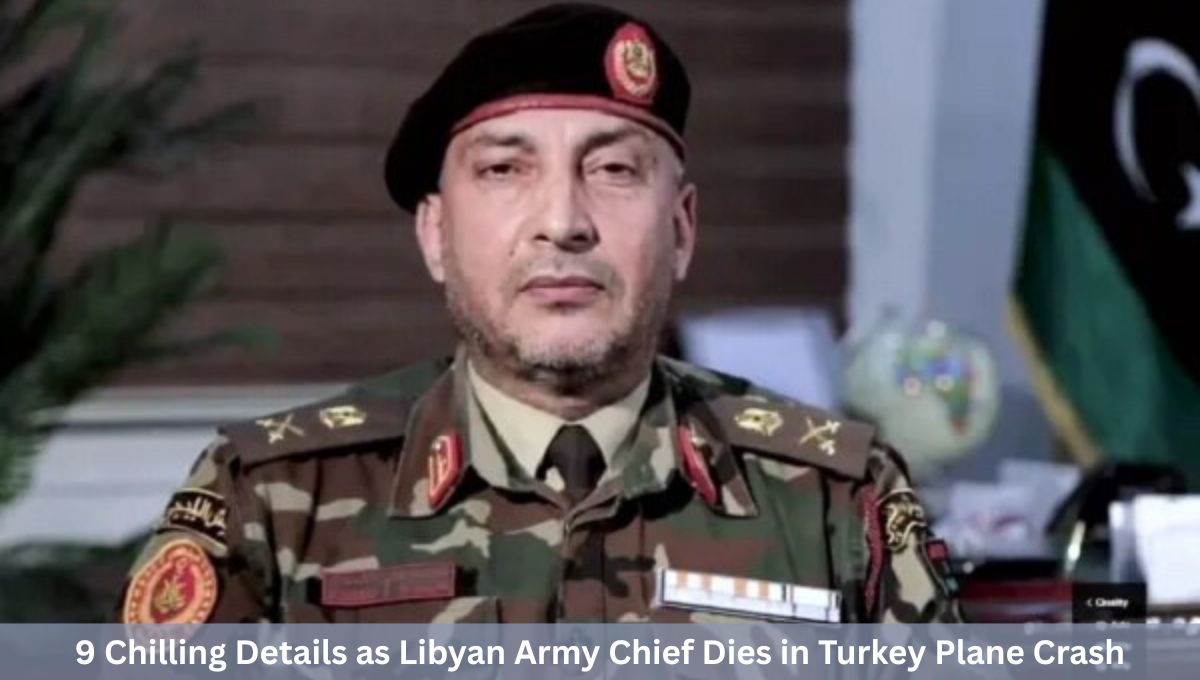
9 Chilling Details as Libyan Army Chief Dies in Turkey Plane Crash after reporting technical glitch. A private jet carrying Libya’s most senior military commander and a high-level defence delegation crashed near Turkey’s capital Ankara, killing everyone on board and sending shockwaves through Libya’s fragile political and security landscape.
The crash, which occurred shortly after take-off from Ankara’s Esenboga Airport, has been described by Turkish and Libyan officials as a tragic accident caused by technical failure, with early findings ruling out sabotage.
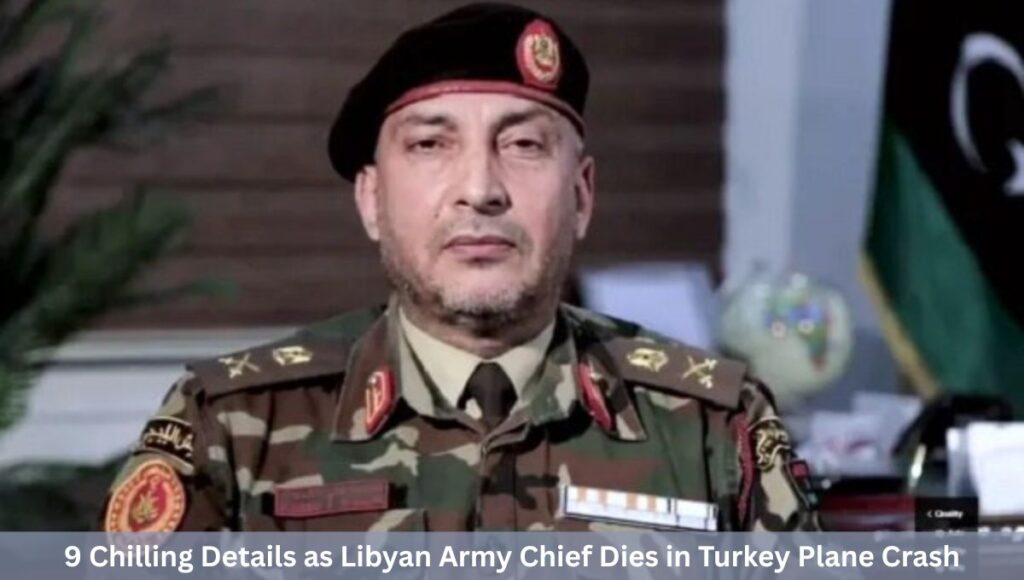
The deaths of Lieutenant General Mohammed Ali Ahmed al-Haddad, Libya’s chief of general staff, and four other senior officers mark one of the deadliest single incidents to strike Libya’s military leadership in years.
Chilling video footage circulating online appears to show the night sky over the Haymana district suddenly lighting up in what looks like an explosion, moments before the aircraft vanished from radar.
9 Chilling Details as Libyan Army Chief Dies in Turkey Plane Crash
Who Was On Board the Crashed Aircraft
The Dassault Falcon 50 business jet was carrying eight people: five senior Libyan military officials and three crew members. Libyan Prime Minister Abdul-Hamid Dbeibah confirmed that all passengers and crew were killed.
Those killed included:
- Lt Gen Mohammed Ali Ahmed al-Haddad, Libya’s chief of general staff and the country’s most senior military commander in western Libya
- Maj Gen Al-Fitouri Ghraibil, head of Libya’s ground forces
- Brig Gen Mahmoud Al-Qatawi, director of the Military Manufacturing Authority
- Mohammed Al-Asawi Diab, adviser to the chief of staff
- Mohammed Omar Ahmed Mahjoub, military photographer attached to the chief of staff’s office
Turkish media later reported that the three crew members were foreign nationals, though their identities have not yet been formally released.
Chilling Video Emerges From Crash Site
A purported video widely shared on social media captured a sudden flash lighting up the night sky over Haymana, around 70 kilometres south of Ankara. The footage appears to show an explosion moments before the aircraft went down.
While several Turkish television networks aired similar security camera footage, media outlets cautioned that the authenticity of videos circulating online could not be independently verified. Nevertheless, officials confirmed that the aircraft disappeared from radar while descending for an emergency landing.
Timeline of the Fatal Flight
Take-off From Ankara
According to Turkey’s Interior Minister Ali Yerlikaya, the Falcon 50 jet departed Ankara’s Esenboga Airport at approximately 8:10 pm local time, en route to Tripoli. The Libyan delegation had just concluded high-level defence talks with Turkish officials.
Emergency Declared Mid-Flight
Around 40 minutes after take-off, the crew contacted air traffic control to report an electrical fault. They requested permission to make an emergency landing and were instructed to return to Esenboga Airport.
Radar Contact Lost
As the aircraft descended toward Ankara, air traffic controllers lost radar and radio contact. The jet issued an emergency landing signal near Haymana before all communication ceased.
Wreckage Located
Search teams later located the wreckage roughly two kilometres south of Kesikkavak village in Haymana district. All eight people on board were confirmed dead at the scene.
What Caused the Plane Crash
Turkish officials said initial investigations point to technical failure rather than foul play. The aircraft reportedly suffered an electrical malfunction shortly after take-off.
Burhanettin Duran, head of Turkey’s presidential communications office, said the jet notified air traffic control of an electrical problem and was redirected for an emergency landing. However, it vanished from radar during descent.
A Turkish official told Al Jazeera that early findings had ruled out sabotage. Turkey’s Justice Minister Yilmaz Tunc confirmed that a formal investigation had been launched by the Ankara chief prosecutor’s office.
Libya Declares National Mourning
Libya’s UN-recognised Government of National Unity (GNU) announced three days of official mourning following the crash.
Flags at state institutions were ordered to fly at half-mast, while official ceremonies and celebrations were suspended.
Prime Minister Dbeibah described the deaths as a “great tragedy” and “a great loss for the nation, the military establishment, and all the people.”
Who Was Mohammed al-Haddad
Al-Haddad had served as Libya’s chief of general staff since August 2020, having been appointed by then prime minister Fayez al-Sarraj. He was widely regarded as the most senior military commander in western Libya.
A career soldier, al-Haddad supported the 2011 uprising that toppled Muammar Gaddafi and later emerged as a key figure in United Nations-brokered efforts to reunify Libya’s fractured armed forces.
A Central Figure in UN Unity Efforts
Libya has remained deeply divided since 2011, with rival administrations in Tripoli and eastern Benghazi and a complex web of militias controlling territory. Al-Haddad was seen as a rare figure capable of navigating these divisions.
He consistently advocated reconciliation and resisted pressure from powerful armed groups, earning respect across political lines. Even rivals in eastern Libya, including commander Khalifa Haftar, issued condolences following his death.
Tributes Pour In Across Libya’s Divide
Eastern Libya commander Khalifa Haftar expressed “deep sorrow over this tragic loss,” while the House of Representatives in Benghazi offered condolences to the families of the victims.
Libya’s state minister for political affairs described al-Haddad’s death as a blow to national unity efforts, noting an outpouring of grief from both western and eastern factions.
The Turkish-Libyan Defence Context
The crash occurred against the backdrop of deepening military cooperation between Turkey and Libya’s Tripoli-based government.
The Libyan delegation had been in Ankara for talks with Turkish Defence Minister Yasar Guler and Chief of General Staff Selcuk Bayraktaroglu. The visit came one day after Turkey’s parliament voted to extend the mandate of Turkish troops deployed in Libya by two more years.
Turkey has supported the UN-recognised government since 2020, providing military training, equipment, and political backing. The two countries have also signed maritime demarcation and energy exploration agreements.
Why the Timing Matters
Analysts say al-Haddad’s death could complicate ongoing efforts to unify Libya’s military institutions at a time when political divisions remain entrenched.
His passing removes a key interlocutor trusted by international mediators and could create a leadership vacuum within the western-based armed forces.
Investigation Under Way
Turkey’s Justice Ministry has appointed multiple prosecutors to investigate the crash. Libya is sending a technical team to Ankara to participate in a joint inquiry.
Officials said the aircraft was a leased Maltese-registered jet, and questions remain about its maintenance history and ownership.
What Happens Next
Investigators will examine flight data, maintenance records, and air traffic communications to determine the precise cause of the crash.
While early findings point to technical failure, final conclusions are expected to take months.
Conclusion
The deadly plane crash near Ankara has robbed Libya of one of its most influential military leaders at a critical moment in its post-war recovery.
As investigations continue, the tragedy underscores both the fragility of Libya’s institutions and the high stakes surrounding its international partnerships.
For now, Libya mourns a commander seen by many as a bridge-builder in a divided nation, even as questions linger about the final moments of the flight that claimed his life.
Also Read: 7 Shocking Moments: Congo Minister’s Plane Bursts into Flames After Runway Skid
Also Read: Conspiracy? Libya army chief Mohamed Al-Haddad dies in plane crash days after Pakistan’s Asim Munir met rebel Khalifa Haftart
Related Posts:
- Southend Plane Crash: Jet to Netherlands Explodes…

- 5 Major Takeaways from the US Supreme Court's…

- 7 Key Details About Deadly UPS Cargo Plane Crash in Kentucky

- 7 Heartbreaking Facts About Venezuela's Earthquake Disaster
- Tragedy in Ahmedabad: Air India AI-171 Crash Claims…
- 7 Powerful Facts About Ayatollah Ali Khamenei’s…