
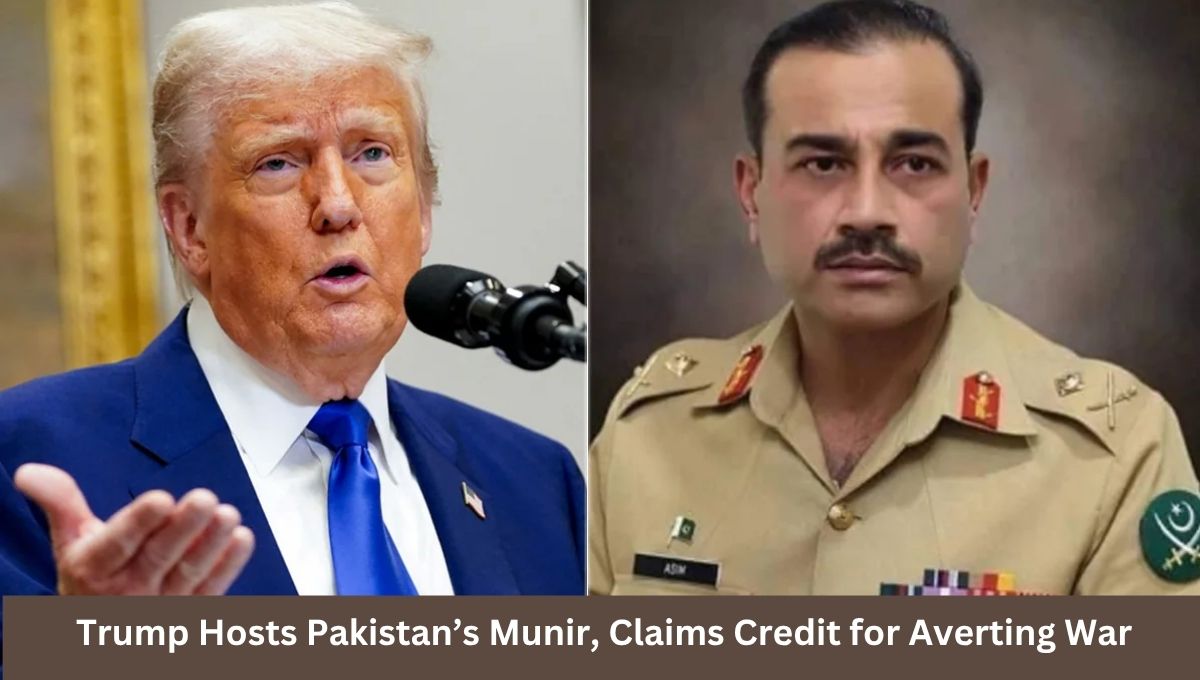
In a striking and controversial diplomatic gesture, Trump Hosts Pakistan’s Munir, Claims Credit for Averting War. U.S. President Donald Trump hosted Pakistan’s powerful army chief, Field Marshal Asim Munir, at the White House for a private luncheon. Held in the Cabinet Room, the meeting was both symbolic and strategic, drawing global attention due to its timing and implications.
The event marked the first time a Pakistani military leader has been formally hosted without civilian leadership present a rare move by Washington that underscores the enduring utility of Pakistan’s military in American foreign policy circles.
Trump Hosts Pakistan’s Munir, Claims Credit for Averting War
The Meeting That Sparked Global Buzz
According to a statement from the Pakistan Army, the luncheon was a follow-up to Munir’s praise of Trump for allegedly preventing a nuclear conflict between India and Pakistan in May.
In fact, Munir even urged Trump’s nomination for the Nobel Peace Prize, citing his “decisive” intervention in halting a dangerous war.
Trump doubled down on this narrative. Speaking to reporters, he said: “Two very smart people decided not to keep going with that war. That could have been a nuclear war. I stopped it.”
India’s Firm Rebuttal: No U.S. Mediation
India’s response was swift and unequivocal. Hours before the Munir meeting, Prime Minister Narendra Modi spoke to Trump in a 35-minute call, during which he reportedly rejected the claim that Trump had mediated the ceasefire.
Foreign Secretary Vikram Misri made the Indian government’s position clear:
“PM Modi told President Trump clearly that there was no U.S. role in ending the hostilities. All communication during the conflict was between Indian and Pakistani military channels.”
India also denied Trump’s assertion that a U.S.-India trade deal was discussed in the same timeframe, calling it “a fabrication.”
Kashmir Attack and India’s Military Response
The latest India-Pakistan flashpoint began on April 22, when a terror attack in Pahalgam, Kashmir killed 26 Indian tourists, including children.
Indian intelligence blamed Pakistan’s ISI, citing a provocative speech by Munir on April 16 that allegedly incited extremist factions.
India’s response came on May 7, when it launched Operation Sindoor, targeting nine terrorist camps in Pakistan and Pakistan-occupied Kashmir (PoK).
The operation lasted four days, involving missile strikes, drones, and artillery, before both sides ceased fire on May 10.
Trump’s Mediation Claim and India’s Strategic Autonomy
Trump’s repeated claim that he “stopped the war” has not gone down well in New Delhi. India has long held that Kashmir and cross-border conflict are bilateral matters, rejecting third-party intervention.
Analysts warn that Trump’s narrative could undermine U.S.-India relations, especially given India’s growing strategic role in the Indo-Pacific.
“For Delhi, it all boils down to an age-old question,” said geopolitical analyst Michael Kugelman. “How much U.S.-Pakistan cooperation can it tolerate without compromising its own standing?”
Pakistan’s Long History of Military Diplomacy
The White House lunch with Field Marshal Munir is part of a longstanding tradition. Since General Ayub Khan’s era, Pakistan’s military elite have served as Washington’s go-to interlocutors, often sidelining civilian leaders.
From Zia-ul-Haq to Pervez Musharraf, U.S. administrations have found it easier to negotiate with Pakistan’s generals, given their control over security, foreign policy, and nuclear assets.
Pakistan’s military is viewed as a “rentier institution” one that trades strategic alignment and services (e.g., air corridors, intelligence sharing) in return for financial aid, arms deals, and diplomatic legitimacy.
The “Three A’s”: Army, Allah, and America
This dynamic is commonly referred to in South Asia as the rule of the “Three A’s of Pakistan” Army, Allah, and America. With democracy often sidelined, Pakistan’s generals use foreign partnerships to bolster domestic authority.
Field Marshal Munir’s self-promotion to his current rank the first since Ayub Khan is seen by many critics as part of this power consolidation.
Iran-Israel War: Why Pakistan Is Back in Focus
Trump and Munir reportedly discussed the ongoing Iran-Israel war, which has seen Israeli airstrikes targeting Iran’s nuclear facilities. With Iran lacking diplomatic ties to the U.S., Pakistan plays a key intermediary role, representing Iranian interests in Washington.
Trump said: “They [Pakistan] know Iran very well better than most. They’re not happy about what’s happening with Israel. And he agreed with me.”
According to reports, Munir urged Trump to avoid military escalation with Iran and instead seek a ceasefire to stabilize the Middle East.
Defense Signals: Lockheed Martin and F-16s
The Trump-Munir optics didn’t go unnoticed on Wall Street. Lockheed Martin, maker of the F-16 fighter jets used by Pakistan, saw a 3% stock surge in the days around the visit.
This prompted speculation about a potential F-16 upgrade deal or fresh U.S. defense cooperation with Pakistan, although no formal agreements were announced.
Counterterrorism: A Rare Breakthrough
One confirmed outcome from the meeting was enhanced counterterrorism cooperation.
U.S. CENTCOM Commander Gen. Michael Kurilla later confirmed that Pakistan had captured and extradited IS-K operative Mohammad Sharifullah, believed to be behind the 2021 Kabul Abbey Gate bombing, which killed 13 U.S. troops.
Munir reportedly personally informed Kurilla about the arrest during his U.S. trip a rare act of transparency from Pakistan’s military.
Public Backlash: Protestors and a Viral Video
The trip wasn’t without its controversies. Outside the Four Seasons Hotel in D.C., protestors from Imran Khan’s PTI party held rallies condemning Munir’s crackdown on political opposition in Pakistan.
Adding to the drama, a viral video surfaced allegedly showing Munir shopping at a U.S. mall. While xAI’s Grok system flagged the video as likely AI-generated, it fueled public debate about the optics of military leaders enjoying personal perks during politically charged state visits.
Modi Declines Trump’s Invite, Sends His Own
Before Munir’s visit, Trump had invited PM Modi for a stopover on his return from the G7 Summit in Canada. Modi declined, citing prior engagements.
However, he invited Trump to India later in the year for the Quad Summit, which Trump accepted.
Despite tensions over narrative control, India-U.S. ties remain intact though likely strained in the short term.
India’s Strategic Message: Zero Tolerance for Terror
Operation Sindoor wasn’t just a tactical military action; it was a message. India is no longer content with merely condemning cross-border terrorism.
Its suspension of the Indus Waters Treaty after the attack sent another loud signal. New Delhi’s new doctrine is simple: respond hard, fast, and independently.
Conclusion: Tactical Gains, Strategic Questions
Trump’s hosting of Field Marshal Munir was meant to be a show of diplomacy but it has turned into a regional flashpoint.
While the meeting may yield short-term counterterrorism benefits and possibly revive U.S.-Pakistan military trade, it risks damaging U.S.-India relations, especially if Trump continues pushing a disputed narrative of war mediation.
As Trump seeks another term, and South Asia remains volatile, the U.S. must weigh whether favoring authoritarian stability today might lead to regional instability tomorrow.
Also Read: Pak Army Chief Asim Munir Heads to US Again, Deepens Military Ties
Related Posts:
- 9 Powerful Signals Behind Saudi Arabia Honoring…

- 5 Powerful Highlights as Trump Lands Second Nobel…

- Trump Stole the Show at 2025 Gaza Peace Summit in Egypt
- Trump Says “They Won’t Give It to Me” as Pakistan…
- Trump’s 2025 Gaza Peace Plan Signing and Historic…

- Can the EU and NATO Impose Tariffs on India and…
