For the second time in two months, Pak Army Chief Asim Munir Heads to US Again, Deepens Military Ties. In a significant development that signals growing military and strategic cooperation between Pakistan and the United States, Pakistan Army Chief Field Marshal Asim Munir is set to visit the US again this week. This will be his second trip to the US in just two months, underlining a deepening defense relationship at a time when tensions between the US and India are escalating over trade tariffs and geopolitical positioning.
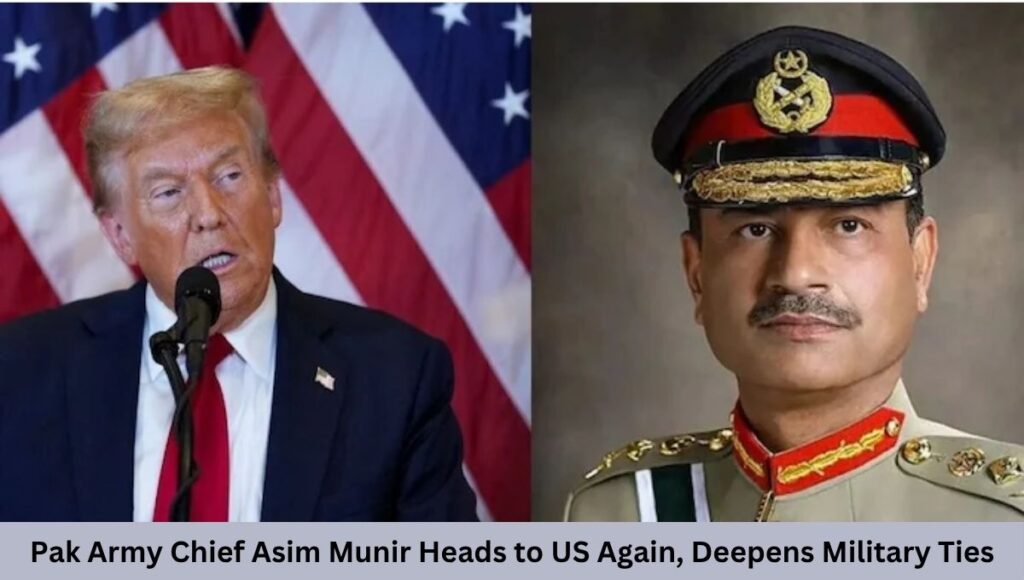
Pak Army Chief Asim Munir Heads to US Again, Deepens Military Ties
Attending CENTCOM Chief General Kurilla’s Farewell
The primary reason for this visit is to attend the farewell ceremony of General Michael Erik Kurilla, Commander of the US Central Command (CENTCOM), who is retiring later this month.
The event will be held at CENTCOM Headquarters in MacDill Air Force Base, Tampa, where Munir is expected to participate in both official and private engagements.
Kurilla has previously described Pakistan as a “phenomenal partner” in counter-terrorism, a sentiment that was warmly welcomed in Islamabad.
In July, Pakistan recognized General Kurilla’s contributions to regional security by awarding him the Nishan-e-Imtiaz (Military), one of the country’s highest honors.
Munir’s Strategic Lunch with Trump in June
This upcoming visit closely follows Munir’s earlier trip to Washington in June, where he held a two-hour private lunch with US President Donald Trump at the White House.
The meeting was historic not only because it involved a direct military leader-to-President conversation, but also because no Pakistani civilian government official was present.
Trump, during and after the meeting, praised Munir for helping to de-escalate hostilities between India and Pakistan following the Pahalgam terror attack and India’s Operation Sindoor.
In a bold move, Munir reportedly endorsed Trump for the Nobel Peace Prize for “averting a nuclear war” between the two nuclear neighbors a nomination later formalized by the Pakistani government.
Deeper Meaning Behind the Visits
While the farewell of a top US general may seem ceremonial, the strategic undertones of Munir’s repeated visits are hard to ignore.
The Pakistani media has touted these developments as a major diplomatic victory, reinforcing Pakistan’s renewed importance in the region’s geopolitical landscape.
Given the current US-India trade tensions, and India’s recent aggressive military posture, Munir’s increasing visibility in Washington is being seen as part of a US recalibration toward Pakistan.
Tensions With India: The Context of Operation Sindoor
The recent round of India-Pakistan conflict began with a deadly terror attack in Pahalgam, Jammu and Kashmir, where 26 civilians were killed.
India responded with Operation Sindoor, a series of precision strikes on terror infrastructure across the Line of Control (LoC) in Pakistan and Pakistan-occupied Kashmir.
Hostilities lasted four days and ended with an understanding between the two countries’ military leadership.
However, Trump has repeatedly claimed that it was his intervention that stopped the conflict claims firmly denied by the Indian government.
Prime Minister Narendra Modi clarified in Parliament that “no foreign leader asked us to stop Operation Sindoor.”
The Indian government insists that the ceasefire was the result of direct military-to-military negotiations.
The Tariff War: US-India Tensions on the Rise
As the US strengthens ties with Pakistan, India is facing heat from Washington over its continued purchase of Russian crude oil.
In a move seen as retaliatory, President Trump recently slapped an additional 25% tariff on Indian exports, raising total duties to 50%.
The decision is part of a broader campaign to pressure countries into reducing their dependence on Russian energy exports.
India has responded strongly, calling the tariffs “unfair, unjustified, and unreasonable.” The Ministry of External Affairs emphasized that India’s oil imports are based on energy security needs for its 1.4 billion citizens.
These developments have created a visible strain in US-India relations, and Pakistan appears to be filling the vacuum militarily and economically.
Trump’s Trade Offer to Pakistan
Adding another layer of complexity, Trump has also announced a preferential trade deal with Pakistan, under which Islamabad will receive reduced tariffs and support in exploring its domestic oil reserves.
This deal is being interpreted as part of Trump’s broader strategy to pull Pakistan closer and reduce its economic dependence on China.
The timing of the trade deal, just weeks after Trump hosted Munir at the White House, has added fuel to speculation that Pakistan is emerging as a key regional ally once again.
Private Dinner in Tampa Hosted by Pakistani-American Businessman
During his Tampa visit, Munir is also scheduled to attend a private dinner hosted by Adnan Asad, a prominent Pakistani-American businessman with deep ties in military and political circles.
Asad, a cousin of former Pakistani military ruler General Pervez Musharraf, owns Venus Group, a company that has long served defense contractors.
This dinner will reportedly bring together top military, business, and diplomatic leaders, further signaling Munir’s mission to boost Pakistan’s defense profile and strategic image in the US.
Asad has a colorful background, known for hosting extravagant events including the famous 2019 “Mika Singh Night” in Karachi, which raised eyebrows due to the alleged presence of associates linked to underworld figures.
What It Means for Regional Dynamics
Munir’s second US visit in two months isn’t just about farewells or ceremonies it’s about positioning Pakistan as a strategic counterbalance to India in South Asia, particularly in the eyes of the US defense and political establishment.
While India is dealing with diplomatic fallout from Operation Sindoor and Trump’s tariff decisions, Pakistan seems to be capitalizing on the moment both militarily and diplomatically.
Whether or not Munir meets Trump again during this visit remains uncertain, but what is clear is that US-Pakistan military cooperation is seeing a revival, reminiscent of the post-9/11 era, albeit with a different set of geopolitical drivers.
Conclusion: A Diplomatic Comeback for Pakistan?
Asim Munir’s rapid re-engagement with Washington highlights a diplomatic comeback for Pakistan on the global stage. Whether it’s counter-terrorism cooperation, strategic positioning, or military diplomacy, Pakistan is making its presence felt again in Washington’s inner circles.
In a world reshaped by new alliances, energy politics, and economic warfare, Pakistan seems to be carving a fresh role with its military once again at the helm of foreign policy maneuvers. As for India, the road ahead may involve reassessing its approach to balancing trade, diplomacy, and strategic messaging especially as Washington appears to be reopening its doors to Islamabad.
Also Read: Trump Hosts Pakistan’s Munir, Claims Credit for Averting War
Also Read: Asim Munir to become president? Pakistan Army gives BIG update as top general heads to US again
Related Posts:
- 9 Powerful Signals Behind Saudi Arabia Honoring…

- 5 Major Takeaways from the US Supreme Court's…

- 3 Explosive Conditions Iran Sets to End War with US…
- 7 Heartbreaking Facts About Venezuela's Earthquake Disaster

- Afghanistan–Pakistan War 2025: Inside the 48-Hour Ceasefire

- 7 Powerful Facts About Ayatollah Ali Khamenei’s…