In a shocking turn in US-India ties, Trump Slaps 50% Tariff on India Over Russian Oil. In a move sending shockwaves through global markets, US President Donald Trump announced an additional 25% tariff on Indian imports, bringing the total duty to a staggering 50%. The official reason: India’s continued purchase of Russian oil, which the White House claims supports Moscow’s war in Ukraine.
But beneath the surface, analysts suspect the real trigger may be something far more personal—a diplomatic snub involving Pakistan and a failed ceasefire credit claim by Trump.
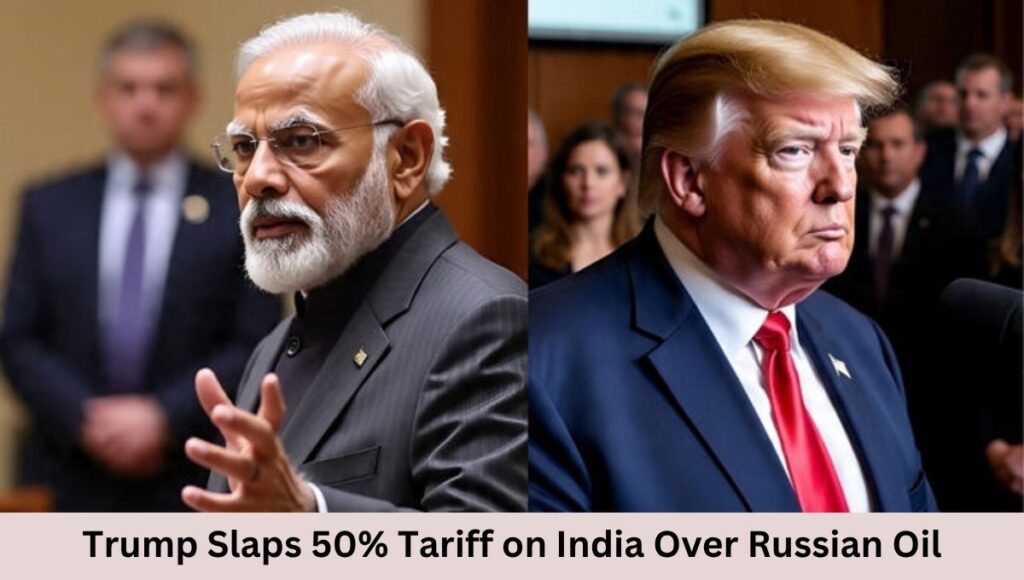
Trump Slaps 50% Tariff on India Over Russian Oil
Ceasefire Credit and the Personal Politics of Tariffs
According to Michael Kugelman of the Wilson Center, this is the “worst crisis in US-India relations in over two decades.”
While Trump publicly cited Russian oil as the reason for the tariff hike, insiders point to a deeper irritant: India’s refusal to let Trump claim credit for mediating a recent India-Pakistan ceasefire.
“Trump wanted public recognition,” says Kugelman. “When India denied that narrative, it became a diplomatic embarrassment for the president.”
Trump has reportedly vented in private that “China didn’t block me like India did” a thinly veiled dig at New Delhi’s decision to dismiss his mediation claims.
Trade Talks Collapse Just Before the Blow
Until recently, Washington and New Delhi were believed to be on the verge of a landmark trade agreement.
India had agreed to:
- Eliminate tariffs on certain US industrial products
- Increase US defense and energy imports
- Gradually reduce tariffs on alcohol and vehicles
However, New Delhi held firm on protecting agriculture and dairy sectors, which employ millions in India’s rural heartlands.
The Trump administration, prioritizing big announcements and broader access to Indian markets, abruptly walked away from the table.
Instead, Trump finalized favorable trade terms with Japan, the EU, and even Pakistan adding salt to India’s wounds.
Trump’s Trade Doctrine: Onshoring Over Alliances
This move aligns with Trump’s “America First” policy, which increasingly prioritizes onshoring over traditional alliances.
“Trump isn’t interested in friend-shoring,” says Vina Nadjibulla of the Asia Pacific Foundation. “It’s about bringing supply chains back to the US even at the cost of long-standing partnerships like India.”
Despite the camaraderie displayed at “Howdy Modi” and “Namaste Trump” events, Trump’s latest move shows that personal rapport doesn’t guarantee protection from his transactional trade style.
The High Cost for Indian Exporters
The 50% tariff will affect over 55% of Indian exports to the US, including vital sectors such as:
- Textiles and Apparel – $10.3B
- Gems and Jewelry – $12B
- Shrimp and Seafood – $2.24B
- Leather and Footwear – $1.18B
- Organic Chemicals – $2.34B
- Machinery & Appliances – Approx. $9B
Sector-Wise Tariff Impact:
| Sector | New Effective Tariff |
| Apparel (knitted) | 63.9% |
| Apparel (woven) | 60.3% |
| Textiles and made-ups | 59% |
| Carpets | 52.9% |
| Diamonds and gold products | 52.1% |
| Furniture and bedding | 52.3% |
| Machinery and appliances | 51.3% |
| Organic chemicals | 54% |
The Global Trade Research Initiative (GTRI) warns that Indian exports to the US could plummet by 40–50% under this new tariff structure.
Industry Leaders Sound the Alarm
Indian exporters are already facing a massive disruption.
“Our exporters are at a 30–35% disadvantage now compared to Vietnam or Ecuador,” said Colin Shah, MD of Kama Jewelry. “Many buyers in the US have paused orders.”
Yogesh Gupta, head of Megaa Moda, warns that Indian shrimp is now priced out of the US market.
“We already compete with Ecuador’s 15% duty. Now Indian shrimp faces 33.26% total duty. It’s unsustainable.”
The Confederation of Indian Textile Industry (CITI) called the move a “huge setback” that would cripple India’s competitiveness in US markets.
US Double Standards?
Indian officials and analysts are openly questioning US consistency.
Despite public condemnation of Russia, the US itself traded $3.5 billion worth of goods with Russia last year.
An Indian foreign ministry official stated:
“We turned to Russian oil only after Western nations diverted traditional suppliers to Europe. We’re stabilizing our energy market, not funding a war.”
This perceived double standard has added fuel to Indian public and political backlash.
A Breakdown in Communication?
According to former US Trade Representative Mark Linscott, this trade fallout might have been avoided with a simple phone call.
“Had Modi picked up the phone, we might not be here,” he said. But sources say Modi deliberately avoided direct contact, fearing a one-sided, media-manipulated conversation after Trump falsely claimed to have mediated India-Pakistan tensions.
Trump’s repeated calls for India to publicly credit his ceasefire efforts proved unacceptable for Indian leadership. It appears this snub struck a deeper chord than anyone expected.
Strategic Consequences: Is India Losing Its Edge?
This tariff now places India in a category with countries like China, Venezuela, and Turkey those facing secondary sanctions from the US.
India, long pitched as a manufacturing alternative to China, is suddenly less attractive to global investors.
“Instability and unpredictability are the biggest threats to business,” warns Nadjibulla. “Firms looking to move supply chains away from China will hesitate to choose India now.”
Pakistan Applauds, While India Watches
In a stunning twist, Pakistan praised Trump’s foreign policy, even suggesting he deserves a Nobel Peace Prize for “resolving” the India-Pakistan skirmish.
India, on the other hand, categorically denied Trump had any role.
This divergent narrative has worsened India’s diplomatic discomfort, especially as Trump extends better trade terms to Islamabad while punishing New Delhi.
India’s Next Moves: Diversify and Diplomacy
Rather than retaliate, India is expected to:
- Accelerate trade talks with the UK and EU
- Explore new energy suppliers, including the US if pricing aligns
- Reassess tariff protections on agriculture and dairy
- Push for a diplomatic reset through backchannel dialogue
PM Modi is also expected to attend the Shanghai Cooperation Organisation (SCO) summit, signaling an interest in easing China tensions, especially if relations with the US continue to sour.
Can the Relationship Be Saved?
Despite the crisis, most analysts believe the US-India partnership can recover but only with strategic compromise and diplomatic creativity.
“This relationship is multi-layered defense, tech, energy it can absorb shocks,” says Kugelman.
Former trade official Ajay Srivastava advises India not to retaliate immediately, but to reassess in six months while preserving space for dialogue.
Final Word: Pick Up the Phone
The message from experts is clear this may still be salvageable.
“We’re in a lose-lose. But with leadership and honesty, it could become a win-win,” said Linscott.
In this unfolding standoff between two of the world’s largest democracies, a single phone call might hold the key to rebooting trust and reopening trade.
Also Read: Trump’s Tariff Tsunami: 50% on Copper, 200% Warning on Pharma – India in the Crossfire
Related Posts:
- Trump’s 2025 Nobel Peace Prize Snub: Politics Over…

- Trump’s 2025 Gaza Peace Plan Signing and Historic…

- “Don’t Want Them To Buy Russian Oil”: Trump Urges…
- 9 Explosive Revelations as Trump Declares His Health…

- Can the EU and NATO Impose Tariffs on India and…

- India ‘Mostly with Us’, Zelensky Counters Trump’s…