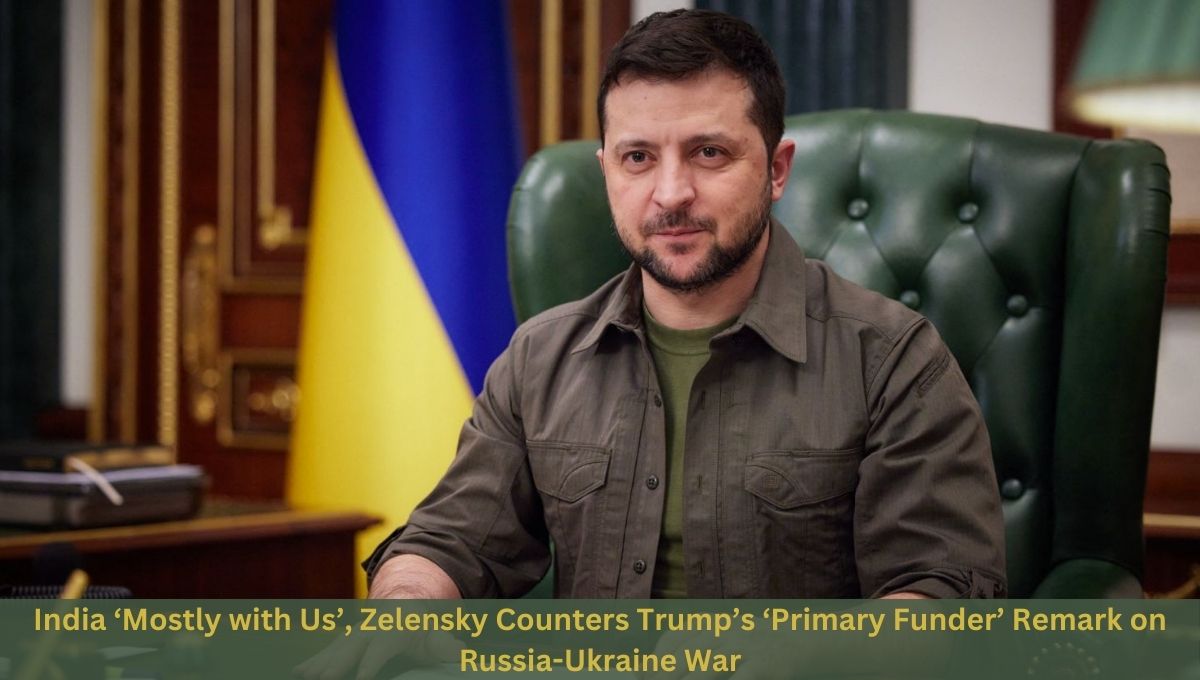
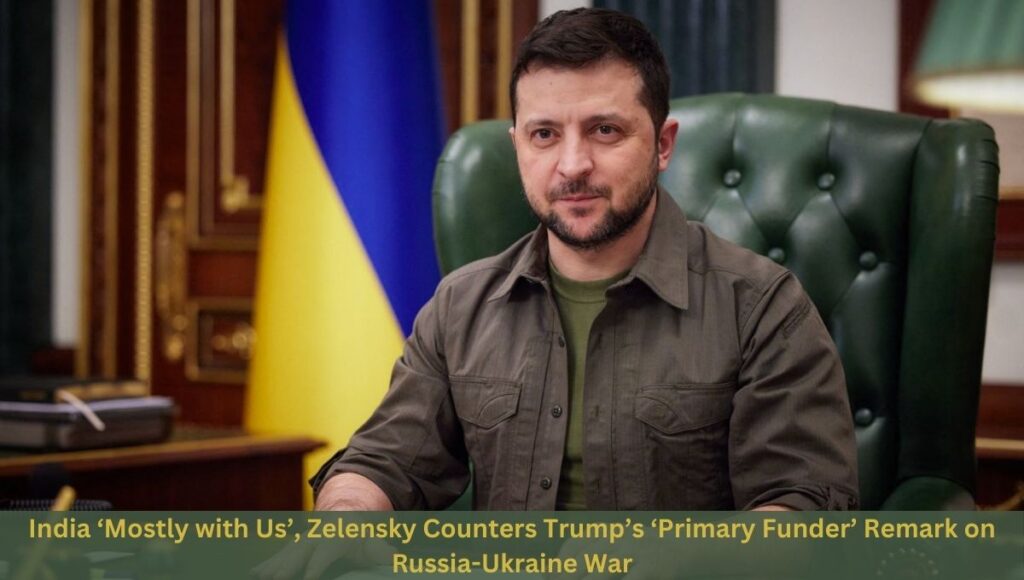
Asserting that India ‘Mostly with Us’, Zelensky Counters Trump’s ‘Primary Funder’ Remark on Russia-Ukraine War. Ukrainian President Volodymyr Zelensky has publicly countered US President Donald Trump’s assertion that India is one of the “primary funders” of Russia’s ongoing war in Ukraine.
Speaking to Fox News anchor Bret Baier on the sidelines of the 80th United Nations General Assembly (UNGA) in New York, Zelensky stressed that India was “mostly with Ukraine,” while admitting that energy-related ties between New Delhi and Moscow remain a challenge. The remarks mark a rare divergence in narratives between Kyiv and Washington, with Zelensky directly defending India at a time when Trump has turned up pressure on New Delhi over its continued import of discounted Russian crude oil.
India ‘Mostly with Us’, Zelensky Counters Trump’s ‘Primary Funder’ Remark on Russia-Ukraine War
Trump at UNGA: ‘India and China are the Primary Funders of the War’
In a 56-minute address to the UNGA, President Trump lashed out at India, China, and European nations for sustaining Moscow’s war chest through continued purchases of Russian energy.
“China and India are the primary funders of the ongoing war by continuing to purchase Russian oil,” Trump declared, calling such transactions “inexcusable” as Ukraine battles to hold its ground against Russian offensives.
Trump’s criticism extended to Europe as well, accusing NATO countries of “funding the war against themselves” by failing to cut off energy imports.
The speech coincided with the rollout of new tariffs on India — a 50% levy imposed on August 27, half of which targeted Indian imports in retaliation for oil trade with Russia.
The move has already caused friction within the Trump administration, with some senior officials publicly questioning the wisdom of penalizing a strategic partner like India.
Zelensky Pushes Back: ‘India Mostly With Us’
In his interview, Zelensky firmly pushed back on the framing of India as a war funder.
“I think India, mostly, with us. Yes, we have these questions with energy but I think President Trump can manage it,” Zelensky told Fox News.
The Ukrainian leader acknowledged New Delhi’s continued dependence on Russian oil, but emphasized that it was not evidence of political alignment with Moscow. Instead, he framed it as an energy security issue that could be managed through closer partnerships with the US and Europe.
“With the Europeans, make closer and stronger relations with India. I think we have to do everything not to withdraw India and they will change their attitude to the Russian energy sector, I am sure,” Zelensky added.
‘With China, It’s More Difficult’
While extending an olive branch to India, Zelensky drew a sharp distinction with China.
“With China it’s more difficult because today, it’s not in their interests not to support Russia,” he said, noting Beijing’s consistent diplomatic and economic backing of Moscow.
He also said he believed President Trump could play a key role in influencing Chinese President Xi Jinping’s approach.
“I think that President Trump can change the attitude of Xi Jinping to this war, because China, we don’t feel that China wants to finish this war,” Zelensky remarked.
India’s Response: Oil Trade a Sovereign Matter
India has consistently defended its energy relationship with Moscow, arguing that it does not violate international law and is critical for domestic energy security.
Indian officials have accused Western powers of hypocrisy, pointing out that the US and Europe themselves have continued to purchase Russian goods worth billions while urging New Delhi to cut ties.
New Delhi’s position remains clear: it will make energy decisions that prioritize its national interest, even as it expands strategic partnerships with the US and Europe.
Fact-Check: Zelensky vs Trump
Zelensky’s remarks functioned as a de facto fact-check to Trump’s sharp UNGA criticism. While Trump labeled India a “primary funder,” Zelensky insisted that New Delhi was “mostly” aligned with Ukraine, albeit with complications.
His intervention could ease some diplomatic strain by signaling Kyiv’s understanding of India’s position. It also highlights Ukraine’s urgent need to maintain goodwill among key Global South players, rather than risk alienating them with accusatory rhetoric.
Trump’s Pressure Campaign on India
Trump’s administration has sought to frame India’s Russian oil imports as a major obstacle to ending the war.
Peter Navarro, a top Trump adviser, recently said, “It is essentially Modi’s war because the road to peace runs, in part, through New Delhi.”
The comment reflects a broader push from Trump to compel India to reduce its Russian energy reliance, despite skepticism from his own officials about whether punitive tariffs will produce results.
Zelensky on Trump: ‘He Showed He Wants to Support Ukraine Till the Very End’
Despite the disagreement over India, Zelensky praised Trump’s overall posture toward Ukraine.
“President Trump was more positive. He showed that he wanted to support Ukraine to the very end. We are ready to finish this war as soon as possible. He wants, and I want what our people want,” Zelensky said.
He added that he was encouraged by Trump’s clear messaging of solidarity.
“What surprised me, in a very positive way, is the clear message from Trump and America that they will stand with us until the war is over.”
‘Putin Knows He Is Not Winning’
Zelensky also took aim at Russian President Vladimir Putin, asserting that Moscow was struggling to achieve its war objectives.
“Putin knows he is not winning but still says to everyone that he is winning,” the Ukrainian leader said, suggesting that Russia’s public confidence belies battlefield challenges.
Energy at the Center of the Dispute
At the heart of the disagreement is energy. For Ukraine, Russia’s ability to export oil and gas provides Moscow with crucial revenues to sustain its military campaign. For India, discounted Russian crude has been a lifeline amid global price volatility.
While Trump frames this trade as New Delhi “funding the war,” Zelensky presents it as a challenge to be addressed through constructive engagement. His comments suggest Kyiv does not want to risk pushing India closer to Moscow by aligning with Trump’s punitive approach.
Europe’s Role: ‘Make Stronger Relations With India’
Zelensky urged European leaders to build stronger partnerships with New Delhi, seeing India as a vital player in shifting the balance of the war.
“With the Europeans, make more close and strong relationship with India. We must do everything not to withdraw India,” he said.
His appeal reflects Ukraine’s recognition that long-term isolation of Russia requires participation not only from the West but also from major economies like India.
India Balancing Between US, Russia, and Ukraine
India’s diplomatic tightrope has been visible since the start of the Russia-Ukraine war in 2022. While refusing to condemn Moscow outright, New Delhi has consistently called for peace and dialogue.
Prime Minister Narendra Modi has told Putin directly that “this is not an era of war,” even as India expanded its oil purchases from Russia.
At the same time, India has supplied humanitarian aid to Ukraine and maintained strong defense and technology cooperation with the US and Europe.
This balancing act has made India both a target of criticism and a potential bridge for peace.
The Road Ahead: Can Trump and Zelensky Align on India?
The divergent messaging from Trump and Zelensky underscores a potential fault line in US-Ukraine coordination. While Trump sees tariffs and pressure as leverage, Zelensky prefers engagement and reassurance.
Both approaches reflect political realities: Trump must project toughness to his domestic audience, while Zelensky must avoid alienating potential partners in the Global South.
Whether the two can reconcile their views on India may determine the extent of Kyiv’s success in broadening its international coalition.
Conclusion
Zelensky’s “India mostly with us” remark illustrates Ukraine’s pragmatic approach in navigating global alliances during the war. By distancing himself from Trump’s accusation that India is a “primary funder,” he positioned Kyiv as more understanding of New Delhi’s energy compulsions — and hopeful about future change.
For Trump, the issue serves as both a foreign policy lever and a political talking point. For India, it is a matter of sovereignty and national interest. As the war continues into 2026, the interplay between these three actors — Washington, Kyiv, and New Delhi — will play a critical role in shaping both the battlefield and the global energy landscape.