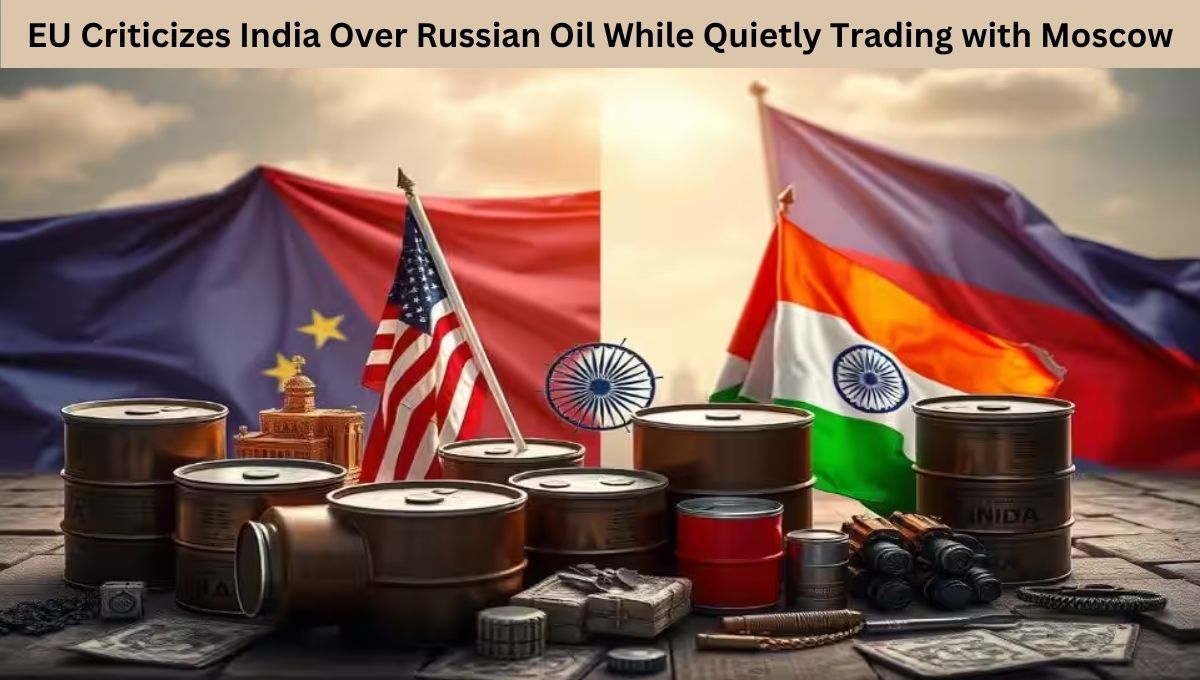
The recent development highlights a double standard, as the EU Criticizes India Over Russian Oil While Quietly Trading with Moscow itself. In 2024 and into 2025, the European Union (EU) and the United States have doubled down on their public condemnation of Russia’s invasion of Ukraine. India, due to its increased oil imports from Russia, has become a favorite punching bag for Western political leaders and media. However, a closer look at trade numbers paints a very different picture one that calls into question the credibility and consistency of the West’s stance.
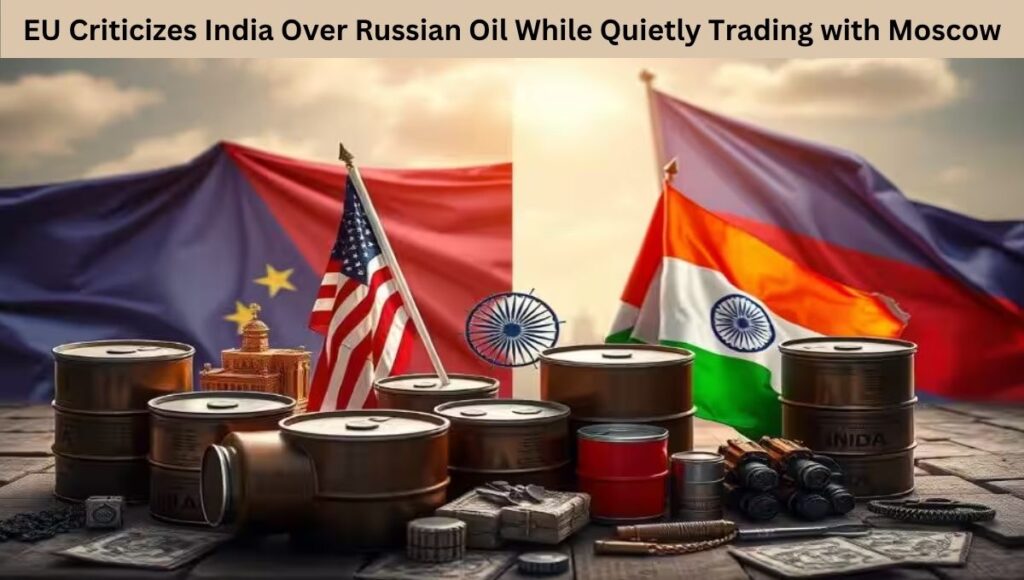
EU Criticizes India Over Russian Oil While Quietly Trading with Moscow
A Tale of Two Trade Partners: India vs. the EU
India’s trade with Russia has seen a sharp uptick, primarily driven by energy imports. In 2024, bilateral trade reached $72 billion of which $59.5 billion (over 80%) came from fuel.
India has maintained that its oil purchases are transparent, legal, and driven by energy security needs. There’s no secrecy, no sanctions evasion, and no backdoor diplomacy.
Meanwhile, the EU which portrays itself as a staunch defender of Ukraine traded goods worth $70.3 billion with Russia in 2024.
And unlike India, Europe’s trade isn’t limited to oil. It includes metals, chemicals, machinery, food, and much more.
India’s Transparent Energy Strategy
India’s position is straightforward: It needs affordable fuel to power its growing economy and secure its energy future. Here’s the breakdown of its 2024 trade with Russia:
- Crude Oil: $52.2 billion
- Coal: $3.5 billion
- Fertilizers: $1.67 billion
India buys openly and legally, without violating any international laws. It does not use G7-owned tankers or repackage oil through shadow routes.
This transparency stands in sharp contrast to the EU’s opaque but continuous trade with Moscow.
The EU’s Contradictory Trade Portfolio with Russia
Despite pushing for tougher sanctions, the EU continues to import a wide range of Russian products:
- Chemicals: $17.6 billion (6x more than India)
- Metals: $6.7 billion
- Food and Agriculture: $5 billion
- Machinery and Electronics: $4.4 billion
- Oil: $24.2 billion
On the export side, the EU sold $34 billion worth of goods to Russia in 2024 7 times more than India’s $4.9 billion exports to Moscow.
This extensive and diversified trade undermines the EU’s narrative of isolating Russia economically.
€212 Billion and Counting: Europe’s Fossil Fuel Bill to Putin
Since Russia’s invasion of Ukraine in 2022, the EU has paid €212 billion to Russia for fossil fuels including crude oil, liquefied natural gas (LNG), pipeline gas, and coal.
Ironically, even in 2025, the EU remains Russia’s largest fossil fuel customer, ahead of even China. Just gas payments alone covered 75% of Russia’s 2024 military budget.
So while Europe talks sanctions, money continues to pour into Putin’s war chest.
The LNG Loophole: A Sanction-Free Backdoor
One of the most glaring examples of Western double standards is the case of LNG. While Russian seaborne crude oil was banned in December 2022, LNG remains fully exempt.
Here’s what happened in 2025:
- EU bought $8.5 billion worth of Russian LNG
- 52% of Russia’s total LNG exports went to the EU
Top LNG importers in the EU:
- France: 7.7 bcm (up 46%)
- The Netherlands: 1.7 bcm (up 81%)
- Belgium and Spain: 5.1 and 5.7 bcm respectively
This LNG is regasified and often redistributed, making it nearly impossible to trace. Yet it remains untouched by EU sanctions.
TurkStream: The Last Pipeline Standing
Even after Nord Stream’s collapse, TurkStream continues to deliver Russian gas to Europe.
- In July 2025, flows via TurkStream rose 37% to 51.5 million cubic meters/day
- In six months, 9.93 bcm of gas flowed through it
There are no EU sanctions on Russian pipeline gas. The only reason for reduced flows is not policy but logistics and geopolitics.
G7 Tankers: Sanctions in Theory, Shipments in Practice
Despite sanctions rhetoric, 56% of Russia’s oil exports in June 2025 were transported using G7-owned or insured tankers. For refined products like diesel and gasoline, the figure was 80%.
The G7 price cap allows such shipments if oil is sold below $60/barrel but enforcement is weak and documentation is murky.
This enables continued trade that complies with the “letter” of sanctions, but not the “spirit.”
Fertilizers: Sanction-Free and Strategic
Fertilizers remain off-limits to sanctions due to their importance in food production.
As of Q1 2025:
- Russia supplies 26% of EU’s fertilizer imports
- In 2021, it was 28% a marginal drop
Germany and France rely heavily on nitrogen-based fertilizers from Russia. The EU quietly carved this sector out of the sanctions regime.
Trump’s Tariff Threats: Hypocrisy or Strategy?
Donald Trump recently criticized India, accusing it of profiting from discounted Russian oil and promising steep tariffs on Indian goods.
Yet the U.S. itself imported $24.5 billion worth of goods from Russia since 2022.
In 2024 alone:
- Fertilizers: $1.27 billion
- Enriched uranium: $624 million
- Palladium: $878 million
India, by contrast, imported $66 billion mostly oil and has no G7 tankers, no backdoor deals, and no LNG dependency.
India’s Growing Ties With Ukraine: A Missed Detail
Contrary to criticism, India hasn’t ignored Ukraine. In fact, India-Ukraine trade hit $1 billion in 2024, a 71% increase from the previous year.
Top imports from Ukraine:
- Animal and vegetable oils: Over $800 million
- Cereals: Over $100 million
By comparison, U.S.-Ukraine trade was under $500 million in the same year.
This reveals that India is not as one-sided in its diplomacy as critics suggest.
RePowerEU: Big Promises, Weak Implementation
The EU’s RePowerEU initiative aims to end Russian fossil fuel imports by 2027 but it’s not legally binding.
Many EU energy firms have long-term LNG contracts with Russia that run until 2040. Without legal reforms, the EU will remain locked into energy dependence.
A Pattern of U.S. Tariff Threats Against India
Trump’s latest remarks are not new. Under his administration, India faced:
- 25% tariffs on exports
- Delays in defense deals
- Accusations of “profiteering” from Russian crude
Despite this, India remains a key strategic partner for the U.S., with trade negotiations ongoing.
India has called these tariff threats “unjustified”, citing continued Western trade with Russia as evidence of double standards.
Conclusion: Western Sanctions Selective and Self-Serving?
If the West truly wants to isolate Russia, consistency is key. Criticizing India while quietly importing billions in Russian oil, gas, metals, and fertilizers sends the wrong message.
India’s trade is transparent, legal, and driven by necessity. It has no historical entanglements with Russia, no hidden pipelines, and no LNG addiction. Meanwhile, the EU and U.S. continue to fund Putin’s economy, even as they preach sanctions.
The question remains: Is the West truly committed to cutting ties with Russia or only when it’s politically convenient?
Also Read: China Blasts U.S. for Hypocrisy Over Trade with Russia
Also Read: Double Standards or Principles? Why the US & EU Trade with Russia While Criticizing India
Related Posts:
- 5 Major Takeaways from the US Supreme Court's…

- 7 Powerful Facts About Ayatollah Ali Khamenei’s…

- 7 Heartbreaking Facts About Venezuela's Earthquake Disaster
- In 8 Moves, EU Targets China-Linked Refineries and…

- 7 Powerful Measures: Trump Sanctions Russian Oil…

- 9 Explosive Claims as Trump Says US Winning Iran War