9 Critical Pressures Trapping Pakistan’s Army Chief Over Gaza in a dangerous dilemma. Pakistan’s most powerful military chief in decades is facing a defining test of authority as the United States intensifies pressure on Islamabad to contribute troops to a proposed international stabilisation force in Gaza.
Thank you for reading this post, don't forget to subscribe!At the centre of the dilemma is Field Marshal Asim Munir, Pakistan’s army chief and newly appointed chief of the defence forces, whose power has expanded dramatically through constitutional changes, tenure extensions and institutional consolidation.
Yet even with unprecedented authority, Munir faces a choice that carries severe consequences whichever path he takes. Agreeing to send Pakistani troops to Gaza risks igniting public outrage in a country where support for the Palestinian cause is deeply entrenched, anti-Israel sentiment runs strong, and overseas military deployments remain politically explosive.
Refusing Washington’s request, however, could strain ties with US President Donald Trump at a moment when Pakistan is seeking investment, military assistance and diplomatic goodwill.
The standoff illustrates how geopolitics, religion, domestic politics and military diplomacy have converged into a single high-stakes decision for Pakistan’s most influential general.
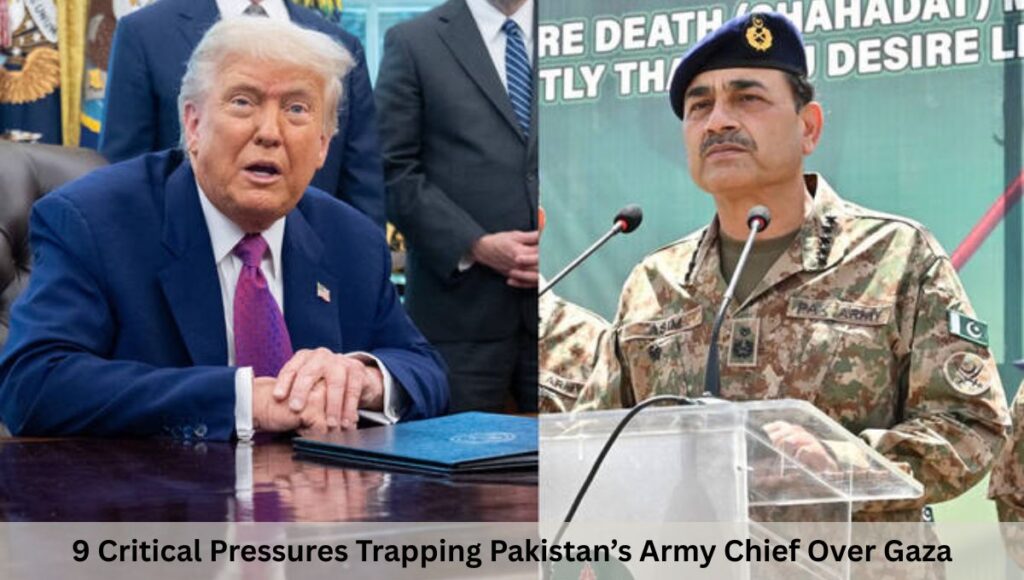
9 Critical Pressures Trapping Pakistan’s Army Chief Over Gaza
Why Washington Wants Pakistan in Gaza
The US push is rooted in President Donald Trump’s 20-point Gaza peace plan, which envisions a multinational stabilisation force overseeing Gaza’s transition after more than two years of devastating war.
Under the plan, the force would:
- Supervise security during a transition phase
- Facilitate reconstruction and economic recovery
- Support political reorganisation in Gaza
- Operate without US ground troops
Washington has been pressing Muslim-majority countries with experienced militaries to take part, arguing that such participation would lend legitimacy and reduce perceptions of Western occupation.
Pakistan, the world’s only Muslim-majority nuclear power with a battle-hardened army and long experience in UN peacekeeping, sits high on that list.
Trump and Munir: A Relationship Unlike Any Other
One factor complicating the decision is Munir’s unusually close relationship with Trump.
Munir has met Trump three times in six months, an extraordinary frequency for a foreign military chief. In June, Trump hosted Munir for a private White House lunch—the first time a US president has met Pakistan’s army chief alone, without civilian leaders present.
Analysts say the meetings reflect Washington’s view that Munir—not Pakistan’s elected government—is the key decision-maker on security and foreign policy.
Munir has actively worked to repair relations with the US after years of mistrust following the Afghanistan withdrawal and Pakistan’s growing ties with China.
Why Saying No Could Anger Trump
Refusing the request risks alienating a US president known for transactional diplomacy and unpredictable retaliation.
Michael Kugelman, Senior Fellow at the Atlantic Council, captured the concern bluntly:
“Not contributing could annoy Trump, which is no small matter for a Pakistani state keen to remain in his good graces—largely to secure US investment and security aid.”
Pakistan’s military remains dependent on:
- US military assistance and spare parts
- Training programs
- Diplomatic cover in international forums
The US recently approved a USD 686 million F-16 sustainment package, a move closely watched by India and welcomed in Rawalpindi. A rupture now could jeopardise future cooperation.
The Gaza Stabilisation Force: What Is Being Asked
Structure and Command
According to US officials and Axios reporting:
- The force would be led by a two-star US general
- A coordination headquarters has been set up in Israel
- US troops would not deploy on the ground
Countries invited include Pakistan, Egypt, Jordan, Qatar, Indonesia, Malaysia, the UAE, France, the UK, Italy and Azerbaijan.
The Hamas Question
Israel insists that any stabilisation force must ultimately help disarm Hamas, Gaza’s Islamist militant group. This is where hesitation sets in.
Few governments are willing to place their troops in a role that could:
- Trigger direct clashes with Hamas
- Be perceived as enforcing Israeli objectives
- Drag forces into a prolonged insurgency
Pakistan’s Foreign Minister Ishaq Dar has already drawn a line, stating that while peacekeeping may be considered, “disarming Hamas is not our job.”
Why Gaza Is Uniquely Sensitive in Pakistan
A Long-Standing Anti-Israel Position
Pakistan has never recognised Israel. Its passport explicitly bars travel to Israel, and its founding leader Muhammad Ali Jinnah opposed the creation of a Jewish state in 1948.
Over decades, Israel has been framed in Pakistani discourse as:
- An occupier of Palestinian land
- A close strategic partner of India
- A symbol of Western double standards
Pakistan did not join the Abraham Accords and maintains that recognition can only follow the creation of a Palestinian state with East Jerusalem as its capital.
Gaza War and Public Anger
The Gaza war that erupted in October 2023 dramatically intensified emotions.
Pakistan’s government:
- Accused Israel of genocide
- Called Prime Minister Benjamin Netanyahu a terrorist
- Supported war crimes investigations
Large protests swept major cities, drawing tens of thousands. Islamist parties, clerics and civil society groups united around Gaza in rare consensus.
Any Pakistani troop deployment—especially under a US-backed framework—would immediately face accusations of betrayal.
Islamist Groups and Street Power
Pakistan’s Islamist movements retain the ability to mobilise quickly and violently.
One particularly influential hardline group, Tehreek-e-Labbaik Pakistan (TLP), has:
- Shut down cities through protests
- Attacked police and state institutions
- Used religious rhetoric to justify violence
Though the government banned the group in October and arrested over 1,500 supporters, security officials acknowledge its ideology remains potent. A Gaza deployment could become a rallying cry for renewed unrest.
Imran Khan Factor: A Political Wildcard
Munir also faces hostility from supporters of jailed former Prime Minister Imran Khan. Despite imprisonment, Khan’s party emerged as the largest force in the 2024 elections, demonstrating enduring public support.
PTI supporters view Munir as:
- Architect of Khan’s downfall
- Symbol of military overreach
Any controversial foreign deployment could be seized upon to mobilise protests, adding political instability to religious anger.
Munir’s Personal Image at Stake
Munir has carefully cultivated an image as a devout Muslim and defender of Islamic values. A deployment to Gaza under US leadership risks undermining that narrative.
Abdul Basit of Singapore’s S. Rajaratnam School of International Studies warned:
“People will say Asim Munir is doing Israel’s bidding. It would be foolish not to see it coming.”
Such perceptions could erode his legitimacy among rank-and-file soldiers as well as the public.
Why Munir Has More Power Than Any General Before Him
Ironically, Munir faces this dilemma at the height of his power.
Recent developments have given him:
- Appointment as Chief of the Defence Forces
- Control over army, navy and air force
- Extension of tenure until 2030
- Lifetime title of Field Marshal
- Constitutional immunity from prosecution
Few individuals in Pakistan’s history have enjoyed such institutional protection.
As Kugelman put it:
“Few people in Pakistan enjoy the luxury of being able to take risks more than Munir. He has unbridled power, now constitutionally protected.”
Yet power does not eliminate political consequences.
Regional Reactions and Muslim World Politics
Munir has recently met leaders from:
- Saudi Arabia
- Turkey
- Qatar
- Jordan
- Egypt
- Indonesia
- Malaysia
Analysts believe these engagements are part of consultations over Gaza. However, reactions within the Muslim world are mixed.
Countries like Turkey and Qatar maintain sympathetic positions toward Hamas, while Egypt and Jordan remain wary of deeper involvement. Pakistan risks alienating one bloc or another regardless of its decision.
What Happens If Pakistan Says Yes
If Islamabad agrees to deploy troops:
- Protests could erupt nationwide
- Islamist mobilisation could intensify
- Political instability may deepen
- Pakistan’s forces risk entanglement in Gaza
The mission’s unclear mandate and Israel’s expectations raise the risk of mission creep.
What Happens If Pakistan Says No
If Pakistan declines:
- Relations with Trump could sour
- Military cooperation may slow
- Investment and diplomatic support could suffer
Given Trump’s transactional style, even a refusal framed diplomatically carries risk.
A Familiar Pakistani Pattern
Pakistan’s military establishment has often relied on external alliances for resources and legitimacy, even when doing so created internal tensions—from Cold War alliances to the War on Terror.
Munir’s dilemma fits that historical pattern: balancing domestic stability against external dependence.
Conclusion: No Safe Exit for Munir
Asim Munir’s Gaza dilemma has no clean solution. Sending troops risks public fury and political instability. Refusing risks angering a powerful US president whose goodwill Pakistan actively seeks.
The decision will shape:
- Pakistan’s regional standing
- Civil-military relations
- Internal stability
- Munir’s legacy as the most powerful general of his era
For all his authority, Munir now confronts a truth that has defined Pakistan’s history:
external pressure and internal politics rarely align—and someone always pays the price.
Whichever path he chooses, the consequences will reverberate far beyond Gaza.
Also Read: Trump Hosts Pakistan’s Munir, Claims Credit for Averting War
Also Read: Pakistani military chief set for Washington trip over Gaza force