20-Point Breakthrough: Trump-Led Peace Plan That Could End the Russia-Ukraine War, outlined by Zelensky. After nearly four years of full-scale conflict, mounting casualties, and deepening global consequences, a new diplomatic effort has revived cautious optimism that the Russia-Ukraine war could finally be approaching a turning point.
Ukrainian President Volodymyr Zelensky has unveiled the outlines of a comprehensive 20-point peace plan, developed with the United States and now forwarded to Moscow for consideration.
The proposal, shaped during intensive talks between Ukrainian and US negotiators and championed by US President Donald Trump, represents the most detailed framework yet aimed at halting fighting that began with Russia’s invasion of Ukraine in February 2022.
While far from guaranteed, the plan lays out ceasefire mechanisms, security guarantees, economic reconstruction, humanitarian measures, and conditional compromises on territory.
Zelensky has described the document as a “foundational framework” for ending the war—one that balances Ukraine’s core red lines on sovereignty with pragmatic steps designed to test Russia’s willingness to negotiate seriously.
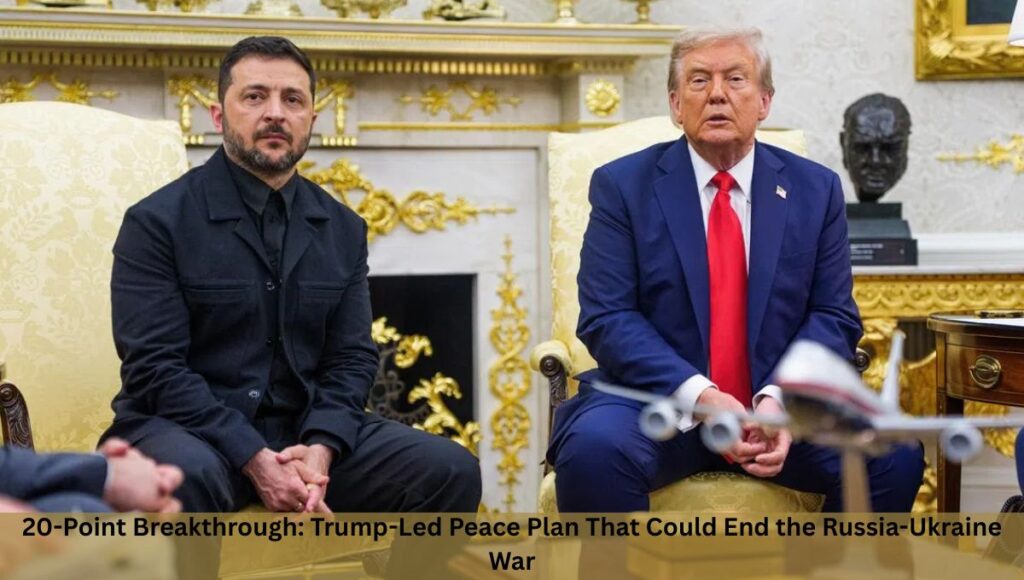
20-Point Breakthrough: Trump-Led Peace Plan That Could End the Russia-Ukraine War
A Trump-Led Push for Peace
Donald Trump has repeatedly claimed that resolving the Ukraine conflict is one of his highest foreign policy priorities.
Speaking to reporters, he acknowledged the “tremendous hatred” between Russian President Vladimir Putin and Zelensky, while insisting that sustained US engagement could still force progress.
The Trump administration’s peace initiative has been spearheaded by US special envoy Steve Witkoff and senior advisers, with negotiations taking place across several locations, including Berlin, Florida, and Miami.
Separate meetings were held with Ukrainian, European, and Russian representatives, reflecting Washington’s attempt to position itself as the central broker in a highly polarised conflict.
According to Zelensky, consensus has been reached on many aspects of the plan between Kyiv and Washington. The unresolved questions—particularly over territory—have been deliberately deferred to higher-level political decisions.
What Is the 20-Point Peace Plan?
The 20-point peace plan, as described by Zelensky in briefings with journalists and reported by AFP, Reuters, and the Associated Press, does not yet exist as a publicly released draft document.
Instead, its contents have been outlined point by point, offering a rare window into the most ambitious attempt yet to freeze or end the war.
At its core, the framework aims to establish an immediate ceasefire, lock in long-term security guarantees for Ukraine, and create conditions for post-war recovery—while avoiding explicit recognition of Russian territorial gains.
Reaffirming Ukraine’s Sovereignty
The first and most fundamental element of the plan is a formal reaffirmation of Ukraine’s sovereignty.
All signatories would explicitly recognise Ukraine as a sovereign state, an essential demand for Kyiv given Russia’s repeated questioning of Ukraine’s legitimacy.
This provision is designed to anchor the entire agreement in international law and prevent future reinterpretations that could undermine Ukraine’s independence.
A Binding Non-Aggression Pact
The plan calls for a full and unconditional non-aggression agreement between Russia and Ukraine.
To ensure compliance, a sophisticated monitoring mechanism would be established along the line of contact, relying on space-based and unmanned surveillance technologies.
Technical teams from both sides would be tasked with defining operational details, early-warning systems, and dispute-resolution procedures to address violations before they escalate into renewed fighting.
Security Guarantees That Mirror NATO’s Article 5
Perhaps the most consequential aspect of the proposal is the promise of strong security guarantees for Ukraine.
Under the plan, the United States, NATO, and European signatory states would provide guarantees that “mirror Article 5,” the alliance’s collective defence clause.
If Russia were to invade Ukraine again, the guarantees would trigger:
- A coordinated military response by guarantor states
- The automatic reinstatement of all global sanctions against Russia
However, the guarantees would be voided if Ukraine were to launch an unprovoked attack on Russian territory.
Zelensky has stressed that this conditionality is intended to reassure Western partners while deterring renewed Russian aggression.
Ukraine’s Armed Forces: No Demilitarisation
Contrary to long-standing Russian demands, the plan explicitly allows Ukraine to maintain a peacetime military strength of 800,000 personnel.
This provision rejects the notion of a demilitarised Ukraine and reflects Kyiv’s insistence that lasting peace requires credible self-defence.
For Ukraine, retaining a strong army is non-negotiable, especially after repeated violations of past ceasefire agreements by Moscow.
Europe, the EU, and Ukraine’s Future
The framework proposes that Ukraine become a member of the European Union within a defined timeframe, alongside immediate privileged access to European markets.
While EU accession remains a complex and lengthy process, the inclusion of a timeline signals political commitment from Brussels and Washington.
This element of the plan underscores Ukraine’s strategic orientation toward Europe and its desire to lock in irreversible integration with Western institutions.
A $200 Billion Reconstruction Vision
Economic recovery forms a central pillar of the peace plan. Zelensky estimates that Ukraine’s war-related losses exceed $800 billion, making reconstruction one of the largest challenges Europe has faced since World War II.
Key proposals include:
- A Ukraine Development Fund targeting high-growth sectors such as technology, data centres, and artificial intelligence
- Joint US-Ukrainian investment in gas pipelines, storage facilities, and energy infrastructure
- Massive rebuilding of cities, housing, and transport networks destroyed by the war
- World Bank-backed financing packages to accelerate recovery
In addition, the US and European partners would establish a capital and grants fund of up to $200 billion, designed to attract private investment under transparent global standards.
Free Trade With the United States
Following the conclusion of the agreement, Ukraine would accelerate negotiations toward a free trade agreement with the United States, deepening economic ties and providing Kyiv with preferential access to the world’s largest economy.
This provision is intended to anchor Ukraine’s recovery in long-term trade relationships rather than short-term aid.
Nuclear Commitments and Zaporizhzhia Plant
Ukraine would reaffirm its status as a non-nuclear state under the Non-Proliferation Treaty. At the same time, the fate of the Zaporizhzhia nuclear power plant—Europe’s largest—emerges as one of the most contentious issues.
The US proposal envisions joint operation by Ukraine, the United States, and Russia. Zelensky has expressed strong reservations, instead proposing a joint US-Ukrainian venture without Russian involvement, a stance Moscow is unlikely to accept.
Territory: The Hardest Question
Territorial control remains the most explosive issue in any Russia-Ukraine ceasefire deal.
Under the plan:
- Current troop positions in Donetsk, Luhansk, Zaporizhzhia, and Kherson would be recognised de facto as the line of contact
- Russia would be required to withdraw from Dnipropetrovsk, Mykolaiv, Sumy, and Kharkiv regions
A working group would later determine future redeployments, potential demilitarised zones, and the creation of special or free economic zones.
Zelensky has suggested that Ukraine could withdraw heavy forces from parts of Donbas it still controls—only if Russia mirrors the pullback—effectively creating a demilitarised buffer monitored by international forces.
Demilitarised and Free Economic Zones
The concept of demilitarised or free economic zones is presented as a compromise between Russia’s demand that Ukraine cede territory and Kyiv’s refusal to surrender sovereignty.
Any such zones would:
- Remain under Ukrainian administration and policing
- Be monitored by international forces along the contact line
- Require approval by Ukraine’s parliament or a nationwide referendum
Zelensky has made clear that “Russian police” or administrations would have no role in these areas.
Humanitarian Measures and Prisoner Exchanges
The plan establishes a humanitarian committee to address unresolved human suffering caused by the war.
Key commitments include:
- An all-for-all exchange of prisoners of war, including those held since 2014
- The return of detained civilians, political prisoners, and children taken to Russia
- Measures to assist victims and rebuild shattered communities
These steps are widely seen as confidence-building measures that could make a ceasefire more durable.
Elections and Referendum in Ukraine
Ukraine would be required to hold national elections as soon as possible after the agreement is signed.
Zelensky has emphasised that elections or referendums cannot be held under fire and would require at least 60 days of genuine ceasefire conditions.
Any final territorial arrangements, he has said, would be put to a nationwide referendum, allowing Ukrainians to decide whether the deal is acceptable.
Enforcement: A Peace Council Chaired by Trump
To guarantee implementation, the agreement would be legally binding and overseen by a Peace Council chaired by President Donald Trump.
The council would include Ukraine, Russia, the United States, NATO, and European partners.
Sanctions and other penalties would automatically apply in case of violations, addressing one of Ukraine’s long-standing concerns about unenforced agreements.
Russia’s Position: Skepticism and Silence
The Kremlin has confirmed that President Putin has been briefed on the proposal and that Moscow will formulate its response.
However, Russian officials have so far declined to discuss specifics, calling public debate “counterproductive.”
Putin has repeatedly insisted that Ukraine must cede large portions of the Donbas, a demand that remains incompatible with Kyiv’s position.
Can This Plan Really End the War?
The 20-point Trump-led peace plan represents the most comprehensive attempt yet to bridge irreconcilable positions in the Russia-Ukraine war.
It offers Ukraine security guarantees and economic recovery while testing whether Russia is willing to compromise under sustained US pressure.
Whether it succeeds will depend on Moscow’s response—and on whether the international community is prepared to enforce the agreement’s guarantees with real consequences. For now, the ball is firmly in Vladimir Putin’s court.
If accepted, the plan could halt one of Europe’s bloodiest conflicts in generations. If rejected, it may still mark the final exhaustion of diplomatic options before the war enters an even more dangerous phase.
Also Read: 28-Point ‘Secret’ US-Russia Peace Plan: Inside Trump’s Bold Ukraine Gamble
Also Read: Ukraine and US agree updated 20-point peace plan after Moscow hit by another deadly bombing
Related Posts:
- 3 Explosive Conditions Iran Sets to End War with US…
- Trump’s 20-Point Gaza Peace Plan Gains Urgent Global…

- 7 Powerful Measures: Trump Sanctions Russian Oil…

- 5 Major Takeaways from the US Supreme Court's…

- 9 Explosive Claims as Trump Says US Winning Iran War

- 10 Powerful Revelations from the Trump–Putin Call on…