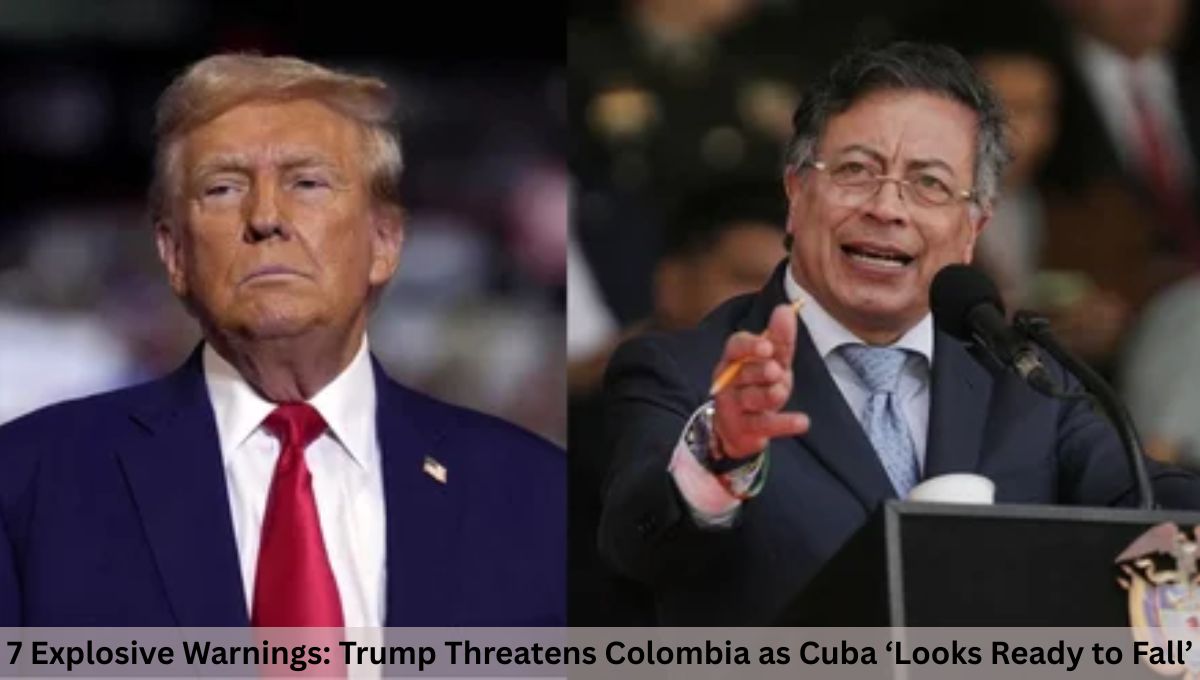
7 Explosive Warnings: Trump Threatens Colombia as Cuba ‘Looks Ready to Fall,’ sparking global alarm. United States President Donald Trump has issued a series of stark warnings across Latin America, openly threatening Colombia’s President Gustavo Petro, declaring that Cuba appears “ready to fall,” and asserting that Washington is now effectively “in charge” of Venezuela following the dramatic U.S. military operation that captured President Nicolás Maduro.
Trump’s remarks, delivered aboard Air Force One, come amid intensifying international outrage over what critics describe as an unprecedented and dangerous escalation of American power in the Western Hemisphere.
Multiple governments—including Brazil, Chile, Colombia, Mexico, Uruguay, and Spain—have condemned the operation as a violation of international law and a destabilizing precedent for regional security.
What began as a U.S.-described law-enforcement mission to arrest Maduro on narco-terrorism charges has rapidly expanded into a broader geopolitical confrontation—raising fears that Venezuela may be only the beginning.
7 Explosive Warnings: Trump Threatens Colombia as Cuba ‘Looks Ready to Fall’
Trump Threatens Colombia’s President Gustavo Petro
Trump’s most provocative comments were directed at Colombian President Gustavo Petro, whom he accused—without evidence—of enabling drug production and trafficking into the United States.
“Colombia is very sick, run by a sick man who likes making cocaine and selling it to the United States,” Trump said. “And he’s not going to be doing it very long.”
When reporters asked whether he was suggesting a U.S. military operation against Colombia similar to Venezuela, Trump replied bluntly:
“Sounds good to me.”
The remarks marked the most explicit threat yet against a U.S. ally in the region and immediately triggered alarm across Latin America.
Petro Responds: ‘Latin America Must Unite’
President Petro responded sharply, accusing Trump of slander and warning that the region risks being treated as subservient unless it acts collectively.
In a series of lengthy posts on X, Petro wrote that the United States had carried out:
“The first bombing of a South American capital in all of human history.”
However, he stressed that retaliation was not the answer.
Instead, Petro called for Latin American unity, urging the region to strengthen political, economic, and diplomatic cooperation beyond dependence on Washington.
“We do not look only to the north,” Petro wrote. “We look in all directions.”
Colombia has since mobilized 30,000 troops along its eastern border with Venezuela, citing fears of refugee flows and regional destabilization.
After Maduro’s Capture, Trump Says the US Is ‘In Charge’
Trump’s threats followed the U.S. military operation—known as Operation Absolute Resolve—that resulted in the seizure of Venezuelan President Nicolás Maduro and his wife Cilia Flores in Caracas.
Maduro has been flown to New York, where he awaits a court appearance on charges including:
- Narco-terrorism conspiracy
- Drug trafficking
- Weapons-related offenses
Trump insisted that Washington now effectively controls Venezuela.
“Don’t ask me who’s in charge,” Trump said. “It would be very controversial. But it means we’re in charge.”
Despite Venezuela’s Supreme Court appointing Vice President Delcy Rodríguez as interim leader, Trump said the United States would intervene again if the new leadership “doesn’t behave.”
Second Strike Threatened Against Venezuela
Trump confirmed that the U.S. military had prepared for a second wave of attacks and warned that further strikes remain an option.
“If they do not behave, we will carry out a second strike,” he said.
Although Trump claimed no American personnel were killed—despite one helicopter being badly damaged—Venezuelan officials say soldiers, civilians, and members of Maduro’s security detail died during the operation.
On the ground, residents near Caracas described homes destroyed, explosions, and chaos, with families scrambling for food and medicine amid fears of renewed attacks.
‘Cuba Is Ready to Fall,’ Trump Declares
Trump also turned his attention to Cuba, asserting that the island nation is nearing collapse following the disruption of Venezuelan oil supplies.
“Cuba is ready to fall. Cuba looks like it’s ready to fall,” Trump said. “They got all of their income from Venezuela. They’re not getting any of it.”
Trump suggested that direct U.S. military intervention in Cuba may not be necessary, arguing that economic pressure alone could bring down the government.
These remarks followed confirmation from Havana that 32 Cuban military and intelligence officers were killed during the U.S. raid in Venezuela—losses Cuba described as occurring during “fierce resistance.”
Rubio: ‘If I Lived in Havana, I’d Be Concerned’
U.S. Secretary of State Marco Rubio, a longtime critic of Cuba and Venezuela, reinforced Trump’s warnings.
“If I lived in Havana and I worked in the government, I’d be concerned,” Rubio said.
Rubio has previously argued that Cuban intelligence and security services were central to propping up Maduro’s rule, making Havana a potential next target of U.S. pressure.
Mexico Also Put on Notice
Trump extended his warnings to Mexico, accusing drug cartels of effectively running the country.
“The cartels are running Mexico whether you like it or not,” Trump said.
While describing Mexican President Claudia Sheinbaum as a “terrific person,” Trump said he had repeatedly offered to deploy U.S. troops to fight cartels—offers Mexico has rejected.
“Something will have to be done,” Trump warned.
Mexico has condemned the Venezuela operation as a violation of the UN Charter, warning that unilateral military actions threaten regional stability.
The ‘Don-roe Doctrine’: Trump’s Hemispheric Vision
Trump has openly framed his actions as a revival—and expansion—of the Monroe Doctrine, the 19th-century policy asserting U.S. dominance in the Americas.
He now refers to his modern version as the “Don-roe Doctrine.”
“American dominance in the Western Hemisphere will never be questioned again,” Trump said.
Analysts argue that this marks a decisive shift away from multilateral diplomacy toward coercive regime pressure across Latin America.
Regional and Global Backlash Grows
Latin America
A joint statement from Brazil, Chile, Colombia, Mexico, Uruguay, and Spain warned that the U.S. actions:
“Contravene fundamental principles of international law and constitute a dangerous precedent for peace and regional security.”
Europe
Most EU states called for restraint, though divisions remain. Italy and Israel expressed support for Washington’s actions, while France and Spain strongly criticized the intervention.
United Nations
UN Secretary-General Antonio Guterres said he was “deeply alarmed,” warning that abducting a sitting head of state could set a perilous global precedent.
Oil, Power, and Control
Trump has denied that the operation was about oil—while simultaneously stating that U.S. companies would rebuild Venezuela’s oil infrastructure and extract wealth from the country.
“We need full access to oil and other resources in Venezuela,” Trump said.
Venezuela holds the largest proven oil reserves in the world, estimated at over 300 billion barrels, making control of its energy sector geopolitically significant.
Is Regime Change the Goal?
Political analysts say Trump’s strategy appears aimed at reshaping Latin America’s political landscape.
David Smith of the University of Sydney noted that Trump often relies on short, spectacular displays of force to coerce compliance without prolonged warfare.
Others argue that Washington is actively favoring right-wing governments, backing leaders like Argentina’s Javier Milei while undermining left-leaning administrations.
Why Cuba Could Be Next
Experts say Cuba remains the most likely next flashpoint due to:
- Longstanding U.S.–Cuba hostility
- Economic dependence on Venezuela
- Strong Cuban-American political influence in Florida
“I would be more concerned if I were in Cuba than Colombia,” said political scientist Matthew Wilson.
Conclusion: A Hemisphere on Edge
Trump’s threats against Colombia, warnings to Mexico, and declaration that Cuba is ‘ready to fall’ have pushed Latin America into its most volatile moment in decades.
With Venezuela under effective U.S. control, troops mobilizing across borders, and global powers watching closely, the future of the Western Hemisphere appears increasingly uncertain.
Whether Trump’s rhetoric translates into further military action—or succeeds in coercing compliance without war—may determine the region’s stability for years to come.
Also Read: $28 Million Cocaine Bust: 7 Stunning Facts Behind the Record USCG Seizures
Also Read: Trump threatens Cuba, Mexico, Colombia, Iran, Greenland and India – all in a matter of few hours