

$28 Million Cocaine Bust: 7 Stunning Facts Behind the Record USCG Seizures that shattered an 18-Year drug seizure record. In one of the most significant maritime drug busts in decades, the U.S. Coast Guard (USCG) seized more than 3,700 pounds of cocaine worth an estimated $28 million just off Miami Beach, charging three men in what officials describe as the largest small-boat cocaine seizure since 1995.
Thank you for reading this post, don't forget to subscribe!The stunning operation unfolded barely two miles east of Government Cut, underscoring both the boldness of traffickers and the escalating intensity of U.S. maritime interdiction efforts. The Miami seizure was soon eclipsed in sheer volume by a record-breaking 20,000-pound cocaine bust in the Eastern Pacific, marking the largest at-sea interdiction in nearly 18 years.
Together, the seizures spotlight an aggressive new phase in the U.S. fight against transnational drug trafficking networks.
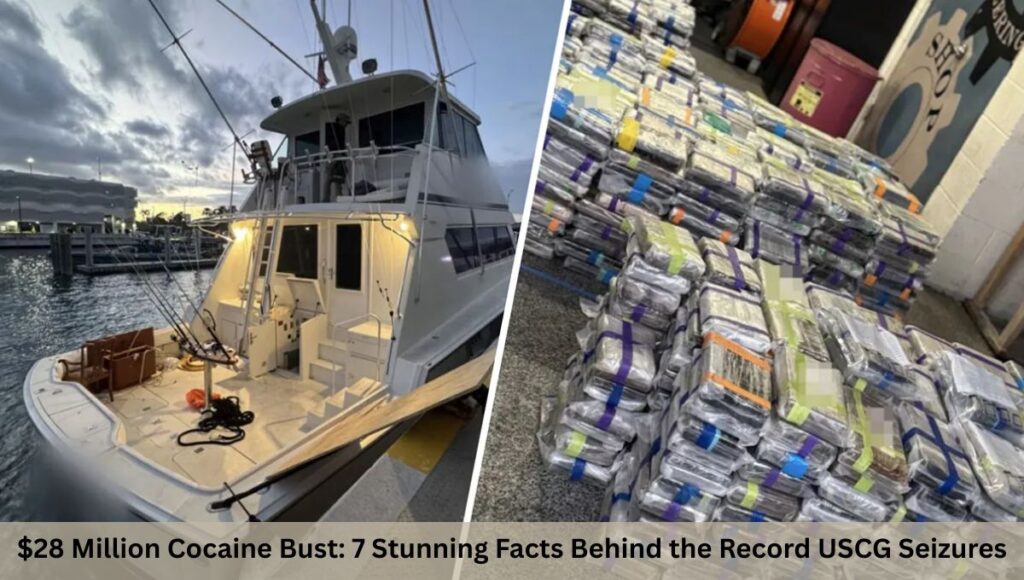
$28 Million Cocaine Bust: 7 Stunning Facts Behind the Record USCG Seizures
Historic Miami Beach Cocaine Bust: What Authorities Found
Routine Safety Check Turns into a Massive Seizure
The operation began Tuesday when members of U.S. Coast Guard Station Miami Beach boarded a 65-foot sports fishing vessel named the “Best Bet” for what was initially described as a routine safety inspection.
What officers found was anything but routine.
According to authorities, the vessel had failed to check in with U.S. Customs and Border Protection (CBP)—a violation that prompted Coast Guard officials to escort the boat to base for further inspection.
“This was the largest USCG Small Boat Station cocaine seizure since 1995,”
— Lt. Matthew Ross, Commanding Officer, USCG Station Miami Beach
Hidden Compartments and Over 1,000 Cocaine Packages
Once docked, CBP’s Office of Field Operations deployed a K-9 unit, which immediately alerted officers to the presence of narcotics.
A detailed physical search uncovered hidden compartments packed with more than 1,000 individually wrapped packages of cocaine, weighing approximately 3,715 pounds in total.
The estimated street value: $28 million.
Who Was Arrested
According to arrest reports, the men taken into custody were:
- Joseito Diaz De Oleo – Captain of the vessel
- Erasme Catalino Paulino Rodriguez – Crew member
- Ober Alexander Villavicencio Jimenez – Crew member
Federal agents transported the trio into custody following the discovery. Attorneys for the men could not be reached, and it remains unclear whether they remained jailed as of Friday night.
Smuggling Plot: Recruited in the Dominican Republic
$100,000 Offer for a High-Risk Run
Two of the suspects reportedly confessed details of the smuggling operation, revealing they were recruited in the Dominican Republic.
According to investigators:
- The men were hired to retrieve a boat in Miami
- They were instructed to travel to a location near Turks and Caicos
- Payment promised: $100,000 upon successful delivery
Off the coast near Turks and Caicos, a smaller fishing vessel pulled alongside, transferring duffel bags filled with cocaine onto the Best Bet. The drugs were then concealed in the vessel’s hidden compartments before the boat headed back toward Miami—where it was ultimately intercepted.
Whole-of-Government Operation Lauded
Coast Guard, CBP, HSI Work Together
The Miami Beach seizure involved coordinated efforts among:
- U.S. Coast Guard Station Miami Beach
- CBP Air and Marine Operations (AMO)
- Homeland Security Investigations (HSI)
- CBP Office of Field Operations K-9 teams
Andy Blanco, Executive Director of CBP Air and Marine Operations Southeast Region, emphasized the significance of the collaboration. “Disrupting maritime narcotics smuggling like this demonstrates the power of teamwork in safeguarding our nation,” Blanco said. “Smugglers should be warned—they will be caught.”
Record-Breaking Seizure in the Eastern Pacific
20,000 Pounds of Cocaine Intercepted
While the Miami bust was historic, it was soon overshadowed by an even larger operation in the Eastern Pacific, where the USCG Cutter Munro, based in Alameda, California, seized more than 20,000 pounds of cocaine—the largest at-sea seizure in nearly two decades.
The interdiction occurred during Operation Pacific Viper, a sweeping campaign targeting maritime drug routes used by cartels originating in Central and South America, including Colombia and Venezuela.
Dramatic Chase and Vessel Disablement
The Coast Guard released video footage showing:
- A “go-fast” vessel attempting to flee
- Helicopters and maritime units in pursuit
- Precision fire used to disable the non-compliant vessel
Once stopped, the cutter Munro seized the illicit cargo. Officials declined to disclose details about the individuals aboard the intercepted vessel, stating only that the primary mission remains stopping drugs before they reach U.S. shores.
Why These Seizures Matter
A Blow to Transnational Criminal Organizations
Officials say the seizures represent a major disruption to cartel supply chains, depriving criminal organizations of hundreds of millions of dollars in revenue.
According to the Department of Homeland Security:
- Operation Pacific Viper has averaged 1,600 pounds of cocaine seized daily since August 2025
- More than 100,000 pounds seized under the operation alone
- Total cocaine seizures in fiscal year 2025 exceeded 510,000 pounds, an all-time record
Escalating Tactics and Growing Controversy
Lethal Force and Legal Questions
The Trump administration has backed aggressive maritime enforcement, including the use of lethal force against suspected drug boats. While officials defend the strategy as necessary, it has sparked controversy among lawmakers and human rights advocates—particularly in cases involving survivors of destroyed vessels.
Despite the debate, Coast Guard leadership remains firm. “We own the sea,” said Admiral Kevin Lunday, Acting Commandant of the USCG. “This historic amount of cocaine seized shows we are defeating cartel operations.”
International Drug Busts Add Pressure
The U.S. seizures come as Colombian authorities also reported major success, intercepting more than seven tons of cocaine in the Caribbean and arresting 11 suspects earlier this week. That haul alone was valued at over $340 million, demonstrating the sheer scale of global narcotics trafficking.
Skill and Precision at Sea
Recent footage from the Eastern Pacific highlights the Coast Guard’s evolving tactics, including sniper interventions from helicopters, designed to stop fast-moving vessels without endangering lives.
Officials describe these operations as examples of:
- Advanced maritime technology
- High-level coordination
- Split-second decision-making in high-risk environments
What Happens Next
Operation Pacific Viper Expands
The Coast Guard has confirmed that Operation Pacific Viper will continue, with intensified maritime and aerial patrols across the Eastern Pacific and Caribbean.
Federal agencies say they remain committed to a whole-of-government approach aimed at dismantling:
- Transnational criminal organizations
- Narco-trafficking networks
- Human smuggling operations
Legal proceedings against suspects in both the Miami and Pacific cases are expected to unfold in the coming weeks.
Conclusion
From a seemingly routine safety inspection off Miami Beach to the largest Pacific cocaine interception in nearly two decades, recent Coast Guard operations underscore a clear message: maritime drug smugglers are under unprecedented pressure.
With record seizures, advanced enforcement tactics, and international coordination, U.S. authorities say the tide may finally be turning in the long-running war against narcotics trafficking—though the risks and controversies surrounding these operations remain far from settled.
Also Read: Insights from Pakistan Navy’s $1 Billion Arabian Sea Drug Seizure
Also Read: Coast Guard offloads a record $362 million worth of cocaine at Port Everglades in Fort Lauderdale
Related Posts:
- Insights from Pakistan Navy’s $1 Billion Arabian Sea…
- 7 Stunning Implications of Trump’s Dramatic…

- 9 Alarming Moments as Australian Police Foil New…

- 9 Explosive Signals as Trump Warns Maduro and U.S.…

- 7 Explosive Warnings: Trump Threatens Colombia as…
- 9 Facts About Trump’s Drug Boat Strikes That Shook the World
