

7 Alarming Developments: Deadly Pakistan–Taliban Clashes Shatter Fragile Ceasefire amid rising border tensions and militant violence. Fresh deadly clashes have once again erupted along the Pakistan–Afghanistan border, deepening one of South Asia’s most volatile security crises.
Thank you for reading this post, don't forget to subscribe!Both Pakistan and Afghanistan’s Taliban government accuse each other of launching “unprovoked firing”, breaking a fragile ceasefire brokered just weeks ago in Qatar and Turkey. At least four Afghan civilians were killed, while three Pakistanis suffered injuries as heavy artillery, mortars and small-arms fire were exchanged near the key border crossings of Spin Boldak and Chaman.
Footage from the scene showed panicked residents fleeing the Afghan border town, reviving memories of the October clashes that killed more than 70 people on both sides. The renewed conflict comes on the heels of failed peace talks in Saudi Arabia, further escalating tensions surrounding militancy, border control and longstanding grievances between Kabul and Islamabad.
Below is a full report on the 7 most alarming developments shaping this fast-moving crisis.
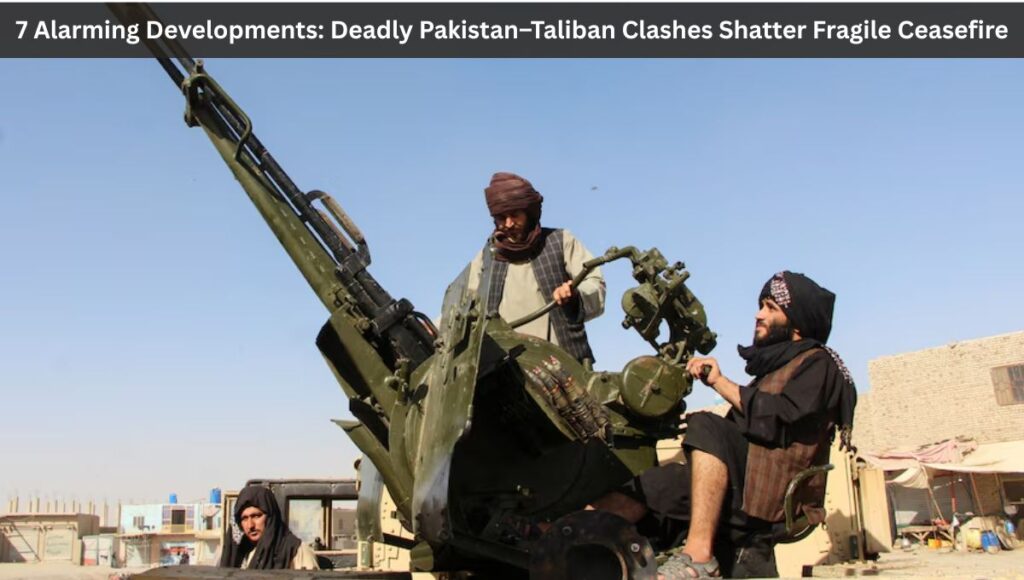
7 Alarming Developments: Deadly Pakistan–Taliban Clashes Shatter Fragile Ceasefire
1. Four Afghan Civilians Killed as Heavy Fire Erupts Overnight
According to Afghan officials, the latest confrontation erupted late Friday night around 10:30pm local time. Afghanistan’s governor for Spin Boldak confirmed that four civilians were killed when Pakistani forces allegedly launched artillery and mortar strikes into residential areas. Local hospitals in Kandahar received multiple bodies, with officials reporting that the shelling struck homes, triggering chaos and mass displacement.
Residents told AFP that heavy fire lasted up to two hours, creating widespread fear that the violence could spread deeper into border communities. On the Pakistani side, the hospital in Chaman reported three minor injuries, with patients discharged shortly after treatment.
2. Both Sides Blame Each Other for Starting the “Unprovoked” Attack
The exchange of accusations has become a familiar pattern between Pakistan and the Taliban:
Pakistan’s Position
Pakistan’s Prime Minister’s spokesperson Mosharraf Zaidi accused Afghan forces of carrying out “unprovoked firing”.
He said:
“An immediate, befitting & intense response has been given by our armed forces… Pakistan remains fully alert & committed to ensuring its territorial integrity & the safety of our citizens.”
Pakistani media also reported that Afghan mortar shells struck areas near the Badani region, prompting Pakistan’s military to return fire.
Afghanistan’s Position
In contrast, Taliban spokesman Zabihullah Mujahid said:
“Pakistan once again initiated attacks towards Spin Boldak.”
He insisted Afghan forces were compelled to respond in order to prevent further casualties and damage. Afghan officials claimed Pakistan used both light and heavy artillery, hitting civilian zones during the exchange.
3. Ceasefire Fragility Exposed After Failed Saudi Peace Talks
The clashes come immediately after peace talks in Saudi Arabia failed to produce a breakthrough, despite optimistic statements that a fragile ceasefire would continue.
Over the past year, negotiations hosted in:
- Qatar (Doha)
- Turkey (Istanbul)
- Saudi Arabia (Riyadh)
have tried—but failed—to create a lasting framework to manage border security and militant threats. Sources familiar with the latest round of Saudi talks told BBC News that the ceasefire would continue, but the renewed violence appears to have shattered that reassurance within days.
4. Rising Militancy: Pakistan Intensifies Pressure on Taliban
One of the most contentious issues fueling the border conflict is Pakistan’s accusation that Afghan soil is being used by militants—especially the Tehrik-e-Taliban Pakistan (TTP)—to conduct deadly attacks inside Pakistan. The TTP, often described as the ideological twin of the Afghan Taliban, has escalated its campaign against Pakistani security forces in recent months.
Just days before the latest border clash:
- A roadside bombing killed three Pakistani police officers
- Pakistan blamed TTP militants operating out of Afghanistan
- Islamabad claimed Afghan nationals increasingly appear in suicide and terror plots
Pakistan also alleges that:
- Balochistan Liberation Army (BLA) militants find sanctuary across the border
- Afghan territory is used by Islamic State’s Khorasan Province (ISKP) fighters
Afghanistan rejects all accusations, saying Pakistan is attempting to shift responsibility for its “own security failures.”
5. Taliban Accuses Pakistan of Conducting Air Strikes Inside Afghanistan
Adding to the tensions is the Taliban’s accusation that Pakistan recently conducted air strikes in eastern Afghanistan, killing 10 civilians including nine children and a woman. The alleged strike took place in late November in Khost province.
Pakistan has categorically denied carrying out any such attack, calling the reports “baseless.” Nevertheless, Taliban officials have used these allegations to frame Pakistan as intentionally escalating tensions, both militarily and politically.
6. Islamabad Closes Key Border Crossings, Demands Security Guarantees
Amid repeated cross-border attacks, Pakistan has shut down major crossings, including Torkham and Chaman, for roughly 50 days—one of the longest closures in years.
The Foreign Ministry stated:
Pakistan will not reopen the border for trade until the Taliban guarantee militants will not cross into Pakistani territory.
Pakistan’s spokesperson Tahir Hussain Andarabi emphasized that:
- Cross-border militancy includes TTP fighters
- Baloch insurgents also exploit Afghan territory
- Afghan nationals allegedly involved in serious crimes enter Pakistan with ease
The Taliban, however, accused Islamabad of using the border as a tool of political coercion, denying Afghans access to essential goods and inflicting hardship on both sides. Taliban spokesman Zabihullah Mujahid said his government will not reopen crossings unless Pakistan provides firm assurances that the border will not be shut again as a pressure tactic.
7. October’s Deadliest Clashes Still Cast a Long Shadow
The region remains haunted by the deadly clashes of October, which:
- Killed more than 70 people
- Wounded hundreds
- Marked the most violent incident since the Taliban returned to power in 2021
These clashes were triggered after Pakistan demanded that Afghanistan rein in militants. The situation deteriorated quickly, shaping months of mistrust and sporadic violence. A ceasefire was eventually signed in Doha on October 19, but the agreement has been repeatedly tested by new incidents, failed talks and escalating rhetoric from both sides.
Border Tensions Risk Regional Spillover
With the Taliban facing serious international legitimacy issues and Pakistan struggling with rising militant violence, both governments are under pressure at home.
Analysts warn that:
- Local skirmishes could transform into prolonged border conflict
- Militant groups may exploit gaps in border control
- Economic damage from border closures could destabilize both sides
Experts also believe that the failure of Saudi, Qatari and Turkish mediation underscores the lack of trust and the widening political distance between Islamabad and Kabul.
What Comes Next?
The path ahead appears turbulent. Both sides claim to support de-escalation and dialogue, yet neither seems willing to concede on core security demands.
Key unresolved issues include:
Pakistan’s Demands
- Stop TTP from using Afghan soil
- Cooperation on intelligence
- Border stabilization mechanisms
- Clear Taliban guarantees on militancy
Afghanistan’s Demands
- End Pakistani air and artillery strikes
- Reopen all border crossings
- Respect Afghan sovereignty
- Stop blaming Kabul for Pakistan’s internal security failures
Until these issues are addressed meaningfully, analysts warn that clashes like the latest episode may become more frequent.
Final Thoughts
The renewed border clashes between Pakistan and the Taliban-controlled Afghanistan mark a dangerous deterioration in relations. With mounting casualties, rising militant attacks, failed peace talks and economic fallout from border closures, both countries stand at a critical turning point.
Unless sustained international mediation and real security cooperation emerge soon, the border could become one of the most volatile flashpoints in the region through 2025.
Also Read: Pakistan–Afghanistan Ceasefire 2025: What to Know About the Qatar-Mediated Deal
Also Read: Pakistan, Afghanistan lock horns again as 5 killed in fresh border clashes
Related Posts:
- Afghanistan–Pakistan War 2025: Inside the 48-Hour Ceasefire

- Pakistan–Afghanistan Border Conflict 2025: Ceasefire…

- Pakistan–Afghanistan Conflict: 10 Civilians Killed…
- Afghanistan–Pakistan Border Clashes 2025: Key Facts…

- 8 Shocking Developments in the Pakistan–Afghanistan…
- 5 Key Takeaways as Pakistan–Afghanistan Peace Talks…
