7 Explosive Claims: Ex-Pentagon Official Blasts Trump Over India–Russia Shift, alienating India with tariffs and confusing foreign policy choices.In one of the sharpest rebukes yet of US foreign policy towards India, former Pentagon official Michael Rubin has accused US President Donald Trump of inadvertently strengthening the strategic partnership between India and Russia.
In a series of pointed comments to ANI, Rubin said Trump “deserves a Nobel Prize” — not for peace, but for accidentally pushing New Delhi and Moscow closer than ever. Rubin’s remarks came as Russian President Vladimir Putin concluded a high-profile two-day state visit to India, receiving a ceremonial welcome, a tri-services Guard of Honour, and a diplomatic warmth unmatched anywhere else in the world.
The visit, which produced 16 wide-ranging agreements, has been viewed in Russia as a major geopolitical victory. Rubin, now a senior fellow at the American Enterprise Institute, argued that the deepening India–Russia engagement is widely seen among US analysts as the direct consequence of Trump’s mishandling of India.
Below is an in-depth analysis of Rubin’s major claims — seven explosive points that have triggered a new debate in Washington and New Delhi.
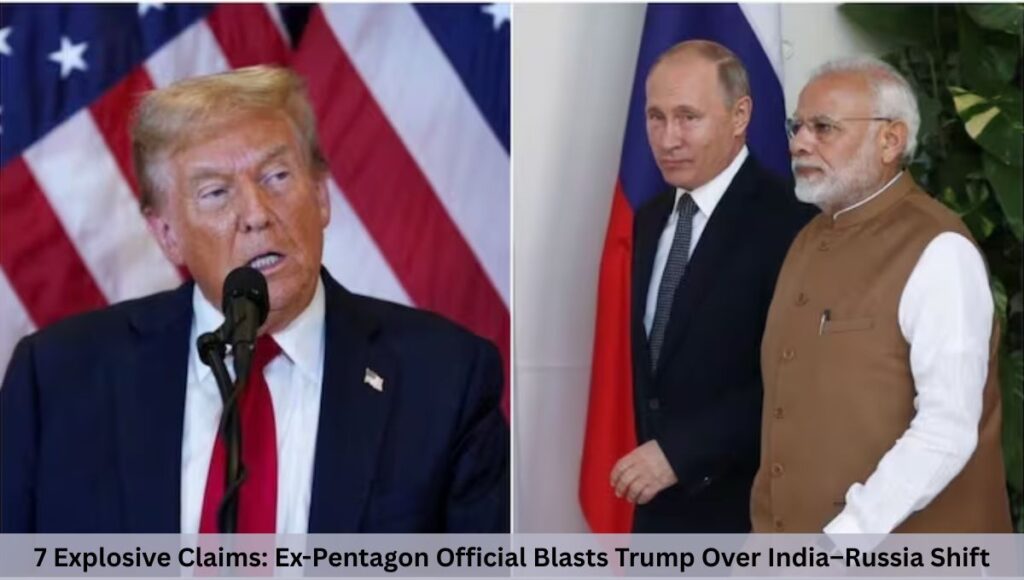
7 Explosive Claims: Ex-Pentagon Official Blasts Trump Over India–Russia Shift
Trump ‘Deserves a Nobel Prize’ — But for the Wrong Reasons
Rubin’s opening statement was dripping with sarcasm.
“Donald Trump deserves a Nobel Prize for bringing India and Russia together the way he did.”
He argued that the exceptionally warm reception Putin received in Delhi was partly driven by India’s frustration with Trump’s erratic policymaking, tariff impositions, and his perceived disrespect towards Prime Minister Narendra Modi.
Rubin questioned how many of the agreements signed during Putin’s visit were the result of genuine strategic alignment — and how many were influenced by Indian annoyance at Trump’s treatment of New Delhi. According to Rubin, Trump’s policies have done more to boost Russia’s influence in India than any deliberate effort by Moscow itself.
Two Americas — The Trump Lens vs. Everyone Else’s
Rubin said American reactions to India’s embrace of Russia fall into two sharply different camps.
Trump’s Interpretation — ‘I Told You So’
Trump, Rubin said, views India’s Russia outreach as validation of his worldview.
“If you’re Donald Trump, it’s perceived through the lens of ‘I told you so.’”
Trump has repeatedly insisted that India respects him and that any strategic shift by New Delhi confirms his instincts.
The Majority View — ‘Gross Incompetence’
But Rubin pointed out that 65% of Americans dislike Trump, citing recent polls.
From their perspective:
“What we are seeing now is the result of Donald Trump’s gross incompetence.”
Rubin argued that Trump reversed years of bipartisan effort to build a stable, strategic US–India partnership. Many analysts in Washington, he said, are “flabbergasted” at how quickly Trump unraveled hard-won diplomatic gains.
Trump’s Tariffs and Pakistan Outreach ‘Pushed India Away’
Another explosive claim by Rubin involved Trump’s sudden pivot towards Pakistan.
He cited:
- A closed-door White House meeting with Pakistani PM Shehbaz Sharif
- The influence of the Pakistani military establishment
- Trump’s friendly tone towards Islamabad
- The imposition of 50% punitive tariffs on Indian imports
- Trump’s public criticism of India’s Russian oil purchases
Rubin’s Bombshell Allegation — ‘Flattery or Bribery’
Rubin suggested — without evidence — that Trump’s tilt towards Pakistan may have been influenced by:
- Flattery
- Or even alleged bribery attempts by Pakistan, Turkey and Qatar
“This is one disastrous bribe that will saddle America with a strategic deficit for decades.”
He argued that Trump’s moves eroded US credibility and pushed India further into Russia’s strategic orbit — something Washington has spent decades trying to avoid.
Calling Out US ‘Hypocrisy’ on India’s Russian Oil Purchases
Rubin was also unsparing in his criticism of the US stance on India’s Russian oil imports. He called Washington’s position “hypocritical” and short-sighted.
The US Also Buys From Russia
Rubin highlighted a fact often ignored in US domestic debates:
“The United States also purchases goods and materials from Russia when alternative markets do not exist.”
This includes critical raw materials and nuclear fuel — a point Putin himself echoed in a recent televised interview on India Today.
India Has Non-Negotiable Energy Needs
Rubin argued that India, set to become the world’s third-largest economy, simply cannot afford to restrict energy purchases based on political lectures from the West.
“India needs energy. Indians elected Prime Minister Modi to represent Indian interests.”
If the US Doesn’t Have Cheaper Fuel, It Should ‘Shut Up’
Rubin delivered one of his most quoted lines here:
“If we don’t have a solution for providing cheaper fuel, our best approach is simply to shut up.”
He stressed that India’s security and economic stability come first — and no amount of Western pressure can override basic national interest.
Putin’s Visit Seen as a Major Strategic Win
Rubin said Putin’s India trip was “extremely positive from Russia’s perspective.”
The Russian president:
- Received ceremonial honours
- Finalized several agreements
- Reinforced decades-old defense and energy ties
- Secured assurances on continued Indian cooperation despite Western pressure
Rubin said Putin “can hardly get such honours anywhere else in the world,” underscoring India’s unique and enduring partnership with Moscow.
How Trump Unwound Years of Strategic Alignment With India
Washington insiders, Rubin said, are stunned at how quickly Trump reversed years of steady progress in US–India relations.
The Bipartisan Momentum Before Trump
For two decades, US policy — whether under Bush, Obama or Biden — followed a consistent goal:
- Strengthening India as a counterbalance to China
- Building defense cooperation
- Expanding intelligence-sharing
- Boosting trade
- Supporting India’s rise as a global power
Trump Broke That Momentum
Rubin listed several actions that disrupted this:
- Erratic tariff decisions
- Unpredictable foreign policy statements
- Public criticism of India
- Pressure over Russian oil purchases
- A perceived tilt towards Pakistan
- Mixed signals to New Delhi during key geopolitical shifts
The outcome, he said, is a strategic deficit that America may struggle to overcome.
India’s Strategic Autonomy Remains Firm
Despite the political drama in Washington, Rubin reiterated that India’s stance remains consistent:
“India will always prioritize Indian interests first.”
This includes:
- Buying cheap Russian oil
- Maintaining defense cooperation with Moscow
- Keeping strategic autonomy in global affairs
- Refusing to choose sides between major powers
India, he said, should not be expected to sacrifice energy security or defense capability simply to fit into Washington’s strategic expectations.
How Rubin’s Comments Fit Into Broader Global Reactions
Rubin’s statements align with several global trends:
1. The Rise of Multipolarity
India is no longer dependent on a single partner. It balances ties with:
- The US
- Russia
- The EU
- The Gulf
- Japan
- Southeast Asia
2. Decline of US Influence Under Trump
Critics argue that Trump’s foreign policy unpredictability has weakened alliances across the globe.
3. Russia’s Effort to Strengthen Asian Partnerships
With the West imposing sanctions, Moscow increasingly relies on India and China.
4. India’s Pragmatic Energy Strategy
India continues buying Russian oil because it’s:
- Cheap
- Reliable
- Available in large quantities
5. The Growing Debate in Washington
Rubin’s comments reflect a wider bipartisan concern that Trump’s foreign policy could undermine decades of US strategy in Asia.
Conclusion — A Debate That Isn’t Ending Anytime Soon
Michael Rubin’s remarks have triggered intense political debate. On one hand, Trump supporters dismiss his criticism as biased or politically motivated. On the other, a growing number of US analysts agree that Trump’s tariff wars, mixed foreign policy signals, and alleged susceptibility to foreign flattery have weakened America’s position in South Asia.
For India, however, the path ahead remains clear: strategic autonomy, economic security, and stable multipolar partnerships, including with Russia.
Putin’s successful India visit and Rubin’s provocative statements have now ensured that US–India–Russia dynamics will remain at the center of global geopolitics — and of American domestic political debates — for months to come.
Also Read: PM Modi, Xi Jinping, Putin Will Join 20 World Leaders at China’s SCO 2025 Summit in Tianjin
Related Posts:
- Trump’s 2025 Nobel Peace Prize Snub: Politics Over…

- 7 Shocking Reasons FIFA’s Peace Prize for Trump…

- Trump Says He Deserves Nobel Peace Prize for Ending…
- Trump’s Nobel Peace Prize Bid: Gaza Peace Plan, 8…
- Dramatic Moments Behind Trump’s Gaza Peace Push and…

- Trump Says “They Won’t Give It to Me” as Pakistan…