7 Explosive Developments as Ukraine City Hit During High-Stakes US Peace Talks, raising questions over security and territory. Russia launched a large-scale aerial attack on Ukraine overnight, striking critical infrastructure in the central Ukrainian city of Kremenchuk, just hours after Ukrainian President Volodymyr Zelensky described recent US-led peace negotiations as “very constructive.”
Thank you for reading this post, don't forget to subscribe!The timing of the strike—following three days of marathon talks in Florida between American and Ukrainian negotiators—highlighted the stark contrast between diplomatic momentum and the grim reality unfolding on the battlefield, where air raids, drone attacks, and civilian disruptions continue unabated.
Ukrainian officials reported no confirmed deaths from the latest assault, but parts of Kremenchuk were left without water, electricity, and heating, emphasizing the vulnerability of civilian infrastructure as peace discussions struggle to translate into de-escalation on the ground.
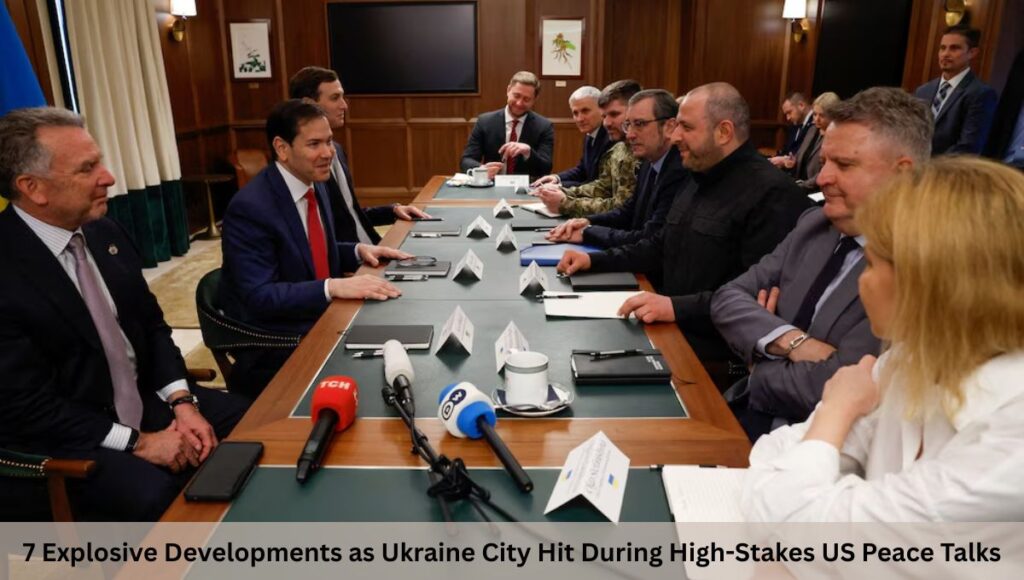
7 Explosive Developments as Ukraine City Hit During High-Stakes US Peace Talks
Kremenchuk Suffers ‘Massive Combined Strike’
Mayor Reports Infrastructure Damage
Vitaliy Maletsk, the mayor of Kremenchuk, described the overnight assault as a “massive combined strike” on the city’s infrastructure. While the full scale of damage was still being assessed on Sunday morning, initial reports confirmed disruptions to essential services for residents.
Kremenchuk, a major industrial hub, lies roughly halfway between Kyiv and Ukraine’s eastern frontline, making it a frequent target since Russia launched its full-scale invasion in February 2022.
The attack followed a broader wave of strikes across Ukraine in the previous 24 hours, which prompted condemnation from Kyiv’s European allies and raised fresh doubts over Russia’s willingness to pursue a diplomatic end to the war.
Russia Claims to Down Ukrainian Drones
77 Drones Shot Down, Moscow Says
Meanwhile, Russia’s defence ministry claimed it had intercepted 77 Ukrainian drones across several regions, underscoring the escalating drone warfare that has become a defining feature of the conflict.
Ukraine has increasingly relied on drone strikes to target Russian logistics, ports, and energy facilities, while Russia continues to use missiles and drones to hit Ukrainian cities and infrastructure.
The overnight exchange reinforced fears that neither side is prepared to pause military operations, even as diplomatic channels remain open.
Peace Talks in Florida End Without Breakthrough
Three Days of High-Level Negotiations
The strikes came just hours after the conclusion of three days of intensive Ukraine-US talks in Florida, aimed at shaping a potential peace settlement acceptable to both Kyiv and Washington.
The meetings involved:
- US Special Envoy Steve Witkoff
- Jared Kushner, President Donald Trump’s son-in-law
- Rustem Umerov, Ukraine’s senior negotiator
- General Andriy Hnatov, Ukraine’s military chief of general staff
Despite what both sides described as “constructive” discussions, Ukrainian officials acknowledged that major unresolved issues remain, particularly surrounding territorial questions and long-term security guarantees.
Zelensky: ‘Ukraine Is Determined’ to Work With the US
Following the conclusion of the talks, President Zelensky said he had held a “long and constructive” phone call with Witkoff, Kushner, and Ukraine’s delegation. “Ukraine is determined to keep working in good faith with the American side to genuinely achieve peace,” Zelensky wrote on X.
He added that discussions focused on how to ensure Russia would adhere to any future agreement, citing Moscow’s history of broken promises. “We covered many aspects and went through key points that could ensure an end to the bloodshed and eliminate the threat of a new Russian full-scale invasion,” Zelensky said.
Security Guarantees and Territory Remain Key Sticking Points
Ukraine Draws Red Lines
According to Ukrainian Ambassador to the US Olga Stefanishyna, the Miami talks made progress but stopped short of resolving core disputes. “Difficult issues remain,” she said, noting that territory and security guarantees remain the central challenges.
Kyiv has consistently insisted that:
- Ukraine must not be forced to surrender more territory
- Any deal must include credible security guarantees to prevent future Russian aggression
These demands clash with Moscow’s stated objectives, particularly regarding eastern Ukraine.
Putin Signals Hardline Position on Donbas
As the Miami talks began earlier this week, Russian President Vladimir Putin publicly reiterated that Russia intends to seize Ukraine’s eastern Donbas region “by any means.”
That statement cast doubt on Moscow’s commitment to compromise and heightened skepticism among Ukrainian and European officials regarding Russia’s intentions.
Although Trump later said US negotiators had held a “very good meeting” with Putin, the Moscow talks failed to deliver a concrete breakthrough.
Kremlin Welcomes New US Security Strategy
Shift in Language Toward Russia
In a notable development, the Kremlin welcomed the Trump administration’s newly released US national security strategy, which dropped language used by previous administrations describing Russia as a direct threat.
Kremlin spokesman Dmitry Peskov called the change a “positive step,” noting that the document contrasted sharply with Biden-era policy.
The strategy:
- Describes Europe as viewing Russia as an “existential threat”
- Frames the US role as one of diplomacy to restore stability
- Reiterates opposition to NATO’s continued eastward expansion
This shift has raised concerns among European allies about Washington’s long-term commitment to their security priorities.
Europe Pushes Back, Demands Stronger Guarantees
Macron, Starmer, Merz to Meet Zelensky
European leaders have been vocal in pushing for robust security guarantees for Ukraine, warning that a weak settlement could invite renewed Russian aggression.
French President Emmanuel Macron expressed “full solidarity” with Zelensky following the latest strikes and reiterated France’s commitment to securing a ceasefire.
Macron, Zelensky, UK Prime Minister Sir Keir Starmer, and German Chancellor Friedrich Merz are scheduled to hold in-person talks in London on Monday, focusing on:
- The state of the war
- Progress of US-led mediation
- Europe’s role in shaping security guarantees
‘Coalition of the Willing’ Proposal Divides Leaders
Sir Keir has led efforts to form a “coalition of the willing”—a group of Ukraine’s allies prepared to continue underwriting Kyiv’s defense if a ceasefire is reached.
The proposal, which could include a peacekeeping or stabilization force, is viewed by supporters as vital for long-term deterrence.
However, Putin has flatly rejected the idea, warning that any foreign troops deployed in Ukraine would be considered “legitimate targets.”
US and Ukraine Urge Russia to Show Commitment
Joint Statement Calls for Serious Steps Toward Peace
On Saturday, US and Ukrainian negotiators issued a joint statement urging Russia to demonstrate a “serious commitment to long-term peace,” including steps toward de-escalation and an end to killings.
Witkoff and Umerov said they had:
- Agreed on a framework of security arrangements
- Discussed deterrence capabilities to sustain peace
- Reviewed Ukraine’s post-war reconstruction needs
They emphasized that real progress depends entirely on Moscow’s actions, not just words.
Trump Growing Impatient Over Elusive Peace Deal
President Trump has repeatedly voiced frustration over the slow progress toward ending Europe’s deadliest conflict since World War Two.
While he has at times criticized both Kyiv and Moscow, his administration continues to portray the Florida talks as productive, with a White House official stating simply: “Progress was made.” Still, Trump has acknowledged that translating diplomatic momentum into a durable settlement remains difficult.
War Rages On Despite Diplomatic Efforts
Civilian Toll Continues to Rise
Even as negotiators met in luxury settings in Florida, the war’s human cost remained stark. Recent Russian drone strikes killed a 12-year-old boy in Ukraine’s Dnipropetrovsk region, Ukrainian officials said.
In response, Kyiv launched its own drone attacks targeting Russian ports and an oil refinery. Russia claims its air defenses intercepted 85 Ukrainian drones, including in Crimea, which Moscow annexed illegally in 2014.
What Happens Next
As diplomatic efforts intensify, so too does skepticism.
Key unresolved questions remain:
- Will Russia agree to binding security guarantees?
- Can Ukraine accept any territorial compromise?
- How far is the US willing to diverge from European allies?
With further talks planned and leaders gathering in London, the coming days may prove decisive—but the overnight strikes on Kremenchuk serve as a stark reminder that peace on paper does not yet mean peace on the ground.
Also Read: 7 Powerful Signals US-Ukraine Peace Talks Are Entering a Critical Phase
Also Read: Putin calls talks with US on ending Ukraine war ‘useful’ but also ‘difficult work’
Related Posts:
- 5 Major Takeaways from the US Supreme Court's…

- Afghanistan–Pakistan War 2025: Inside the 48-Hour Ceasefire

- 7 Heartbreaking Facts About Venezuela's Earthquake Disaster
- Trump’s 20-Point Gaza Peace Plan Gains Urgent Global…

- Impacts of the Trump-Putin Call on Ukraine’s 2025 Strategy

- 7 Powerful Facts About Ayatollah Ali Khamenei’s…