

9 Powerful Facts Behind Trump’s Deadly US Strikes on ISIS in Nigeria amid rising attacks on Christians.The United States has carried out a series of airstrikes targeting Islamic State (ISIS) militants in northwest Nigeria, marking one of the most significant US military actions inside Africa’s most populous nation in recent years.
The strikes, announced by US President Donald Trump on Christmas Day, were described as “powerful and deadly” and aimed at ISIS fighters allegedly responsible for attacks on civilians.
While US military officials confirmed coordination with Nigerian authorities, Trump’s framing of the operation—particularly his repeated claims that ISIS was primarily targeting Christians—has sparked debate, diplomatic sensitivity, and scrutiny from human rights groups and security analysts.
This article examines what happened, why the strikes occurred, how Nigeria responded, and what the operation means for regional security and US–Nigeria relations.
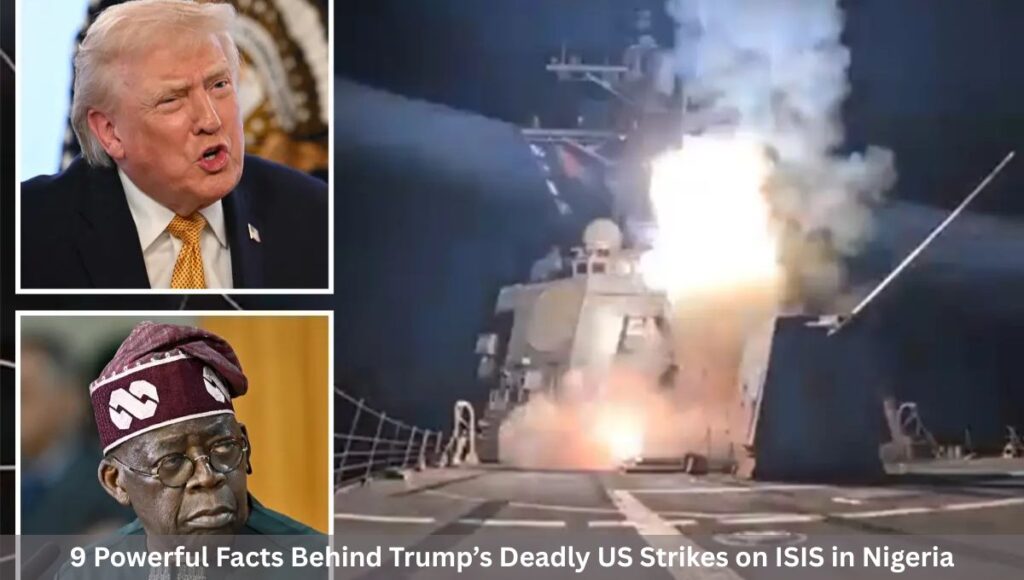
9 Powerful Facts Behind Trump’s Deadly US Strikes on ISIS in Nigeria
Trump Announces ‘Powerful and Deadly’ Strikes
On Thursday evening, President Donald Trump announced via his Truth Social platform that he had ordered US forces to strike ISIS targets in northwest Nigeria.
“At my direction as Commander in Chief, the United States launched a powerful and deadly strike against ISIS terrorist scum in Northwest Nigeria,” Trump wrote.
Trump accused the militant group of “targeting and viciously killing, primarily, innocent Christians,” claiming the violence had reached levels “not seen for many years, and even centuries.”
He added that the US military had carried out “numerous perfect strikes” and warned that further action would follow if attacks continued.
AFRICOM Confirms Operation in Sokoto State
Shortly after Trump’s announcement, the US military’s Africa Command (AFRICOM) confirmed that it had conducted airstrikes in Sokoto State, which borders Niger.
According to AFRICOM:
- The strikes targeted ISIS-linked camps.
- Multiple militants were killed.
- The operation was conducted in coordination with Nigerian authorities.
In an initial statement—later deleted—AFRICOM said the strike had been carried out at the request of Nigeria. Subsequent official statements emphasized close cooperation and intelligence sharing.
Nigeria Confirms Cooperation, Rejects Religious Framing
Nigeria’s Ministry of Foreign Affairs confirmed early Friday that the country had worked with the United States on precision airstrikes targeting terrorist groups in the northwest.
“Nigeria remains engaged in structured security cooperation with international partners, including the United States, in addressing the persistent threat of terrorism and violent extremism,” the ministry said.
However, Nigerian officials were careful to distance themselves from Trump’s claims that the operation was specifically about protecting Christians.
Foreign Minister Yusuf Maitama Tuggar told the BBC that the mission was:
- A joint counterterrorism operation
- Directed at “terrorists”
- “Not about a particular religion”
Defense Secretary Hegseth Praises Cooperation
US Defense Secretary Pete Hegseth publicly thanked the Nigerian government for its support.
“Grateful for Nigerian government support & cooperation,” he wrote on X, adding: “Merry Christmas!”
The US Department of Defense later released a short unclassified video showing what appeared to be a missile launch from a military vessel, though operational details remained limited.
Weeks of Warnings Led to the Strikes
The Christmas Day airstrikes did not occur in isolation. They followed weeks of escalating rhetoric and policy moves from the Trump administration.
Nigeria Designated a ‘Country of Particular Concern’
In November, Trump formally designated Nigeria a “Country of Particular Concern” under the US International Religious Freedom Act.
The designation is used for countries accused of engaging in or tolerating severe violations of religious freedom and can open the door to sanctions.
Trump claimed that Christianity faced an “existential threat” in Nigeria and alleged that “thousands” of Christians had been killed, though no evidence was provided to support those figures.
Claims of Christian Genocide Contested
Trump’s repeated references to a genocide against Christians in Nigeria have been strongly contested by:
- Nigerian officials
- Human rights organizations
- Conflict monitoring groups
Groups such as ACLED, which tracks political violence globally, report that:
- Both Christians and Muslims are victims of extremist violence
- In many cases, Muslims have made up the majority of victims of jihadist attacks
Human rights organizations say there is no credible evidence that Christians are being disproportionately targeted nationwide.
Nigeria’s Complex Security Landscape
Nigeria faces one of the most complex security environments in the world, shaped by overlapping conflicts rather than a single religious war.
Jihadist Insurgency in the North and Northeast
For more than a decade, groups such as:
- Boko Haram
- Islamic State West Africa Province (ISWAP)
have killed thousands, displaced millions, and devastated entire regions—particularly in the northeast. Most victims of these attacks have been Muslim civilians, according to independent datasets.
Banditry and Emerging ISIS Cells in the Northwest
The northwest, including Sokoto State, has seen rising violence from:
- Armed bandit groups
- Criminal gangs
- Smaller ISIS-aligned factions
Security analysts note that these groups often:
- Operate from forest hideouts
- Target villages, security forces, and travelers
- Have shifting ideological and criminal motives
Some reports suggest the US strike may have targeted emerging ISIS-linked camps rather than Boko Haram strongholds.
Farmer–Herder Violence in Central Nigeria
In central Nigeria, frequent clashes occur between:
- Mostly Muslim nomadic herders
- Farming communities, often Christian
These conflicts are driven by:
- Competition over land and water
- Climate stress
- Weak law enforcement
While religious identity often overlaps with these disputes, experts stress that they are not purely religious conflicts.
Nigerian Leadership Responds
President Bola Ahmed Tinubu has repeatedly rejected claims that Nigeria tolerates religious persecution.
In a Christmas message shared on X, Tinubu said:
“I remain committed to protecting Christians, Muslims, and all Nigerians from violence.”
He emphasized that Nigeria’s constitution guarantees religious freedom and that insecurity affects communities “across faiths and regions.”
Political Messaging and Domestic US Politics
Analysts say Trump’s language around the strikes plays strongly to his domestic political base, particularly evangelical Christian voters in the United States.
The issue of Christian persecution in Nigeria has been a long-standing concern among conservative US politicians, with figures like Senator Ted Cruz calling for sanctions and intervention.
Contradictions With Trump’s ‘Peace First’ Agenda
Trump has often portrayed himself as a president who avoids foreign wars.
However, since returning to office, he has:
- Ordered strikes on ISIS targets in Syria
- Increased pressure on Iran’s nuclear program
- Overseen a major military buildup near Venezuela
The Nigeria strike adds to a growing list of direct military actions under his leadership.
Regional and Diplomatic Implications
The US strikes raise important questions about:
- Nigerian sovereignty
- The role of foreign militaries in Africa
- The risk of internationalizing local conflicts
While Nigeria welcomes intelligence and technical support, officials have emphasized that any military action must respect the country’s sovereignty.
What Comes Next?
Both US and Nigerian officials have suggested the operation may not be the last. AFRICOM has not ruled out additional strikes, and Trump warned that “more will come” if attacks continue.
For Nigeria, the challenge remains balancing:
- Foreign assistance
- Domestic political narratives
- A highly complex and multifaceted security crisis
Conclusion
The US airstrikes on ISIS targets in northwest Nigeria represent a rare and consequential escalation in American military involvement in the country.
While Washington and Abuja agree on the need to combat terrorism, they sharply differ on how the violence should be framed—particularly along religious lines.
As Nigeria continues to battle jihadist insurgents, banditry, and communal violence, the long-term impact of US intervention will depend not only on military success but also on diplomacy, accuracy in public narratives, and respect for Nigeria’s complex social fabric.
Also Read: 9 Explosive Moments: Benin Coup Attempt Shakes West Africa
Also Read: US bombs target ISIL in Nigeria: What’s really going on?
Related Posts:
- Trump Threatens Military Action in Nigeria Over…
- 7 Explosive Reactions as Trump Threatens Military…

- 7 Explosive Lines as Zelensky’s Christmas Message…

- 7 Unbreakable Stories of Faith: Christmas Returns to…
- 7 Explosive Developments as Trump Bars South Africa…

- Trump’s 2025 Gaza Peace Plan Signing and Historic…
