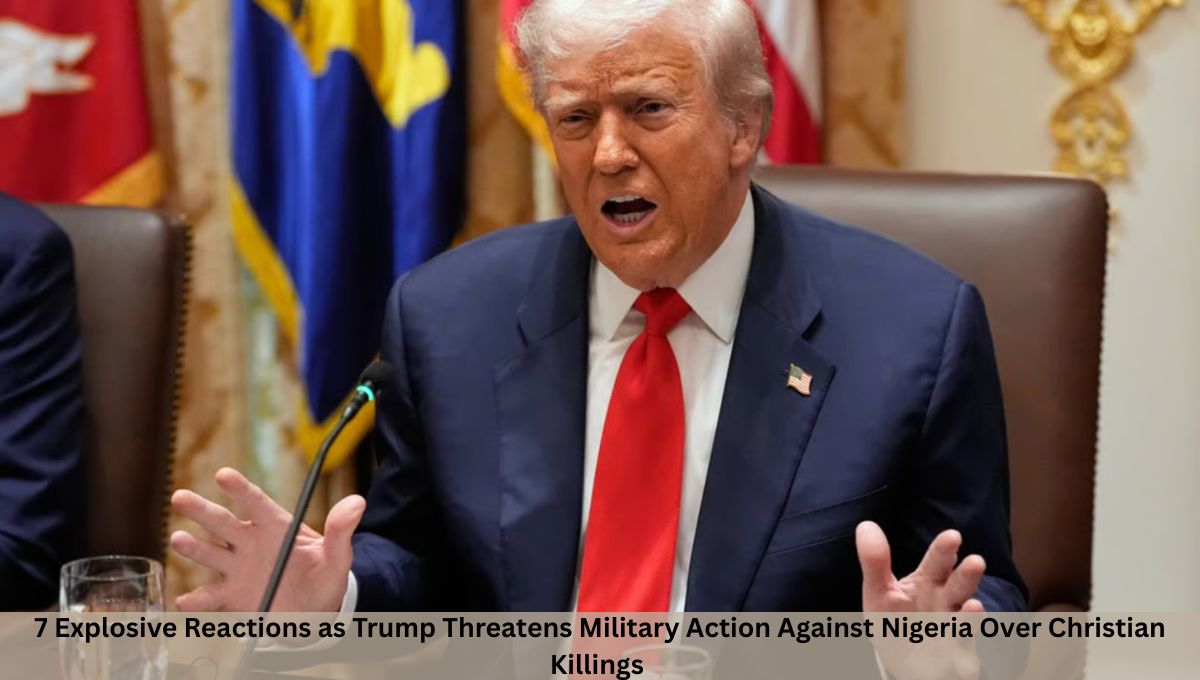
7 Explosive Reactions as Trump Threatens Military Action Against Nigeria Over Christian Killings, warns of halting U.S. aid. In a move that has shocked both diplomatic and religious circles, U.S. President Donald Trump has threatened military intervention in Nigeria, accusing the Nigerian government of allowing what he described as “mass killings of Christians.”
Posting on his Truth Social platform, Trump said the United States would immediately stop all aid and assistance to Nigeria if the violence persisted — and hinted that military action could follow.
“If the Nigerian Government continues to allow the killing of Christians, the U.S.A. will immediately stop all aid and assistance to Nigeria, and may very well go into that now disgraced country, ‘guns-a-blazing,’ to completely wipe out the Islamic Terrorists who are committing these horrible atrocities,” Trump wrote.
The U.S. President also claimed to have instructed the Department of War to prepare for possible action. “If we attack, it will be fast, vicious, and sweet, just like the terrorist thugs attack our cherished Christians! WARNING: THE NIGERIAN GOVERNMENT BETTER MOVE FAST!” he added.
Trump’s statements have sent ripples through international policy circles, prompting reactions from Nigeria’s government, the White House, faith-based organisations, and even celebrities such as Nicki Minaj, who publicly supported his comments on X (formerly Twitter).
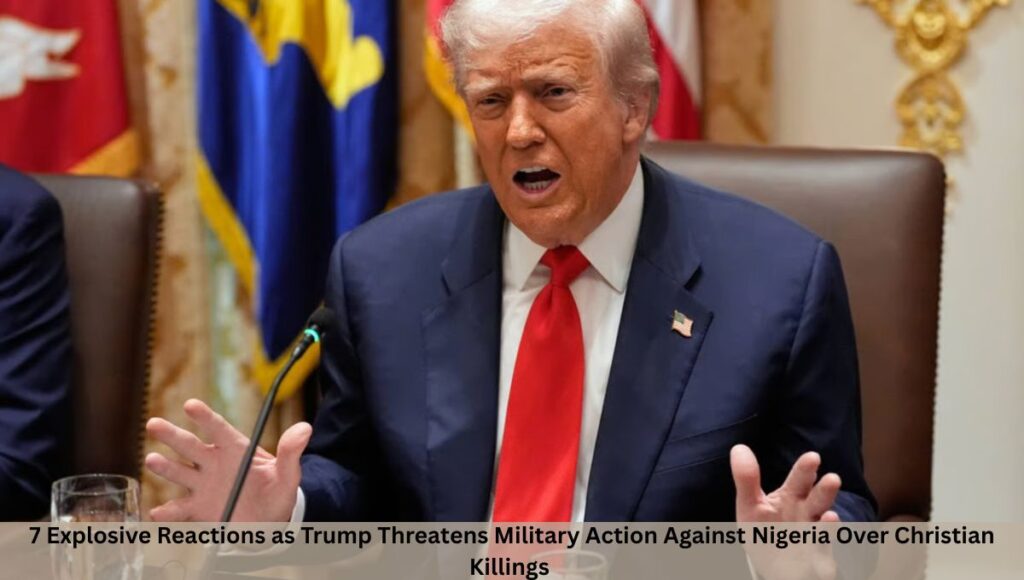
7 Explosive Reactions as Trump Threatens Military Action Against Nigeria Over Christian Killings
White House Follows Trump’s Lead
Soon after Trump’s remarks, U.S. Defence Secretary Pete Hegseth took to X, reinforcing the President’s message.
“Either the Nigerian Government protects Christians, or we will kill the Islamic Terrorists who are committing these horrible atrocities,” Hegseth said, confirming that the renamed Department of War is preparing for possible action.
The Trump administration recently reinstated Nigeria on its list of “Countries of Particular Concern,” a U.S. State Department watch list reserved for nations accused of serious violations of religious freedom.
This move marks a major policy reversal from the Biden administration, which had removed Nigeria from the list in 2021. Trump’s reclassification underscores his renewed focus on protecting Christian minorities worldwide — a policy cornerstone of his second term.
Nigeria Pushes Back: Tinubu Rejects Trump’s Claim
In response, Nigerian President Bola Ahmed Tinubu rejected Trump’s accusations and defended his government’s record on religious freedom and tolerance.
“Religious freedom and tolerance have been a core tenet of our collective identity and shall always remain so,” Tinubu wrote on X. “Nigeria opposes religious persecution and does not encourage it.”
He insisted that Nigeria’s constitution protects citizens of all faiths, dismissing the notion of a systemic campaign against Christians.
“The characterisation of Nigeria as religiously intolerant does not reflect our national reality, nor does it take into consideration the consistent and sincere efforts of the government to safeguard freedom of religion and beliefs for all Nigerians.”
Nigeria’s Foreign Ministry: “Reports Are Misleading”
Information Minister Mohammed Idris and Foreign Ministry spokesperson Kimiebi Ebienfa both disputed Trump’s allegations, describing the reports of “mass Christian killings” as “very misleading.”
Ebienfa stated that Nigeria is committed to protecting all citizens, irrespective of religion. “Like America, Nigeria has no option but to celebrate the diversity that is our greatest strength,” he said.
Nigeria’s government further emphasised that both Christians and Muslims have been victims of violence by extremist groups, such as Boko Haram and Islamic State West Africa Province (ISWAP).
While these groups claim religious motives, analysts argue that the violence is rooted more in political, economic, and territorial conflicts than pure religious persecution.
Trump Declares Christianity ‘Under Existential Threat’
Trump doubled down on his position on Saturday, calling the situation in Nigeria a “Christian genocide” and vowing to “save our great Christian population around the world.”
“Christianity is facing an existential threat in Nigeria,” Trump said. “Thousands of Christians are being killed. Radical Islamists are responsible for this mass slaughter. I am hereby making Nigeria a ‘Country of Particular Concern’ — but that is the least of it.”
The President cited alarming figures suggesting that over 3,000 Christians were killed in Nigeria last year — though independent observers note that these numbers are not verified and likely represent total casualties from various forms of communal violence, not only religious persecution.
Trump further directed Congressman Riley Moore and House Appropriations Committee Chairman Tom Cole to investigate the killings and report back to him. “When Christians, or any such group, are slaughtered like is happening in Nigeria, something must be done,” he said.
‘Fast, Vicious, and Sweet’: Trump’s Military Threat Explained
The phrase “fast, vicious, and sweet” quickly became viral across social media platforms, symbolising Trump’s aggressive foreign policy stance.
Analysts see the comment as part of a broader ‘America First’ reassertion of U.S. power — particularly in Africa, where Washington faces growing competition from China and Russia. Security experts, however, warned that any U.S. military intervention in Nigeria could destabilise an already fragile region.
“Nigeria is dealing with overlapping conflicts — religious, ethnic, and economic. A U.S. military strike would only inflame tensions,” said Dr. Ebenezer Obadare, Senior Fellow for Africa Studies at the Council on Foreign Relations. “The right approach is cooperation, not confrontation. Invading Nigeria would be counterproductive.”
Global Reactions and Political Shockwaves
Trump’s comments have drawn mixed reactions globally.
- Human rights groups condemned the threat of force, warning it violates international law and Nigeria’s sovereignty.
- Christian organisations in the U.S. welcomed the focus on persecution but urged restraint, calling for “strategic diplomacy, not military aggression.”
- African Union officials privately expressed concern that Trump’s rhetoric could reignite old colonial tensions between African nations and the West.
In Europe, some far-right political figures voiced support for Trump’s warning, claiming that Western leaders have ignored the plight of persecuted Christians for too long.
Nicki Minaj Reacts to Trump’s Threat
The debate took an unexpected pop-culture turn when rap icon Nicki Minaj weighed in on Trump’s Truth Social post. Sharing a screenshot of his message on X, she wrote:
“Reading this made me feel a deep sense of gratitude. We live in a country where we can freely worship God. No group should ever be persecuted for practising their religion. We don’t have to share the same beliefs in order to respect each other.”
Minaj’s post immediately went viral, with many conservatives praising her stance. Commentators from Turning Point USA and independent journalists hailed her as “one of the few celebrities brave enough to stand with persecuted Christians.”
However, others accused her of endorsing Trump’s militaristic rhetoric, while some questioned whether she was aligning herself with Republican politics.
This sparked speculation that Minaj might be leaning Republican, though records show she is not a registered U.S. voter. Born in Trinidad and Tobago, Minaj has often maintained a non-partisan stance, though she has occasionally made political references in her music.
Minaj’s Past Political Comments
In 2012, she appeared to endorse Mitt Romney in a song lyric — “I’m a Republican voting for Mitt Romney, you lazy bitches are f***ing up the economy” — but later clarified that it was sarcasm, thanking then-President Barack Obama for recognising her humour.
More recently, she has voiced support for Democratic figures such as Andrew Cuomo and Letitia James, suggesting she is not formally affiliated with any party.
Still, her praise for Trump’s Nigeria post has elevated her into the political spotlight once again — illustrating how social media and celebrity culture now influence global diplomatic debates.
Background: U.S.–Nigeria Tensions and Past Frictions
Relations between the United States and Nigeria have long been complicated by security concerns, human rights issues, and religious freedom disputes.
In 2020, Trump’s first administration placed Nigeria on the “Countries of Particular Concern” list, citing widespread violence against Christians. That decision drew criticism from Nigerian officials, who said Washington was oversimplifying complex internal conflicts.
In 2021, President Joe Biden removed Nigeria from the list, saying progress had been made in protecting minority rights. However, under Trump’s renewed leadership, Nigeria has been reinstated, reviving old tensions.
The two nations also clashed over counterterrorism cooperation, with the U.S. pressing Nigeria to be more aggressive against Boko Haram and ISWAP, while Nigerian leaders accused Washington of failing to understand local dynamics.
Analysts point out that U.S.–Nigeria relations are vital: Nigeria is Africa’s largest democracy and one of its biggest oil producers. It also serves as a key military partner in regional counterterrorism efforts across West Africa.
A U.S. military intervention, experts warn, could fracture diplomatic ties, potentially driving Nigeria closer to China or Russia — nations that have expanded their presence in Africa through infrastructure investment and security assistance.
Religious Violence: A Complex Reality
While Trump frames Nigeria’s crisis as a Christian persecution issue, experts caution that the reality is more nuanced.
Groups like Boko Haram have indeed targeted Christians, but they have also killed thousands of Muslims who reject their ideology. Meanwhile, farmer-herder clashes often involve economic and land disputes, not purely religious motives.
According to the Associated Press, Nigeria’s violence “stems from a complex mix of causes — religious extremism, farmer-herder clashes, ethnic rivalries, and separatist movements.”
Nevertheless, Trump’s blunt framing has once again forced the issue of religious freedom in Africa to the centre of U.S. foreign policy debates.
Analysts Warn of Diplomatic Fallout
Policy analysts in Washington warn that Trump’s threat could have far-reaching consequences.
“Threatening a key African partner with military action over unverified reports is reckless,” said Dr. Sarah McCuen, a researcher at Georgetown University’s School of Foreign Service. “It undermines America’s credibility, alienates allies, and could push Nigeria into the arms of America’s rivals.”
However, Trump’s supporters argue that his stance reflects moral clarity — a refusal to “appease regimes that enable religious persecution.”
Conclusion: A New Flashpoint in U.S.–Africa Relations
Trump’s fiery remarks have opened a new flashpoint in U.S.–Africa relations, igniting debate over the balance between religious freedom advocacy and respect for national sovereignty.
For Nigeria, the threat underscores how domestic security issues can quickly escalate into international crises when amplified by global leaders.
Whether or not Trump follows through on his “guns-a-blazing” warning, his words have already reshaped the diplomatic landscape, forcing both Washington and Abuja to confront a growing narrative of religious persecution and political intervention.
As the world watches, the incident may well mark the start of a new and more confrontational U.S. policy toward Africa — one defined by faith, force, and fiery rhetoric.
Also Read: “No Kings” Protests Rock Nation as Trump Celebrates Military Parade and Birthday
Also Read: Potus hints being ‘anti-Trump is probably illegal’ as he targets another late night host
Related Posts:
- Trump Threatens Military Action in Nigeria Over…
- 9 Powerful Facts Behind Trump’s Deadly US Strikes on…
- 11 Explosive Warnings as Trump Vows to ‘Knock the…

- 5 Powerful Highlights as Trump Lands Second Nobel…

- 9 Explosive Revelations as Trump Declares His Health…
- Trump's 3 Blunt Warnings to China and Russia Over…