5 Shocking Facts About the Harvard Medical School Explosion That Rocked Boston and prompted an FBI-led investigation. An intentional explosion in the early hours of Saturday morning has rattled Harvard Medical School (HMS) and the wider Boston community. The blast, which occurred around 3 a.m. inside the Goldenson Building on Harvard’s Longwood Campus, caused no injuries but has sparked a major investigation involving federal authorities, including the FBI and the Bureau of Alcohol, Tobacco, Firearms and Explosives (ATF).
Officials confirmed the explosion was “intentional”, marking one of the most serious security incidents in recent years at the prestigious Ivy League institution.
5 Shocking Facts About the Harvard Medical School Explosion That Rocked Boston
1. The Explosion Struck Before Dawn on Harvard’s Longwood Campus
According to reports from The Harvard Crimson and The Boston Globe, the explosion occurred on the fourth floor of the Goldenson Building — a research facility that houses multiple laboratories and offices.
A Harvard University Police Department (HUPD) officer responded to a fire alarm at 2:48 a.m. and saw two masked individuals fleeing the scene. The officer attempted to stop them but was unsuccessful before proceeding to the source of the alarm.
Authorities said that the blast was deliberate, though the motive and nature of the explosive device remain under investigation. No secondary devices were found during a sweep of the building by the Boston Fire Department’s Arson Unit.
“The explosion was intentional, but at this stage, we do not believe there is an ongoing threat to the community,” a fire department official confirmed.
2. Surveillance Footage Shows Two Masked Suspects Fleeing
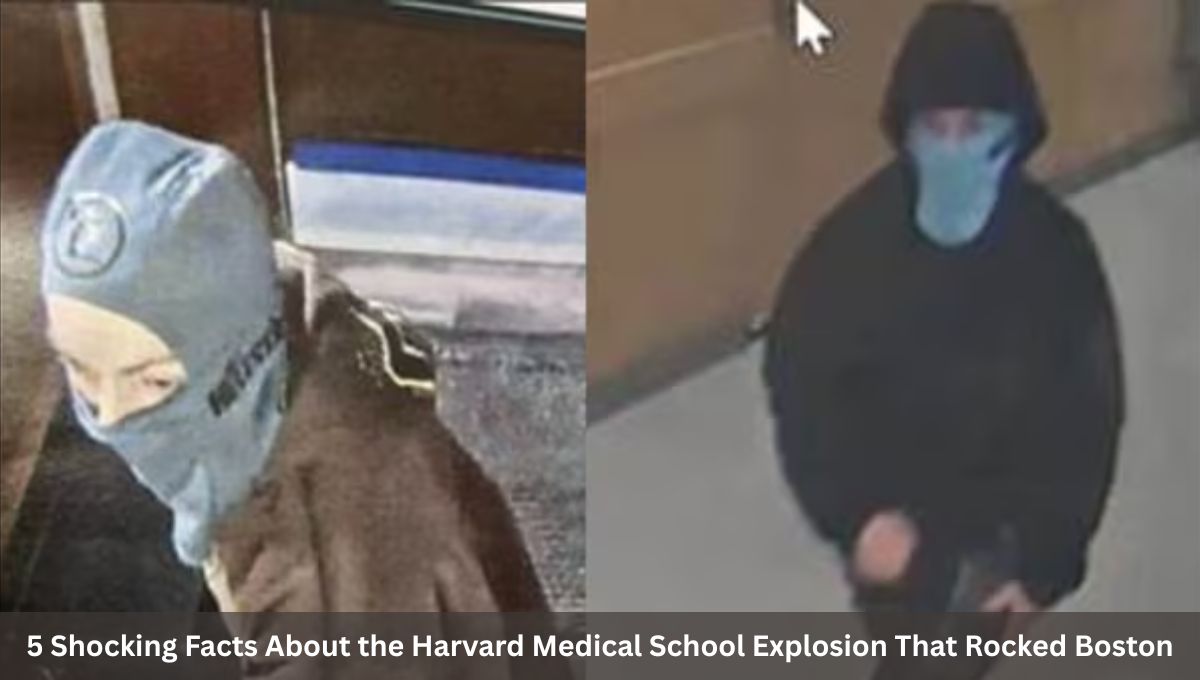
Security cameras captured two unidentified individuals running from the Goldenson Building moments after the explosion. Both suspects were wearing hooded sweatshirts and face coverings, obscuring their identities.
The Harvard University Police Department has since released photos of the suspects and is urging the public to help identify them.
“We are urging anyone with information about the individuals or their whereabouts to come forward,” said a university spokesperson.
Despite efforts by a campus officer to intercept them, the two suspects escaped into the surrounding area. Their current whereabouts are unknown.
3. FBI and Federal Agencies Join the Investigation
In response to the apparent act of deliberate sabotage, the FBI’s Boston Division confirmed it has joined the investigation alongside Harvard University Police, the Boston Police Department, and the Boston Fire Department.
“The FBI is on the scene and we’re assisting our partners at the Harvard University Police Department with what is a very active investigation,” FBI Boston spokesperson Kristen Setera told USA Today.
Officials are also working to determine whether the explosion targeted a specific lab, research project, or individual. The Bureau of Alcohol, Tobacco, Firearms and Explosives (ATF) has also been consulted to assess the explosive materials used.
Harvard’s Public Information Officer, Steven G. Catalano, confirmed that local, state, and federal agencies are collaborating closely to identify the suspects and establish a motive.
Also Read: What Caused the Explosion At Harvard Medical School? Police Reveal Details
4. Harvard Issues Security Advisory and Closes Part of the Building
Following the explosion, Harvard Medical School administrators sent an internal email advising staff and researchers to avoid the Longwood Campus unless absolutely necessary. The email stated that the Goldenson Building has been cleared and remains open, except for the fourth floor, where the explosion occurred.
“If you had not intended to or do not need to come to campus this weekend, you should not come in,” the message warned. Although no injuries or major structural damage were reported, officials said the incident has prompted a comprehensive security review.
Patrols around the Longwood Medical Area have been increased, and access to research wings has been temporarily restricted. “We are grateful that no one was hurt,” said a Harvard spokesperson. “We will continue to prioritise safety as the investigation continues.”
5. Harvard’s Explosion Comes Amid Heightened Tensions on U.S. Campuses
The intentional explosion comes at a time when U.S. universities are facing intense public scrutiny and security challenges following a politically and socially charged year.
The incident occurs just as Harvard University continues high-level talks with the White House over federal funding issues and ongoing lawsuits linked to academic freedom and campus protests.
While investigators have not linked the explosion to any political motive, officials have acknowledged that the timing — amid national debate about campus safety and free speech — adds another layer of concern.
Police Release Photos of Two Persons of Interest
The Harvard University Police Department has publicly released still images from campus surveillance footage showing the two individuals believed to be connected to the incident.
Authorities said both suspects were last seen running across the main quad moments after the explosion. Investigators are appealing to anyone who was in the Longwood area between 2:30 a.m. and 3:30 a.m. to share any possible dashcam or CCTV footage.
“The Harvard University Police Department is actively investigating this incident in coordination with local, state, and federal law enforcement partners,” said HUPD in its official statement.
Anyone with information has been urged to contact the Detective Bureau at 617-495-1796 or email steven_catalano@hupd.harvard.edu.
Authorities Confirm the Blast Was Intentional
The Boston Fire Department’s Arson Unit has officially classified the explosion as intentional. After an extensive sweep, officials confirmed there were no secondary devices or ongoing threats on campus.
“At approximately 2:48 AM this morning, a Harvard University Police Department officer was dispatched to the Goldenson building for a fire alarm activation,” officials said.
“The Boston Fire Department Arson Unit responded and made an initial assessment that the explosion appeared to be intentional. The Boston Police Department conducted a sweep of the building to check for any additional devices; none were found.”
The precise composition of the explosive device remains undisclosed, but experts believe it was likely a small-scale chemical or improvised explosive, given the limited damage and absence of casualties.
Harvard Community Reacts with Shock but Gratitude
The explosion has triggered shock and anxiety among Harvard students, faculty, and alumni. Yet many expressed relief that the incident did not result in injuries or fatalities. On social media, students praised campus police and Boston emergency services for their swift response.
“Scary to wake up to news of an explosion at HMS, but thankful everyone’s safe,” one student wrote on X (formerly Twitter). Harvard’s administration said support resources and counselling services are being offered to anyone affected by the event.
Campus Security Tightened as Investigation Continues
In the aftermath, Harvard University has increased security measures across its Boston campuses. Officers are patrolling more frequently, especially in research buildings housing sensitive equipment or materials.
Boston Police officials stated that there is no ongoing danger to the public but urged vigilance. Federal investigators continue to review evidence from surveillance cameras, forensic residues, and eyewitness accounts.
As of Saturday night, no arrests have been made, but authorities believe the two masked suspects remain the primary focus of the investigation.
Recent U.S. Incidents Add to Nationwide Security Concerns
The explosion adds to a worrying pattern of violence and deliberate attacks across the United States. In recent months, incidents ranging from mass shootings to acts of sabotage have raised concerns about domestic threats to public safety.
According to the Gun Violence Archive, the United States has recorded over 300 mass shootings in 2025. While the Harvard explosion does not appear related to gun violence, it underscores the broader issue of security vulnerability at educational institutions.
The most shocking cases this year include the Leland, Mississippi shooting, which left seven dead, and the Utah Valley University assassination of activist Charlie Kirk.
Authorities across states are now reinforcing safety measures at public venues and campuses to prevent similar incidents.
What’s Next for the Harvard Investigation?
As the investigation unfolds, officials are focusing on determining whether the explosion was an act of targeted sabotage, a personal vendetta, or an ideologically driven statement.
Given Harvard’s prominence in research and politics, federal authorities are leaving no angle unexplored. The FBI and ATF are analysing materials recovered from the site, while the Boston Police Department continues to review surveillance data.
Harvard University has promised full transparency and cooperation with law enforcement. “We will continue to work closely with investigators and ensure our community’s safety remains paramount,” the university said.
Conclusion
The Harvard Medical School explosion has shaken one of the world’s most respected academic communities, raising urgent questions about campus safety and motive. While no injuries were reported, the deliberate nature of the blast underscores how even top-tier institutions are not immune to acts of violence. As federal authorities pursue the masked suspects, the Harvard community — and the nation — watches closely for answers.
Also Read: Trump Ends 33-Year Pause on US Nuclear Testing
Related Posts:
- 13 Shocking Facts About the Brown University…
- 5 Major Takeaways from the US Supreme Court's…

- 11 Explosive Reasons Pentagon Cut All Military Ties…

- 11 Powerful Shifts in New US Dietary Guidelines That…

- 7 Heartbreaking Facts About Venezuela's Earthquake Disaster
- Japan's New Spy Agency: 7 Powerful Facts Behind Its…