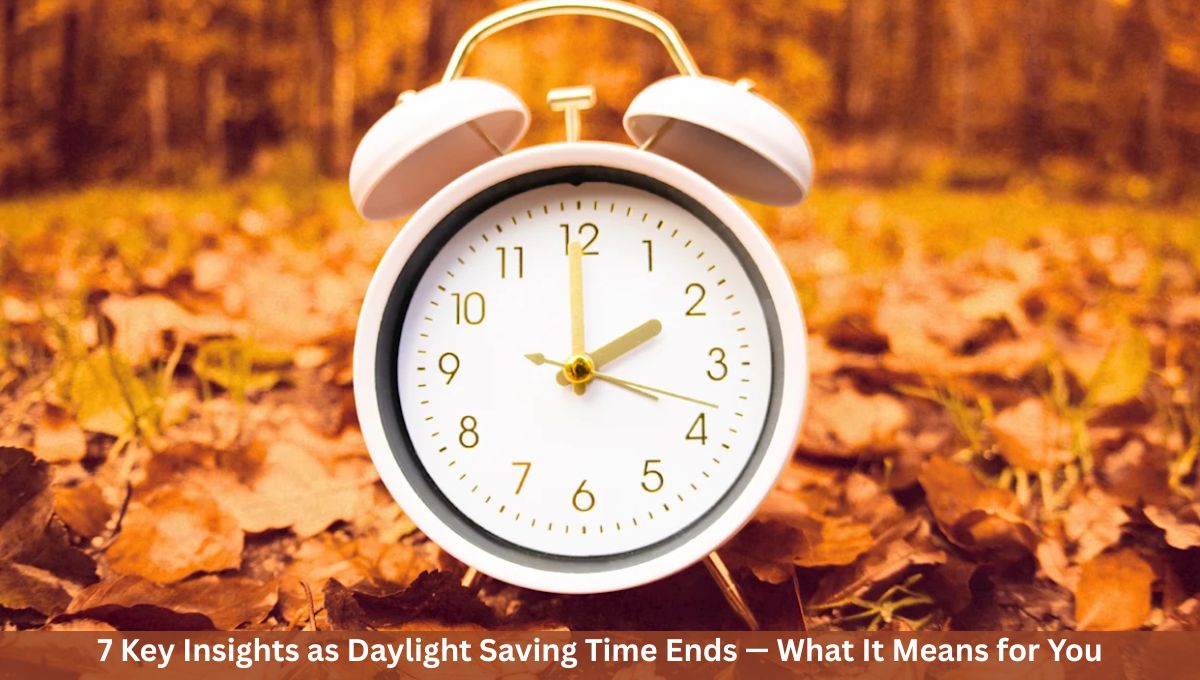
7 Key Insights as Daylight Saving Time Ends — What It Means for You, how it affects health, and which states want to scrap it. As the winter season approaches, it’s that time of year again when Americans prepare to “fall back”. On Sunday, November 2, Daylight Saving Time (DST) officially ends, giving most people an extra hour of sleep while marking the return to standard time.
The change occurs at 2 a.m. local time, when clocks are set one hour back. For many, it’s a small adjustment — but one that affects sleep, health, mood, and even daily routines. Here’s a detailed look at what this shift means, how it impacts your body, and why many states want to end the twice-yearly clock change for good.
7 Key Insights as Daylight Saving Time Ends — What It Means for You
1. What Is Daylight Saving Time?
Daylight Saving Time is the practice of advancing clocks by one hour between March and November to make better use of daylight during longer summer days.
- In the US and Canada, clocks go forward in March and fall back in November.
- In Europe and the UK, clocks change at 2 a.m. on the last Sunday in October.
This year, DST began on March 9, 2025, and ends on November 2, 2025. The next change — when clocks “spring forward” again — will happen on March 8, 2026.
The idea is to extend evening daylight hours, reducing the need for artificial lighting and conserving energy. But opinions on its effectiveness remain deeply divided.
2. Why Do We “Fall Back”?
When we set clocks back in the fall, mornings become brighter, and evenings darker. The extra daylight in the early hours helps people wake up more naturally during winter’s shorter days.
This adjustment aims to:
- Maximise natural daylight during typical working hours.
- Help conserve electricity by aligning active hours with sunlight.
- Provide more daylight for morning commuters and school children.
Computers and smartphones update automatically, but don’t forget to manually reset wall clocks, ovens, and wristwatches.
For most, the first noticeable difference is an earlier sunrise and earlier sunset, creating shorter daylight periods and longer nights.
3. What Changes This Sunday — and Who Observes It
At 2 a.m. on Sunday, November 2, most Americans will gain an extra hour of sleep as DST ends. However, not all US regions follow this practice.
🕑 States and territories that do NOT observe DST:
- Hawaii
- Most of Arizona
- Puerto Rico
- Guam
- American Samoa
- US Virgin Islands
Residents in these areas stay on standard time year-round, citing consistency and a lack of noticeable benefit from clock changes.
Meanwhile, in states that do observe DST, people will notice:
- Brighter mornings — sunrise about an hour earlier.
- Darker evenings — sunset arriving sooner.
- A shift in mood and activity patterns as daylight hours shorten.
4. How the Time Change Affects Sleep and Health
The end of Daylight Saving Time is often associated with a welcome extra hour of rest, but it can still disrupt the body’s internal clock, also known as the circadian rhythm.
Health experts, including the American Medical Association and the American Academy of Sleep Medicine, have long argued that the twice-yearly clock change causes more harm than good.
“When the clock is regularly disrupted, the instruments fall out of sync,” said Dr. Jamie Zeitzer, co-director of Stanford’s Center for Sleep and Circadian Sciences.
Even small shifts can lead to:
- Temporary insomnia or fatigue.
- Mood swings or irritability.
- Reduced focus and productivity.
- Slight increases in car accidents or heart attacks following the change.
The spring forward adjustment tends to be harder because losing an hour of sleep can cause cumulative fatigue. But even the fall back shift affects those sensitive to light changes or dealing with seasonal affective disorder (SAD).
5. Science Behind the Clock — What Studies Reveal
A Stanford University study and research from the University of Oxford both found that keeping one consistent time year-round — preferably standard time — benefits human health more than switching twice a year.
According to Professor David Ray, co-director of Oxford’s Sir Jules Thorn Sleep and Circadian Neuroscience Institute:
“Our internal clocks naturally align with the light-dark cycle. Problems start when people are forced to live their lives against the clock.”
He explained that being “one hour misaligned” with natural daylight may seem minor but can contribute to chronic fatigue, metabolic issues, and reduced alertness.
A 2024 UK study of 11,000 participants found:
- Sleep duration dropped by 65 minutes on the Sunday after spring’s clock change.
- However, participants recovered lost sleep in the following days.
For shift workers and night staff, who already operate on irregular hours, DST transitions can make sleep debt worse and increase workplace fatigue.
6. How to Adjust Smoothly to the Time Change
Even though we gain an hour, the sudden shift can still unsettle your body’s rhythm. Experts recommend preparing in advance for a smoother transition.
🌅 Simple steps to ease into standard time:
- Adjust your bedtime gradually — go to bed 15 minutes earlier each night leading up to the change.
- Get morning sunlight exposure by opening blinds or taking a short walk — natural light helps reset your internal clock.
- Avoid heavy meals, caffeine, or alcohol close to bedtime on the night of the switch.
- Stick to a regular schedule — try to eat, sleep, and exercise at consistent times.
- Use the change as a reminder to check smoke detectors and carbon monoxide alarms. Many fire departments promote this as part of the “Change Your Clock, Change Your Battery” safety campaign.
While it may take a few days to fully adjust, these steps help minimise fatigue and improve alertness during the darker weeks ahead.
7. Which States Want to End Daylight Saving Time
Momentum to end the biannual clock change is growing across the United States. In recent years, 19 states have passed legislation to make Daylight Saving Time permanent, awaiting federal approval before implementation.
📜 States that have approved permanent DST legislation:
- Texas
- Oklahoma
- Colorado
- Alabama
- Georgia
- Minnesota
- Mississippi
- Montana
- Idaho (Pacific time zone only)
- Louisiana
- South Carolina
- Utah
- Wyoming
- Delaware
- Maine
- Oregon (Pacific time zone only)
- Tennessee
- Washington
- Florida
However, under current federal law, states can adopt permanent standard time, but not permanent DST, without Congressional approval.
The Sunshine Protection Act, which would make DST permanent nationwide, has been introduced multiple times in Congress, but has repeatedly stalled.
Former President Donald Trump urged lawmakers earlier this year to pass the bill, calling it “very popular” and saying the biannual switch is “a big inconvenience and costly event.”
Since 2015, state legislatures have introduced over 750 bills or resolutions to alter time zone laws, reflecting the country’s frustration with the outdated system.
Public Health and Lifestyle Concerns
Many experts support permanent standard time, not DST, arguing it’s more in sync with the natural light-dark cycle. Studies link clock changes to higher risks of:
- Heart attacks
- Strokes
- Workplace injuries
- Traffic accidents
It’s not just people who suffer — pets do too. According to Amber Batteiger, a communications manager at Embrace Pet Insurance, dogs rely heavily on routine, and abrupt time changes can throw off their feeding and walking schedules.
“Even animals feel the shift,” Batteiger explained. “A sudden one-hour change can leave them restless or confused.”
Daylight Saving Time and the Winter Countdown
The end of DST signals the countdown to winter and the approach of the winter solstice, which falls on December 21 at 8:03 a.m. EST — the shortest day of the year.
From now until then, daylight will gradually shrink by a few minutes each day, making evenings darker earlier.
In Michigan, for example:
- Detroit’s sunrise will move to 7:07 a.m., with sunset at 5:24 p.m.
- Grand Rapids: sunrise 7:18 a.m., sunset 5:35 p.m.
- Marquette: sunrise 7:33 a.m., sunset 5:32 p.m.
While darker evenings can dampen spirits, they also bring cosier nights, holiday lights, and the anticipation of longer days returning after December 21.
Conclusion
As Daylight Saving Time ends on November 2, Americans once again face the familiar ritual of resetting clocks, adjusting sleep schedules, and adapting to shorter days.
Though the extra hour of rest is welcome, the ongoing debate about DST’s future continues to grow louder. With 19 states already pushing for permanent change, the question remains: will Congress finally act to end the biannual clock switch?
Until then, remember to set your clocks back, soak in the morning sunlight, and embrace the season’s slower rhythm — because every extra minute of daylight still counts.
Also Read: 5 Alarming Revelations as FBI Foils Halloween Terror Attack in Michigan
Also Read: Daylight Saving Time Explained: When To Set Clocks Back And Why It Happens
Related Posts:
- Trump Ends Canada Trade Talks Over Digital Services…

- 7 Alarming Moments: Trump Appears to Doze Off During…

- 5 Major Takeaways from the US Supreme Court's…

- 7 Powerful Facts About Ayatollah Ali Khamenei’s…

- 7 Heartbreaking Facts About Venezuela's Earthquake Disaster

- 9 Alarming Impacts of a Massive U.S. Winter Storm