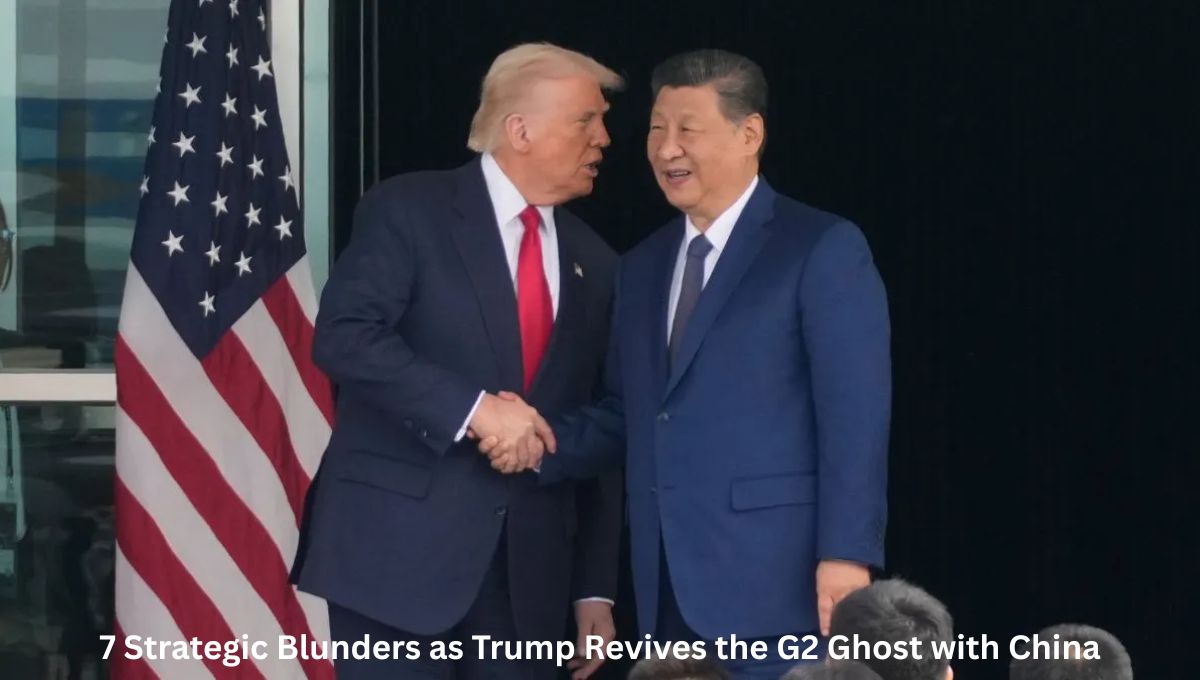
7 Strategic Blunders as Trump Revives the G2 Ghost with China — why it could backfire on the US. When US President Donald Trump unexpectedly declared that “the G2 will be convening shortly” ahead of his meeting with Chinese President Xi Jinping in South Korea, policymakers and analysts around the world scrambled to interpret the message.
For Washington’s allies — particularly India, Japan, and Australia — the statement rekindled memories of an idea long buried: a two-power condominium between the United States and China managing global affairs. The G2 concept, originally floated by economist C. Fred Bergsten in 2005 and sporadically referenced during the Obama era, envisaged a pragmatic partnership between the world’s two largest economies. But in 2025, Trump’s apparent attempt to resurrect it has sparked deep unease.
Experts warn that the move, while billed as pragmatic diplomacy, risks undoing years of coalition-building in the Indo-Pacific and could ultimately prove self-defeating for US strategic interests. This article analyses seven major strategic blunders embedded in Trump’s G2 revival — examining their causes, consequences, and what policy experts across Washington, Beijing, and New Delhi are saying.
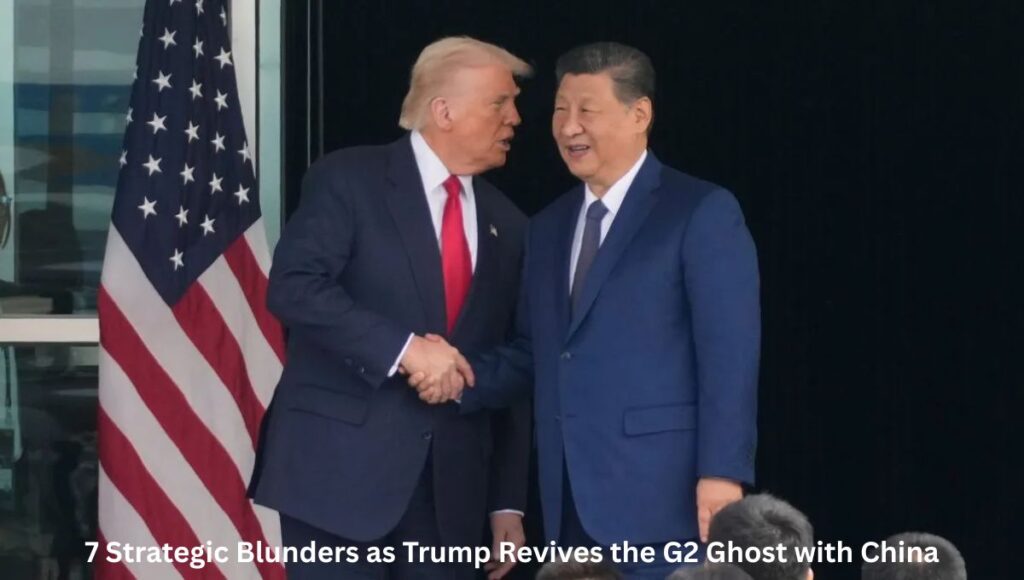
7 Strategic Blunders as Trump Revives the G2 Ghost with China
1. Undermining America’s Indo-Pacific Alliances
Cause
Trump’s outreach to Xi comes just years after Washington championed the Quad — an alliance of the US, India, Japan, and Australia aimed at balancing China’s assertiveness in the Indo-Pacific. The sudden pivot toward a bilateral G2 narrative has unsettled partners who invested heavily in Washington’s “free and open Indo-Pacific” vision.
Consequence
According to Dr Michael Green, CEO of the United States Studies Centre and former White House Asia adviser, “The signal to allies is unmistakable — America may once again be tempted by great-power bargains at the expense of regional partnerships.”
Tokyo and Canberra, both of which have expanded defence ties under the AUKUS and Quad frameworks, now face renewed uncertainty. For India, once hailed as the “linchpin” of US Indo-Pacific strategy, the G2 revival suggests a return to transactionalism.
Expert View
A Chatham House commentary notes that Trump’s G2 overture “risks hollowing out the very architecture that Washington spent the past decade building to contain Beijing’s influence.” Analysts stress that trust deficits created by such abrupt shifts take years — if not decades — to repair.
2. Alienating India — America’s Key Counterweight to China
Cause
India’s emergence as a strategic counterbalance to China has been a bipartisan consensus in Washington. Yet, Trump’s latest tariff hikes on Indian goods, combined with warm overtures to Beijing, have sent mixed signals.
Consequence
Dr Tanvi Madan of the Brookings Institution observes that “India perceives any US-China rapprochement as inherently destabilising for its security calculus.” India, facing an unresolved border dispute with China and a $15-billion trade deficit, views Washington’s U-turn as strategic abandonment.
Expert View
RAND Corporation’s Derek Grossman points out that “Trump’s G2 narrative effectively tells New Delhi that partnership with the US is expendable — a huge diplomatic gift to Beijing.” In response, India has modestly re-engaged China through economic and diplomatic channels, including reopening direct flights and approving selective investments. But policymakers in New Delhi remain wary, seeing Trump’s pivot as undermining their leverage in the Indo-Pacific order.
3. Weakening the Quad and Emerging Security Architecture
Cause
The Quadrilateral Security Dialogue, revived in 2017, was the centrepiece of America’s counter-China strategy. By now implying a two-power global compact, Trump risks marginalising the Quad’s raison d’être.
Consequence
CSIS analyst Bonnie Glaser notes that “Trump’s language undercuts the collective nature of deterrence in Asia. It signals a preference for bilateral deal-making over multilateral balancing.”
This has left member states questioning the US’s long-term reliability. In Tokyo, officials privately worry that a weakened Quad could embolden China’s grey-zone tactics in the East China Sea.
Expert View
An analysis from the Lowy Institute argues that “the Quad’s credibility rests on consistent US commitment. If that falters, regional states will hedge — deepening economic dependence on China even as they arm defensively.” The G2 narrative, therefore, does not merely revive a concept; it actively unravels years of alliance-building.
4. Misreading China’s Strategic Intentions
Cause
While Trump portrays the G2 as a pragmatic reset, Beijing views such offers through a lens of tactical patience. Chinese scholars at Tsinghua University told the Global Times that “China welcomes cooperation but rejects any arrangement implying shared hegemony.”
Consequence
As Dr Elizabeth Economy of the Council on Foreign Relations notes, “China plays a long game — accepting concessions today to strengthen its hand tomorrow.” Trump’s reduction of tariffs and easing of fentanyl restrictions may win short-term headlines but offer Beijing breathing space amid economic slowdown. In essence, Trump’s G2 overture may validate Xi’s vision of a multipolar order led by China, not shared with America.
Expert View
Dr Evan Medeiros of Georgetown University cautions that “the US should not mistake tactical cooperation for strategic convergence. Beijing seeks parity, not partnership.” China’s restrained response — urging “multilateralism” and downplaying G2 talk — underscores that Xi sees the concept as a tool, not a treaty.
5. Eroding US Credibility Among Middle Powers
Cause
In global politics, credibility is currency. By oscillating between confrontation and conciliation with Beijing, Washington risks appearing erratic.
Consequence
Professor Rory Medcalf of the Australian National University argues that “for middle powers like Japan, South Korea, and ASEAN states, predictability is as important as power. The G2 flirtation reinforces perceptions of American volatility.” Recent meetings between US and Chinese defence officials in Malaysia and South Korea have already left ASEAN capitals questioning whether Washington is reprioritising great-power harmony over regional security.
Expert View
The Economist Intelligence Unit notes that “China will capitalise diplomatically on this confusion, positioning itself as the stable interlocutor in an era of Western inconsistency.” In essence, Trump’s self-proclaimed “everlasting peace” narrative might end up legitimising Beijing’s rhetoric of “win-win cooperation” — while sidelining US allies.
6. Undervaluing Domestic Political Constraints
Cause
Trump’s foreign policy is often driven by personal conviction and electoral calculus rather than institutional consensus. His willingness to unilaterally reduce tariffs on Chinese goods and announce “peace through strength” without congressional consultation raises red flags in Washington.
Consequence
According to Foreign Affairs, Trump’s transactionalism “risks politicising US foreign policy to the point of paralysis.” With an election cycle underway and bipartisan hostility towards Beijing entrenched, a sudden G2 revival may face resistance from both Republicans and Democrats.
Expert View
Richard Haass, former president of the Council on Foreign Relations, wrote on X that “Trump may find that reviving the G2 idea is like resurrecting a ghost — politically seductive, but strategically unsustainable.”
If Congress refuses to fund China-related cooperation or if the Pentagon resists de-escalation, Trump’s G2 initiative could collapse under domestic pushback, weakening American diplomacy further.
7. Ignoring the Lessons of History
Cause
History offers precedents for great-power management — from the Concert of Europe to the G7 and the original G2 flirtations of 2008. Each failed when one power sought dominance rather than balance.
Consequence
Dr Henry Farrell of Johns Hopkins University observes that “any arrangement premised on equal partnership between unequal systems is inherently unstable.” The US and China operate on divergent political, economic, and value systems — democracy versus authoritarianism, market openness versus state capitalism.
Expert View
A Brookings analysis concludes: “The G2 is a mirage — it overestimates cooperation, underestimates competition, and neglects the agency of others.” By reviving it, Trump risks repeating the very miscalculations that defined the early 21st century: assuming interdependence guarantees stability, when in fact it magnifies vulnerability.
The Road Ahead
As Trump celebrates his “everlasting peace” with Xi, the structural realities of global politics remain unchanged. The United States and China are competitors locked in a systemic rivalry — economic, technological, and ideological. No tweet or handshake can suspend that competition.
For India and other Indo-Pacific states, Trump’s G2 rhetoric is a reminder that American policy can swing dramatically with each administration. Dr C. Raja Mohan of the Institute of South Asian Studies notes that “India must hedge against US unpredictability and pursue strategic autonomy with renewed vigour.”
Meanwhile, Japan and Australia are likely to double down on independent deterrence capabilities, and ASEAN will continue its cautious balancing act. If Washington truly wishes to sustain leadership, analysts argue, it must invest in alliances, not illusions. The United States cannot counter Beijing’s ambitions by romanticising a bygone era of great-power duopoly.
The future of the Indo-Pacific will be shaped not by a G2, but by a web of partnerships that reflect 21st-century multipolar realities. Trump’s G2 revival may thus go down as a diplomatic paradox — a gesture meant to project strength, but one that exposes strategic fragility. The lesson for policymakers, as RAND’s Grossman aptly summarises, is simple: “In trying to share the world with China, America may end up losing its world.”
Also Read: 5 Key Breakthroughs as Trump and Xi Seal Major U.S.–China Trade Reset
Also Read: How Trump’s revival of G2 ghost is self-defeating for the US