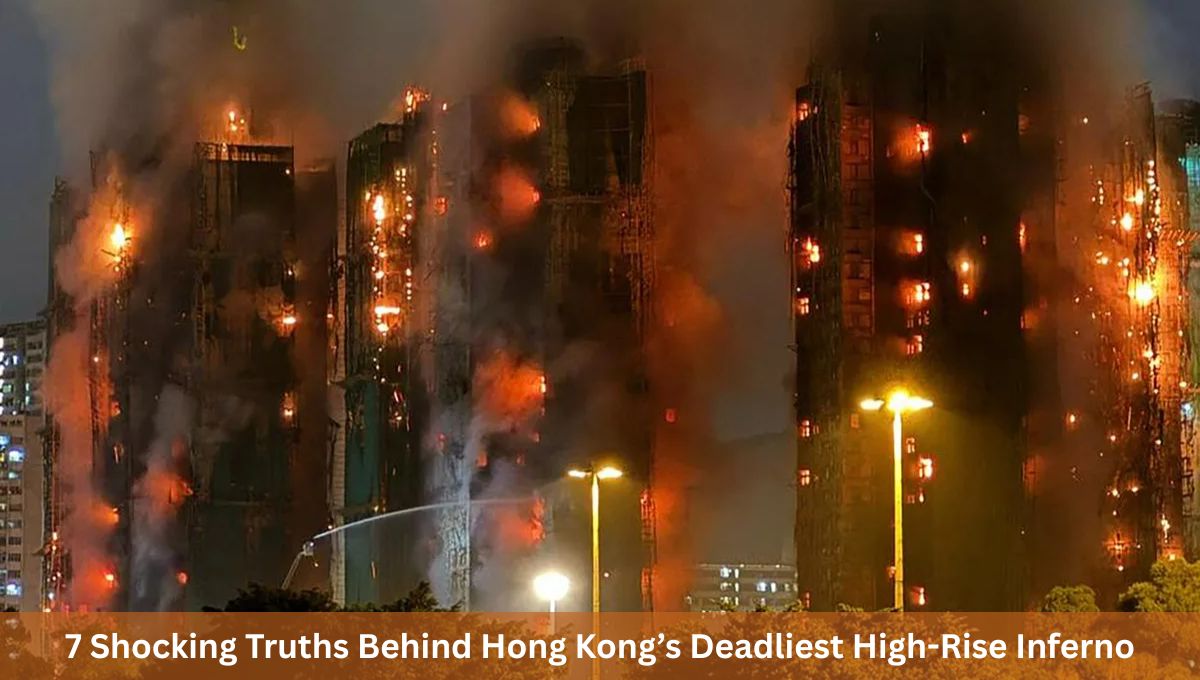
7 Shocking Truths Behind Hong Kong’s Deadliest High-Rise Inferno: 44 Dead, nearly 300 missing. The towering residential blocks of Wang Fuk Court in Hong Kong’s Tai Po district were once considered an ordinary, quiet government housing estate. Home to nearly 5,000 residents, the cluster of eight 32-storey towers stood as a typical example of the city’s high-density living.
But within minutes on a tragic Wednesday afternoon, these concrete homes transformed into the site of Hong Kong’s deadliest high-rise fire in modern history—a catastrophe that has shaken the entire city and reignited national debate over renovation safety, building regulations, and disaster preparedness.
At least 44 people are confirmed dead, including a 37-year-old firefighter, and nearly 300 residents remain unaccounted for as rescue crews continue to sift through the ashes. For a city accustomed to efficiency and crisis management, the scope of this disaster is almost unimaginable.
Residents trapped behind sealed windows, collapsing scaffolding, flammable renovation materials, and powerful winds combined to create a firestorm that experts say was “almost impossible to contain.” This is the complete story of what happened, how it spiraled out of control, and why the Wang Fuk Court inferno will go down as one of the darkest days in Hong Kong’s history.
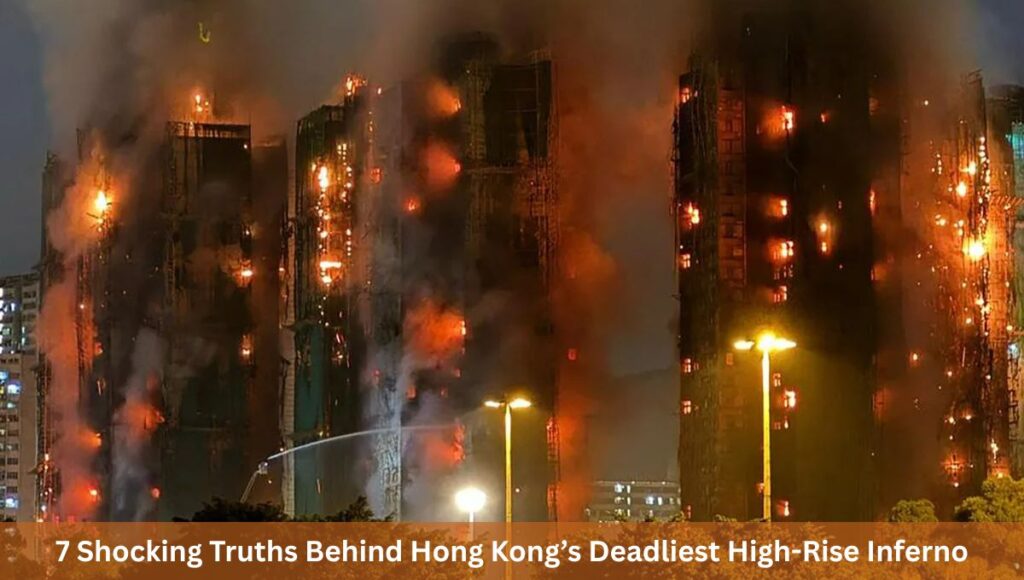
7 Shocking Truths Behind Hong Kong’s Deadliest High-Rise Inferno
The Fire That Changed Hong Kong Forever
How the Blaze Ignited
The fire began shortly before 3 p.m. on Wednesday at Wang Cheong House, one of the towers undergoing renovation. Like many Hong Kong buildings, the exterior was encased in bamboo scaffolding, wrapped in layers of plastic construction netting and sheeting to prevent debris from falling onto pedestrians.
But this very combination—scaffolding, plastic coverings, and wind tunnels—would become the destructive mechanism that turned a routine renovation into a citywide tragedy. Firefighters later revealed that the flames ignited somewhere on the scaffolding structure, quickly catching onto the plastic nets, fabric sheets, and protective coverings.
The materials, all highly flammable, acted like fuel soaked in accelerant. Within minutes, the blaze spiraled upward, racing along the bamboo framework and climbing multiple floors in rapid succession.
Strong Winds Turned the Towers Into Chimneys
Tai Po often experiences strong air currents due to the layout of its residential clusters. On the day of the fire, these winds funneled through the narrow spaces between the eight towers of Wang Fuk Court, creating a chimney-like suction effect.
Instead of slowing the flames, the wind pulled oxygen through the scaffolding, feeding the fire and propelling it upward. Within 30 minutes, the entire face of Wang Cheong House was engulfed. The fire leapt to adjacent buildings as burning plastic and bamboo collapsed, sending fiery debris crashing onto lower floors and neighboring towers.
Videos captured by residents show the terrifying speed of the blaze—an entire section of the building swallowed by flames in mere seconds.
The Human Tragedy: Lives Lost, Hundreds Missing
The Death Toll
As of the latest official count, 44 people have been confirmed dead, including:
- Residents found inside apartments
- Individuals who collapsed during evacuation
- A 37-year-old firefighter, Ho Wai-ho, who fell unconscious during a rescue mission and later died in hospital
Nearly 300 Missing
Between 279 and 300 residents remain unaccounted for. Authorities caution that not all may be trapped; some may have evacuated without registering, fled to relatives’ homes, or simply cannot be contacted.
“We cannot assume all missing individuals are deceased or trapped,” said Secretary for Security Chris Tang. “But the number is deeply worrying.”
Families gathered outside emergency shelters, clutching photos and calling relatives’ phones endlessly, praying for one more ring tone.
Scenes of Chaos and Desperation
Residents described pitch-black hallways filled with choking smoke. Many attempted to escape but found staircases blocked by flames, melted scaffolding debris, or collapsed plastic sheets.
Some survivors said they tried to break windows to escape the heat but were shocked to discover polystyrene foam boards sealing the windows—materials installed by contractors as part of the renovation project. These foam boards, not only flammable but also insulating, trapped residents in airless rooms filled with toxic smoke.
A tearful survivor said:
“We were trapped like animals. The windows wouldn’t open. The fire kept coming closer. We thought we would die there.”
The Scaffolding Catastrophe: A Systemic Failure
Why Bamboo Scaffolding Was a Major Contributor
Hong Kong is one of the few modern cities that still extensively uses bamboo scaffolding—a traditional method known for flexibility, strength, and low cost. But firefighters and construction experts confirm that bamboo also burns easily, especially when paired with plastic mesh and synthetic coverings.
When the fire jumped to the plastic netting that wrapped the bamboo structure, the entire setup ignited like a torch. The scaffolding acted both as a fuel source and a vertical highway for the fire to race up 30-storey exteriors.
One expert described it as:
“A full building-sized bonfire.”
Use of Flammable Window Materials
Police later uncovered that several windows were sealed with flammable polystyrene foam boards—a shocking lapse in safety.
These foam boards prevented:
- Heat from escaping
- Smoke ventilation
- Windows from opening
- Residents from using fire hoses out of the window
Firefighters called the foam boards “a death trap for anyone inside.”
Arrests and Accountability
Three People Arrested for Manslaughter
Police arrested three men connected to the renovation company responsible for the works:
- Two company directors
- One engineering consultant
They are being investigated for gross negligence, illegal use of materials, and manslaughter, after investigators found:
- Foam boards used to seal windows
- Non-standard construction materials
- Insufficient scaffolding safety clearance
- Use of flammable coverings
“These decisions cost lives,” police stated bluntly.
Lawmakers Demand Industry-Wide Reform
Legislators are now calling for:
- New rules on scaffolding materials
- A ban on flammable coverings
- Mandatory audits for renovation contractors
- A review of Hong Kong’s reliance on bamboo scaffolding
Public anger is mounting, with many demanding criminal charges, resignations, and systemic reform.
The Rescue Operation: Heroism Amid Chaos
Over 800 Firefighters Deployed
Hong Kong mobilized one of the largest rescue operations in its history:
- 800+ firefighters
- 128 fire trucks
- 57–60 ambulances
Fire services battled extreme heat, collapsing scaffolds, and toxic smoke for more than 16 hours before the blaze was considered “under control.”
Why Helicopters Could Not Be Used
Many residents questioned why helicopters did not drop water onto the buildings.
Experts explained:
- Strong winds would blow water sideways
- Water drops could push flames deeper into the building, trapping more people
- Flying close to burning scaffolding is life-threatening
Firefighters defended their strategy, stating that helicopter deployment would have increased casualties rather than reduced them.
Human Stories from the Ashes
A Community Uprooted
More than 1,000 residents fled the estate during the disaster.
Nearly 900 were placed in emergency shelters.
Families arrived carrying children, elderly relatives, and essential belongings stuffed into shopping bags. Some had no time to collect even their wallets or shoes.
One mother, covered in soot, recounted:
“We lost everything. Our home, our documents, our memories. But we survived. Many didn’t.”
The Last Moments of a Firefighter
Firefighter Ho Wai-ho collapsed during a life-saving mission. Despite immediate medical assistance, he succumbed to his injuries.
He leaves behind a wife and two young children.
Hong Kong residents lined up outside fire stations the next morning to lay flowers in his honor.
Government Response and Political Fallout
John Lee Calls It a “Major Disaster”
Hong Kong Chief Executive John Lee visited the shelters and pledged:
- full support for survivors
- immediate housing relocation
- investigation into renovation firms
- financial assistance for affected families
He admitted the tragedy exposed “serious problems” in safety oversight.
Xi Jinping Issues Condolences
Chinese President Xi Jinping issued an official statement urging Hong Kong to:
- spare no effort in rescue
- treat injured residents urgently
- prevent secondary disasters
- help displaced families
Why This Fire Is Now the Worst in Hong Kong’s History
A Disaster Decades in the Making
The Wang Fuk Court fire now surpasses:
- The 1996 Garley Building fire (41 deaths)
- The 2016 Mong Kok fire
- The 1997 Mei Foo Sun Chuen fire
This was not a single failure—it was a stacked chain of systemic issues:
- flammable renovation materials
- outdated scaffolding safety rules
- sealed windows
- strong wind corridors
- delayed cross-tower evacuations
- dense population
Experts say it was “a perfect storm of lethal factors.”
The Future: Will Hong Kong Change?
Calls for a Full Overhaul of Construction Safety
Safety groups are demanding:
- a ban on foam window insulation
- replacing bamboo scaffolding with metal
- stricter fire inspections during renovations
- real-time public updates during emergencies
Residents Demand Justice
Families of missing residents say they will pursue legal action. Lawyers expect civil cases and class-action lawsuits against:
- the renovation contractor
- the Housing Authority
- related subcontractors
Trust in Hong Kong’s building safety systems has been shaken to its core.
Final Word
The inferno at Wang Fuk Court was more than a fire—it was a national wake-up call. A tragic combination of systemic failures, dangerous materials, wind conditions, and oversight gaps led to one of the deadliest disasters Hong Kong has ever witnessed.
As search teams continue to uncover the full scale of devastation, Hong Kong faces a hard truth:
This tragedy was preventable. And unless major reforms follow, it could happen again.
Also Read: 7 Shocking Moments from the COP30 Brazil Fire Chaos
Also Read: What we know about Hong Kong’s deadly high-rise fire
Related Posts:
- 7 Shocking New Revelations as Hong Kong Fire Death…
- 7 Shocking Findings Behind Hong Kong’s Deadliest…
- 7 Heartbreaking Facts About Venezuela's Earthquake Disaster
- Saudi Arabia to Open Property Market to Foreign…

- Israel-Iran War Escalates: Cluster Bombs, Missile…

- 5 Major Takeaways from the US Supreme Court's…