

7 Shocking Moments from the COP30 Brazil Fire Chaos that disrupted key climate negotiations. The COP30 climate summit in Belem, Brazil, was thrown into sudden disarray when a massive fire tore through part of the Blue Zone—triggering panic, halting negotiations, and forcing thousands of delegates, journalists, and staff to flee the venue.
The incident, which Brazilian authorities say was likely caused by a microwave or other electrical equipment, came at a critical moment as negotiators were scrambling to finalize key climate agreements. Within minutes, towering smoke clouds billowed over the temporary structures, videos flooded social media, and emergency responders rushed to the site.
At least 21 people received medical treatment—19 for smoke inhalation and two for anxiety—though officials confirmed that no burn injuries occurred and all patients were either discharged or receiving appropriate care. The blaze, while controlled swiftly within six minutes, resulted in the temporary shutdown of the Blue Zone and a ripple effect on an already tense summit schedule.
With the conference set to conclude on Friday, the unplanned disruption has added fresh uncertainty to already strained negotiations. Here’s a full breakdown of everything that happened, what investigators know so far, and how the fire threatens to derail COP30’s final stretch.
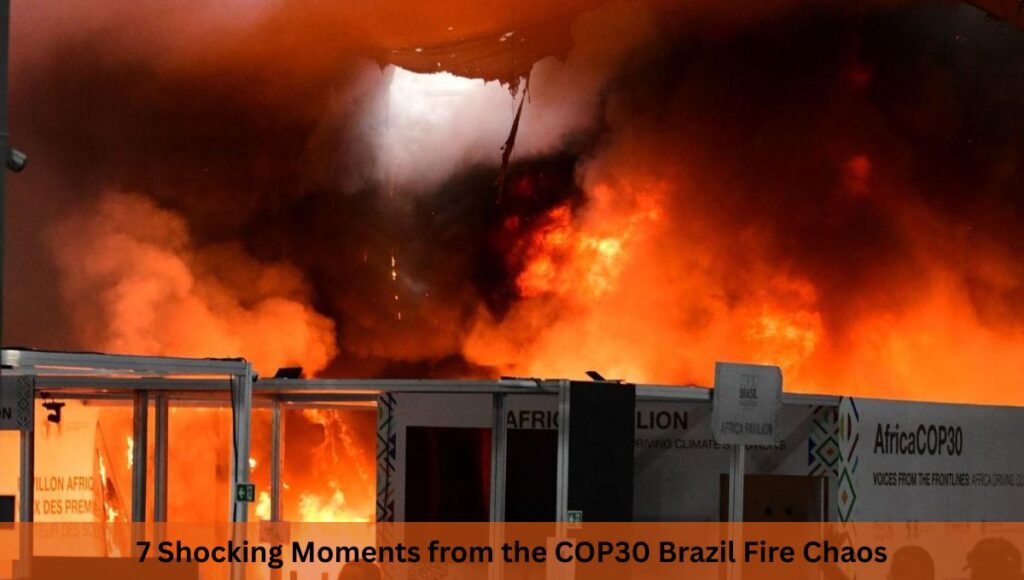
7 Shocking Moments from the COP30 Brazil Fire Chaos
How the COP30 Blue Zone Fire Unfolded
A sudden flash of flames at 2 pm local time
The fire erupted around 2 pm on Thursday inside the Blue Zone pavilion—a restricted and highly secured area that houses:
- negotiation rooms
- country pavilions
- media centres
- offices of top dignitaries
- the main plenary hall
Witnesses described scenes of chaos as flames spread quickly to decorative textiles lining the temporary structure. Huge black plumes rose above the venue and were visible from several kilometres away.
Security personnel immediately began shouting “Evacuate! Evacuate!” as people sprinted in all directions, seeking exits.
Fire controlled in six minutes
The Brazilian fire service, working alongside UN security officers, controlled the fire swiftly. Their rapid intervention prevented what could have been a catastrophic incident in a venue hosting more than 190 country delegations.
Officials later said the likely cause was an electrical malfunction—possibly a microwave, though investigations are ongoing.
Evacuation of Thousands: “People Ran Out of Every Exit Gate”
The fire triggered a full-scale evacuation of the entire Blue Zone. Security officers formed a human barrier across the main hallway to redirect delegates toward open areas.
Scenes of panic unfolded as some people ran, others shouted warnings, and staff attempted to maintain order. Heavy rains struck minutes after the fire broke out, leaving thousands of attendees—already outside due to the evacuation—stranded in the open as they waited for updates.
A UNDSS “Flash Report” recap noted:
“Security personnel immediately responded using fire extinguishers until firefighters arrived. The fire was fully controlled. Some panic ensued as people began leaving the area.”
All United Nations Security Management System (UNSMS) personnel were later confirmed safe and accounted for.
21 People Injured — Mostly Smoke Inhalation
Brazil’s Ministry of Health issued an evening update confirming:
- 19 cases of smoke inhalation
- 2 cases of anxiety episodes
- 0 burn injuries
Twelve were discharged promptly, with others under observation in Belem’s health facilities.
The Ministry said:
“Municipal, state and federal health teams continue to monitor the medical assistance and health status of those affected.”
The UN confirmed that emergency protocols worked exactly as planned, aiding quick treatment and evacuation.
UN Secretary-General Antonio Guterres Was Inside the Blue Zone
One of the most dramatic revelations came from officials confirming that UN Secretary-General António Guterres was inside the venue at the time of the fire.
UNDSS protection officers “promptly evacuated” him, executing their emergency protocol flawlessly.
India’s Environment Minister Bhupender Yadav and the Indian delegation were also inside the Blue Zone but exited safely, according to the Environment Ministry.
Blue Zone Shutdown Throws COP30 Negotiations Into Chaos
The fire could not have come at a worse time.
Negotiators were in the middle of finalizing a new draft of the “mutirão” decision text, which is expected to guide global efforts on:
- phasing down fossil fuels
- climate finance for developing nations
- carbon space and equity
- adaptation measures
- energy transition pathways
Dozens of crucial talks were scheduled for the afternoon, including meetings with:
- Alliance of Small Island States
- the European Union
- major negotiating blocs
All were immediately cancelled or postponed, pushing COP30 further behind schedule and raising expectations that the summit may need to extend beyond Friday.
Observers now fear the fire disruption could affect the intensity and closure of the summit’s most contentious agenda items, including the fossil fuel roadmap.
India’s Concerns: “Momentum Could Be Lost”
For India, the incident amplified existing concerns around the summit’s tight timeline and fragile negotiations. India has repeatedly emphasized:
- equity
- climate justice
- concessional finance
- differentiated responsibilities
- protection of developing nations’ carbon space
Indian negotiator Suman Chandra warned:
“Without scaled-up finance, developing nations cannot adequately mitigate or adapt.”
Indian officials worry that the sudden halt in negotiations could weaken commitments on finance and dilute the language of the fossil fuel transition roadmap.
Infrastructure Concerns Resurface
Just a week earlier, UN Climate Change chief Simon Stiell had expressed deep concern over infrastructure issues at the COP30 venue. He wrote to Brazilian President Luiz Inácio Lula da Silva detailing:
- unsecured doors
- water leaks near electrical fixtures
- questions about emergency preparedness
Brazilian authorities said they addressed all concerns—but Thursday’s fire has renewed scrutiny of venue safety.
Authorities Close, Inspect, and Reopen the Blue Zone
Immediately after the fire, Brazilian emergency authorities assumed control of the venue.
The UNFCCC issued an urgent bulletin:
“The premises are now under the authority of the Host Country and are no longer considered a Blue Zone.”
Fire services conducted a full safety sweep. The Blue Zone was reopened after more than six hours, at 8:40 pm local time, but the country pavilion area (Zone B) remains closed for the rest of the summit.
The Green Zone, which hosts exhibitions and public events, was never affected and remained open throughout.
COP30 Presidency Urges Solidarity: “We Have Substantial Work Ahead”
In a joint statement, the COP30 Presidency and the UNFCCC assured delegates that the disruption would not derail the summit:
“We still have substantial work ahead, and we trust that delegates will return in a spirit of solidarity and determination to ensure a successful outcome.”
They emphasized:
- plenaries will resume the next day
- all sessions will be live-streamed
- media and observers will be kept fully informed
With limited time left, negotiators are now deep in shuttle diplomacy.
Day 10: Fire Overshadows Progress on Food Systems and Fossil Fuels
Before the fire broke out, Day 10 of COP30 had been dedicated to agriculture and land use, with major announcements including:
The RAIZ Accelerator
A public–private initiative aimed at:
- restoring degraded farmland
- boosting climate-resilient agriculture
- strengthening food systems
Alliance of Champions for Food Systems Transformation
An expanded coalition of countries committing to sustainable agricultural reforms.
Simon Stiell noted:
“This conference is delivering real-world climate actions that will mean stronger economies, more jobs and better lives for millions.”
But momentum was disrupted when the fire stopped all negotiations.
Fossil fuel roadmap debate intensifies
More than 80 countries continued pushing for a formal commitment to phase out fossil fuels, a key component of the “Belem Package” expected to emerge from COP30.
The fire’s timing means this politically charged issue may now go into overtime.
Eyewitness Accounts Capture the Panic
Independent journalist Fernando Ralfer Oliveira, who recorded early footage of the blaze, described:
“A commotion of people started running… Someone shouted ‘Fire, fire, fire!’… Security was already coming in force saying ‘Evacuate, evacuate’.”
Delegates were escorted toward food court areas outside the pavilion, unsure when they could return.
Could the Fire Derail COP30’s Final Outcome?
While the fire caused no fatalities and relatively few injuries, its impact on negotiations may be far more consequential.
Key questions now hang over the summit:
- Will negotiators regain enough time to finalize the fossil fuel roadmap?
- Can developing nations secure adequate finance commitments?
- Will the mutirão text retain ambitious climate language?
- Will the summit need to be extended?
With only hours left, the fire has added pressure, uncertainty, and urgency to a summit already grappling with political divides and infrastructure concerns.
Conclusion: Fire Extinguished, Pressure Rising
The fire at COP30’s Blue Zone has become one of the most dramatic moments of the 2025 climate summit—an event marked by urgency, geopolitical tension, and high-stakes negotiations. While firefighters brought the flames under control within minutes, the disruption they caused may reverberate for the remainder of the conference.
With the clock ticking down and negotiators scrambling to salvage a meaningful agreement, COP30 will now be judged not only by the deals it delivers but also by how effectively it recovers from this unexpected crisis.
Whether the summit ends with a breakthrough or a weakened outcome may depend on how quickly delegates can regain momentum in the final hours ahead.
Also Read: 7 Key Developments as China Steps In and Trump Skips COP30
Also Read: COP30 schedules in disarray after fire razes part of venue
Related Posts:
- 7 Alarming Forces Driving the COP30 Climate Summit…

- 7 Powerful Shifts at COP30 as 80 Nations Demand a…

- 7 Heartbreaking Facts About Venezuela's Earthquake Disaster

- 7 Key Developments as China Steps In and Trump Skips COP30

- 5 Major Takeaways from the US Supreme Court's…

- Afghanistan–Pakistan War 2025: Inside the 48-Hour Ceasefire
