7 Alarming Forces Driving the COP30 Climate Summit to the Brink over fossil fuel phaseout, climate finance, and equity. The 2025 United Nations Climate Change Conference, COP30, has entered its most dramatic and contentious phase yet. What was expected to be a decisive moment in global climate action has instead turned into a tense standoff in Belém, Brazil, where the two-week summit is now running far past its scheduled end.
At the center of the crisis is a stunning development: the latest draft deal contains no mention of fossil fuels at all—despite global expectations that COP30 would deliver a strengthened commitment to move the world away from coal, oil, and gas.
The omission has triggered outrage from dozens of nations, civil society groups, and youth activists, who see this as a retreat from the already fragile progress made at COP28 in Dubai. It has also revealed a deeper truth: the global climate system is under severe strain, and consensus is becoming harder to achieve as geopolitical divides widen.
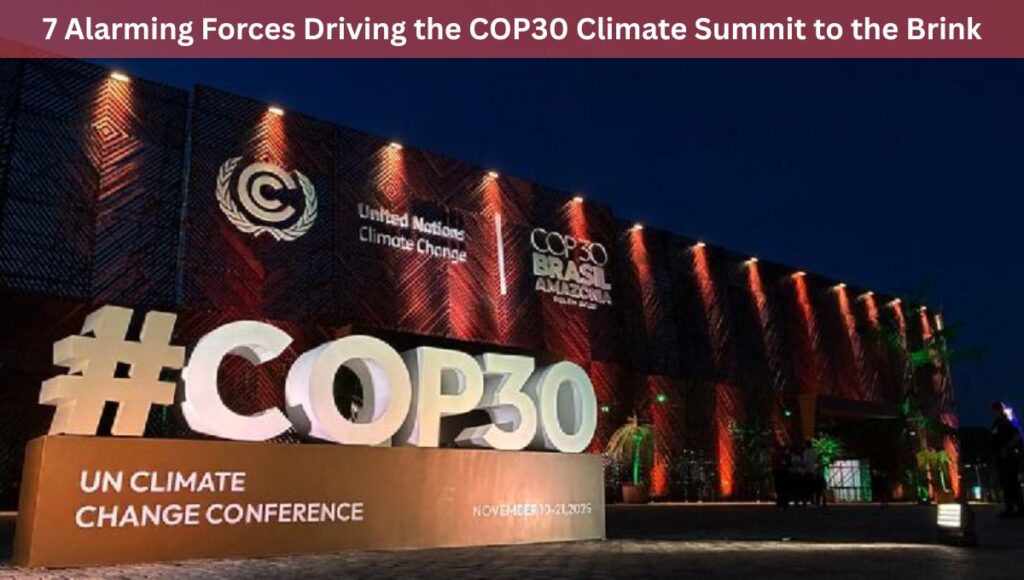
7 Alarming Forces Driving the COP30 Climate Summit to the Brink
A Fractured Summit Runs Overtime
The official schedule had set COP30’s conclusion for Thursday evening, but that deadline evaporated as talks descended into deadlock.
Negotiating rooms remained sealed, journalists camped in hallways, and delegations scrambled to find accommodations as cruise ships moored in the Amazon port city were set to depart.
According to negotiators inside the room, the atmosphere has grown heated. One diplomatic source speaking to the BBC admitted simply:
“There is a lot of fighting.”
Brazil, as the summit host, has pushed for a unifying outcome. Yet even President Luiz Inácio Lula da Silva’s personal involvement in shuttle diplomacy has not been enough to break the impasse.
Brazil’s leadership had initially signaled strong support for a fossil fuel transition roadmap, raising expectations worldwide.
But the new “Mutirão” text, released in the early hours of Friday morning, reversed course entirely—removing the core element many nations expected and demanded.
Why the Fossil Fuel Roadmap Matters
A Turning Point Lost
The global community had hoped that COP30 would mark a transformational moment: the first clear pathway for reducing fossil fuel use in alignment with the Paris Agreement temperature goals. A roadmap, even a flexible one, would have provided direction for how countries could meet the targets of:
- 43% emissions reduction by 2030,
- 60% by 2035, and
- Net-zero by 2050.
Instead, the final text avoids even naming fossil fuels. Instead of concrete commitments, it merely acknowledges the likelihood of exceeding the 1.5°C warming limit, a goal once considered the non-negotiable cornerstone of global climate policy.
A Powerful Bloc Blocks Progress
The strongest resistance to a fossil fuel roadmap came from a coalition of major energy producers and consumers:
- China
- India
- Saudi Arabia
- Russia
- Nigeria
These countries argue that developed nations—who built their wealth on fossil fuels—should bear the heaviest responsibility for cutting emissions. They also emphasized energy security and developmental needs for billions of people still living without reliable power.
A Growing Coalition Demands Action
Almost 30 nations, led by Colombia, fiercely opposed the removal of the fossil fuel language. They co-signed a letter declaring:
“We cannot support an outcome that does not include a roadmap for implementing a just, orderly and equitable transition away from fossil fuels.”
More than 80 nations backed a separate declaration insisting that the climate crisis cannot be tackled without directly confronting fossil fuels.
France, the EU, island nations, many African states, and Latin American countries echoed this sentiment.
Climate Finance Becomes the Dealbreaker
While fossil fuels dominate headlines, another issue is equally explosive: climate finance.
Developing nations argue they cannot transition away from fossil fuels—or adapt to climate impacts—without the financial support already promised by rich countries.
A Long-Promised Obligation
Under Article 9.1 of the Paris Agreement, developed countries are legally required to provide financial resources to developing nations for climate mitigation and adaptation.
COP30’s text reaffirms this obligation and announces:
- A two-year work programme to address climate finance
- A call to triple adaptation finance by 2030
- A reference to scaling flows to $1.3 trillion per year by 2035
However, the text does not specify who will pay, leaving developing countries frustrated.
Pakistan’s delegation put it bluntly:
“Who will pay the cheque? That is the question.”
Many vulnerable nations argue they cannot sign onto a fossil fuel transition without parallel guarantees of funding.
US Absence Deepens the Crisis
COP30 is the first climate summit in a decade to occur without participation from the United States. President Donald Trump, who returned to office earlier this year, has long dismissed climate change as a “hoax,” and his administration withdrew entirely from the negotiations.
This absence has had profound effects:
- It removed a historically crucial voice that once supported a fossil fuel phaseout.
- It weakened pressure on Saudi Arabia, India, and other resistant states.
- It shifted more responsibility onto the EU, vulnerable nations, and Brazil.
Without Washington’s diplomatic weight, the balance of power at COP30 has visibly shifted.
Fires, Infrastructure Failures, and Chaos at the Venue
As if negotiations weren’t strained enough, COP30 experienced multiple disruptions:
A Fire Erupts in the Pavilion
On Thursday, a sudden fire tore through an exhibition pavilion’s internal structure. The blaze lasted only minutes but forced a full evacuation.
- 19 delegates were treated for smoke inhalation.
- The summit was closed for hours.
- Already-delayed negotiations stalled further.
Infrastructure Issues
Delegates reported:
- Electrical malfunctions
- Air-conditioning failures
- Structural concerns
The Amazon rainforest’s heat and humidity compounded these problems, adding physical discomfort to diplomatic tension.
Activists, Youth, and Indigenous Leaders Demand Accountability
Outside negotiating rooms, the atmosphere was equally intense.
Protesters Rally for Fossil Fuel Action
Campaigners filled hallways and plazas with banners reading:
- “Fossil fuels out”
- “Stop Amazon oil”
- “1.5°C under threat: time to act”
The energy reflected frustration that countries were retreating from commitments seen as essential to humanity’s survival.
Mexican youth organizer Shurabe Mercado said:
“A good outcome could mean giving us a future and a present worth fighting for.”
Indigenous Voices: Present but Not Heard
COP30 included the largest representation of Indigenous delegates in UN climate history. Yet many leaders said they still felt ignored, despite being recognized as the world’s most effective guardians of biodiversity.
Their message was simple:
There is no climate solution without protecting forests and Indigenous rights.
The “Mutirão” Text: A Compromise or a Collapse?
The final draft presented in Belém—named after the Portuguese term for “collective effort”—reflects a global community divided on fundamental issues.
What the Text Includes
The draft:
- Recognizes the dwindling carbon budget
- Reaffirms commitment to the Paris Agreement
- Calls for enhanced international cooperation
- Launches a Global Implementation Accelerator
- Addresses trade-related climate challenges
- Reiterates 2030 goals on deforestation
What the Text Leaves Out
Crucially, it omits:
- Mention of fossil fuels
- A roadmap for transition
- A new adaptation finance goal
- Clear commitments for developed countries
Many developing nations see this as a partial victory on finance but a sweeping failure on equity.
Climate policy expert Arunabha Ghosh summarized the sentiment:
“The global south is not asking for favours—it is asking for the basic foundations needed for a fair and effective climate response.”
Trade, Equity, and the Global Divide
Trade policy emerged as a major sticking point. Countries such as China and India strongly oppose unilateral climate-linked trade measures like the EU’s Carbon Border Adjustment Mechanism (CBAM).
COP30’s text offered a subtle compromise, stating such measures must not become disguised restrictions on trade.
Yet experts noted that the compromise favored developed countries and may limit developing nations’ negotiating leverage in the future.
A Summit at the Edge of Failure—and the World Still Watches
The world’s attention now turns to Belém as negotiators push through the final hours and possibly the weekend.
UN Secretary-General Antonio Guterres has urged nations to confront disinformation and act with unity:
“Communities on the front lines are watching too, counting flooded homes, failed harvests, lost livelihoods.”
With extreme weather intensifying and global trust diminishing, COP30 is more than a diplomatic gathering—it is a test of whether multilateral climate cooperation can still function.
What Happens Next?
Three Scenarios Loom
- A Weak Deal Passes
A consensus text lacking fossil fuel language becomes the final outcome. Many countries accept it reluctantly, citing lack of alternatives. - Countries Reject the Text—COP30 Ends Without a Deal
A no-deal scenario would be unprecedented and potentially devastating to global climate governance. - A Last-Minute Breakthrough
Fresh language is added under immense pressure, preserving a pathway to fossil fuel transition.
Brazil, as host, is under intense scrutiny to steer talks back toward meaningful action. The world will judge whether COP30 becomes a historic milestone—or a missed opportunity.
Conclusion: COP30 Reveals a World Divided, But Not Without Hope
The controversy engulfing the COP30 negotiations is not simply a political dispute—it reflects the profound and unequal realities of a planet in crisis.
While nations disagree on responsibility, timelines, and finance, the scientific reality remains unchanged:
Fossil fuels are the primary driver of climate change, and every year of delay increases human suffering.
The road ahead will be turbulent, but the voices of youth activists, Indigenous communities, vulnerable nations, and a growing coalition of climate-ambitious countries show that the demand for bold action is stronger than ever.
Whether COP30 ends in progress or paralysis, the fight for a safer future continues—and the world will remember what was done, or not done, in Belém.
Also Read: 7 Powerful Shifts at COP30 as 80 Nations Demand a Fossil Fuel Phase-Out Roadmap
Also Read: At UN climate summit, world leaders say time is running short to stop the worst effects of warming
Related Posts:
- 7 Powerful Shifts at COP30 as 80 Nations Demand a…

- 7 Shocking Moments from the COP30 Brazil Fire Chaos

- Lula Slams Trump’s 50% Tariff as “Unacceptable…

- 7 Key Highlights That Will Shape the High-Stakes G20…

- In 8 Moves, EU Targets China-Linked Refineries and…

- 9 Explosive Claims as Trump Says US Winning Iran War