

7 Powerful Shifts at COP30 as 80 Nations Demand a Fossil Fuel Phase-Out Roadmap amid stiff resistance from petro-states. At COP30 in Belem, Brazil, the global climate fight has reached a new turning point — and a moment of reckoning. More than 80 countries across continents have issued the strongest collective demand yet: create a global, time-bound roadmap to phase out fossil fuels.
From African nations to Pacific small island states, from European Union members to countries across Asia and Latin America, a diverse coalition is urging negotiators to put fossil fuel transition where it belongs — at the heart of the global climate agenda.
But even with this historic show of unity, deep divides remain. Political resistance from petro-states, competing development priorities, and a lack of climate finance continue to obstruct progress. Meanwhile, the Brazilian presidency — despite being hailed as a champion of climate ambition — has struggled to navigate competing pressures within its own government.
This is the story of how COP30 became a battleground for the most important issue still missing from the official agenda: a roadmap to phase out oil, gas, and coal.
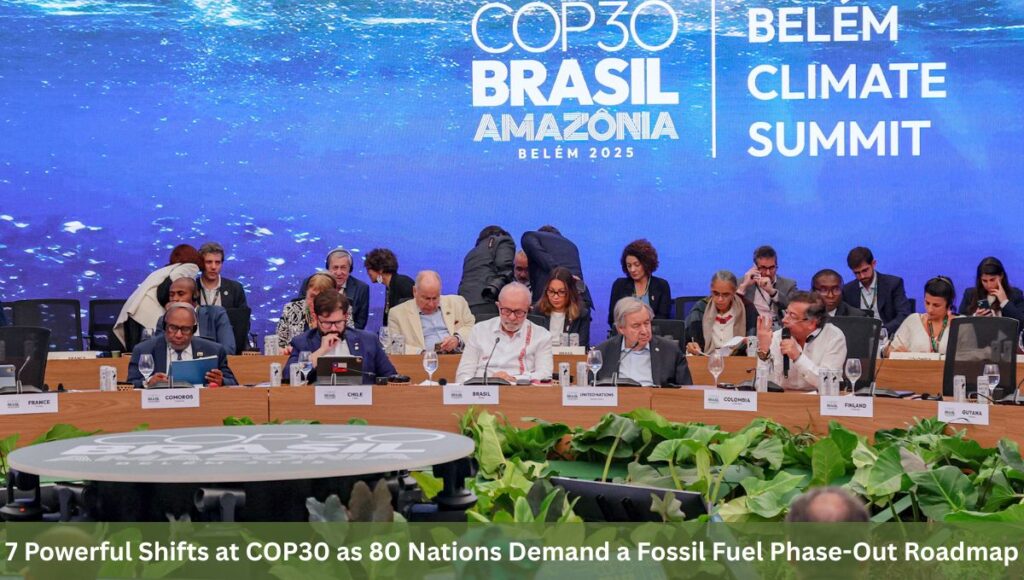
7 Powerful Shifts at COP30 as 80 Nations Demand a Fossil Fuel Phase-Out Roadmap
A Historic Call: 80+ Nations Unite for a Fossil Fuel Roadmap
In a packed hall in Belem, the call came loud and clear. Surrounded by ministers representing 20 nations, Marshall Islands climate envoy Tina Stege stood before delegates and urged the world to rally behind a fossil fuel phase-out roadmap.
“Let’s get behind the idea of a fossil fuel roadmap,” Stege said. This wasn’t a symbolic plea. It was a coordinated, strategic demand that had been brewing for days as discussions hit stalemate.
Activists outside the venue, including 40,000 people marching through Belem, echoed the same message: no fossil fuel roadmap, no credible path to keeping global warming below 1.5°C.
Greenpeace International’s Jasper Inventor declared the moment:
“the turning point of COP30.”
This level of unity — from the Global North and Global South alike — is unprecedented. But it comes at a time when global emissions are still rising, and when the world is projected to heat between 2.4°C and 2.8°C by the end of the century, according to the latest climate models.
Three COPs Later: Why the Roadmap Still Doesn’t Exist
The demand for a fossil fuel phase-out roadmap didn’t emerge from thin air. It’s rooted in three years of global climate politics:
COP28 (Dubai)
The world finally agreed to “transition away from fossil fuels,” but the language was vague and immediately contested by oil-producing nations.
COP29 (Baku)
Negotiators were unable to agree on how to implement or operationalize that commitment.
COP30 (Belem)
Shockingly, Brazil removed fossil fuel transition from the official negotiating agenda altogether — even excluding it from closed-door debates on finance and NDCs.
This omission forced supportive countries to take matters into their own hands, culminating in the powerful collective demand we are witnessing today.
Brazil’s Draft Text: Hope, But Not Enough
A new Brazilian draft decision text released on Tuesday included, for the first time, the possibility of a fossil fuel phase-out roadmap.
But many nations — including Vanuatu and several African states — say it lacks:
- measurable targets
- deadlines
- clear guidance on finance
- commitments to equity
Supporters emphasized that a roadmap does not force identical timelines on every nation. Instead, it recognizes:
- different starting points
- varying capabilities
- the need for climate finance
- the need for technology transfer
The Global South stressed that without financing commitments, no roadmap will be achievable or fair.
Why COP30 Still Can’t Agree: The Three Major Roadblocks
1. Petro-States are Blocking Progress
Countries like:
- Saudi Arabia
- Russia
- Bolivia
continue to resist any language referencing fossil fuel phase-out. They argue that oil and gas remain essential for economic stability and claim that alternative proposals lack realism. Saudi Arabia reportedly threatened to veto the roadmap entirely.
2. Industrialized Nations Want Action — Without Paying For It
Developed countries, including the EU and the US, insist on faster fossil fuel transition. But they resist calls for:
- trillions in climate finance
- technology transfer
- compensation for historical emissions
This contradiction remains one of the deepest fractures in global climate diplomacy.
3. Developing Nations Want Fairness and Support
Countries like Brazil and India say:
- rich nations caused the crisis
- but poorer nations are being asked to pay the price
- development needs cannot be ignored
- affordable technology and finance are essential
India’s environment minister Bhupender Yadav made it clear:
“Climate change is real and imminent. Developed nations must reach net zero far earlier than current targets and deliver new, additional climate finance.”
Ten Years After Paris — The World Is Still Off Track
The Paris Agreement (2015) marked a global turning point. At the time, the world was headed toward 4–5°C heating. Today, we are headed toward 2.4–2.8°C — better, but still catastrophic.
The 2018 IPCC report warned that to keep 1.5°C alive, emissions must fall:
- 45% by 2030 (from 2010 levels)
- but instead they are still rising every year
The UNEP Emissions Gap Report shows:
- 2.3% increase in emissions in 2024
- the rate of increase is accelerating
- global action is “completely off target”
UNEP says the world needs a 55% cut in emissions by 2035 compared to 2019 — a monumental task. This urgency is why more than 80 countries want the fossil fuel roadmap included in COP30 outcomes.
Lula Steps In: Brazil Pushes for Consensus
With negotiations dragging, Brazilian President Luiz Inácio Lula da Silva personally stepped in to salvage progress.
Lula held intensive meetings with delegations from:
- China
- India
- Indonesia
- Latin American nations
- African and Caribbean blocs
He repeatedly emphasized:
“We need to show society that we want this without imposing anything… Each country must decide what it can do within its own time and possibilities.”
Lula argues that a roadmap must be built on:
- equity
- historical responsibility
- shared global effort
But even within Brazil, Lula faces internal divisions. Some parts of the government want to expand oil and gas exploration — especially Petrobras investments.
Global South vs Global North: The Core Divide
The harsh truth is this:
Developing nations want:
- more climate finance
- technology transfer
- respect for equity
- freedom to use fossil fuels temporarily for development
Developed nations want:
- rapid fossil fuel phase-out
- global commitments
- but minimal financial obligations
Petro-states want:
- no fossil fuel phase-out language
- no limits on oil and gas expansion
Small island nations want:
- urgent action
- survival
This is the foundational tension that prevents COP30 from moving forward.
Scientists Issue a Warning: A Roadmap Must Be Real
Seven leading climate scientists advising the presidency issued a public letter stressing:
“A road map must be a real workplan that shows us how to get from where we are to where we need to be.”
They warned that without measurable targets, the roadmap would be meaningless.
India’s Strong Stand: Climate Finance Is Non-Negotiable
India has become a leading voice on climate equity. Early in the week, Indian environment minister Bhupender Yadav declared:
- rich nations are not meeting their 2030 emissions targets
- climate finance obligations remain unmet
- technology must be accessible and affordable
India may announce its updated climate plan in December, but says that ambition must be matched by support.
EU Signals Support — But With Caveats
EU Climate Commissioner Wopke Hoekstra said:
“We very much like the roadmap idea.”
He highlighted Europe’s “Fit for 55” strategy and its 2040 vision for 90% emissions reductions.
But EU negotiators also want:
- strong language
- universal commitments
- and less focus on historic responsibility
This remains a sticking point with the Global South.
Also Read: EU missing from COP30 push to drop fossil fuels
Civil Society Sounds the Alarm
Climate activist Harjeet Singh issued a scathing critique of the current draft:
“The climate regime is being diluted to protect the wealthy…
COP30 will be remembered for burying equity, not saving the Amazon.”
Indigenous groups also protested exclusion from key decision rooms — a persistent issue at UN climate talks.
What Happens Next at COP30?
New revised texts are expected Thursday, with Lula continuing his push for consensus.
The questions looming over the summit:
- Will the fossil fuel roadmap survive Saudi Arabia’s veto threat?
- Will the Global North commit real money, or just ambition?
- Will developing nations accept timelines without guarantees of finance?
- Will Brazil’s leadership be enough to bridge these divides?
What is clear is that without a fossil fuel phase-out roadmap, COP30 risks repeating the failures of COP28 and COP29.
The world cannot afford another cycle of promises without action.
Conclusion: The World Demands a Roadmap — Will COP30 Deliver?
The demand from more than 80 countries is a historic milestone for global climate politics.
But consensus — the lifeblood of UN climate summits — remains uncertain. COP30 carries the hopes of billions.
The world cannot meet the 1.5°C target without:
- a fossil fuel phase-out roadmap
- financing for the Global South
- timelines rooted in equity
- meaningful commitments from major emitters
- political courage from leaders
This summit could still become a turning point — or yet another missed opportunity. As Brazil works to forge consensus, the world is watching.
The stakes could not be higher.
Also Read: Over 20% of the Ocean Is Darkening: A Growing Threat to Marine Life and Climate Health
Related Posts:
- 7 Alarming Forces Driving the COP30 Climate Summit…
- 7 Shocking Moments from the COP30 Brazil Fire Chaos

- 7 Key Developments as China Steps In and Trump Skips COP30
- 7 Key Highlights That Will Shape the High-Stakes G20…

- 7 Critical Reasons Kharg Island Is Iran’s Oil “Crown…

- Lula Slams Trump’s 50% Tariff as “Unacceptable…
