
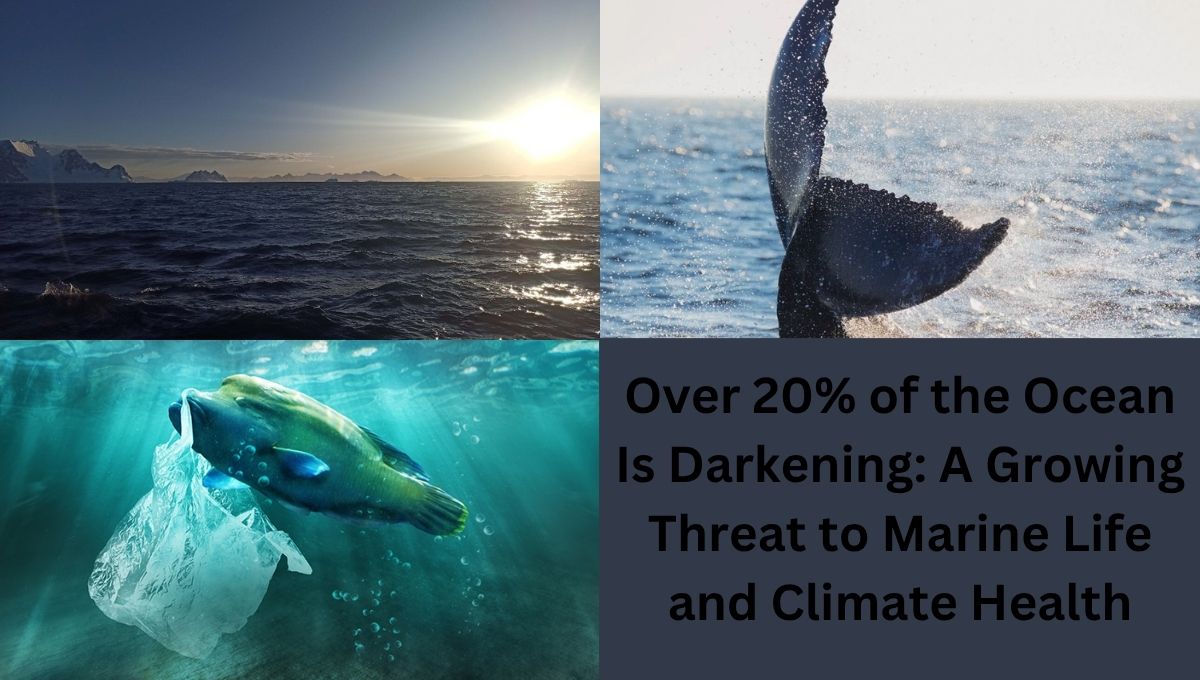
In a groundbreaking new study, Over 20% of the Ocean Is Darkening: A Growing Threat to Marine Life and Climate Health. Scientists have revealed a concerning shift in the Earth’s oceans: over 21% of the global ocean an area larger than 75 million square kilometers has experienced ocean darkening over the last two decades.
Published in Global Change Biology, the research points to a significant decline in light penetration into the ocean’s photic zones, the sunlit layers that support 90% of marine life. This alarming trend has vast implications for marine ecosystems, climate stability, and human wellbeing, sparking fresh urgency among scientists and environmentalists worldwide.
Over 20% of the Ocean Is Darkening: A Growing Threat to Marine Life and Climate Health
What Is Ocean Darkening?
Ocean darkening refers to the reduction of light that penetrates into the upper layers of the ocean. This results in a shrinking of photic zones, which are critical for photosynthesis, marine biodiversity, and ecological balance.
Without sufficient sunlight, the ability of ocean ecosystems to function and support life weakens drastically.
From 2003 to 2022, researchers discovered:
- 21% of the global ocean became darker.
- More than 9% of the ocean saw photic zone depths decrease by over 50 meters—an area roughly the size of Africa.
- 2.6% of the ocean experienced reductions of more than 100 meters in photic zone depth.
Meanwhile, 10% of the ocean became lighter, offering some contrast but not enough to counterbalance the overall trend.
How the Study Was Conducted
The study was carried out by researchers from the University of Plymouth and Plymouth Marine Laboratory, who have long studied oceanic changes, including the impact of artificial light at night (ALAN) on marine environments.
They used data from NASA’s Ocean Color Web, which divides the ocean into 9-kilometer-wide pixels. By applying advanced algorithms, they measured how light penetrates seawater at different points around the globe.
The team also integrated solar and lunar irradiance models to determine how light shifts during both daylight and nighttime conditions. The result? A detailed global map of where the ocean’s sunlit zones are receding and a clearer understanding of the consequences.
Causes of Ocean Darkening
The causes of ocean darkening vary by region but are closely linked to human activity and climate change.
In Coastal Areas:
- Agricultural runoff carries excess nutrients and sediment into the sea.
- Increased rainfall, driven by climate change, worsens sediment discharge.
- This promotes excessive plankton blooms, which cloud the water and limit sunlight penetration.
In the Open Ocean:
- Rising sea surface temperatures disrupt plankton communities.
- Algal bloom dynamics have shifted, possibly due to changing nutrient cycles.
- These factors collectively reduce how deeply sunlight can reach.
According to Dr. Thomas Davies, associate professor of marine conservation at the University of Plymouth, “Such changes reduce the amount of ocean available for animals that rely on the sun and the moon for their survival and reproduction.”
The Ecological Impact of Shrinking Photic Zones
As photic zones become shallower, marine organisms that depend on sunlight like phytoplankton, fish, and invertebrates are being pushed closer to the surface.
Professor Tim Smyth of Plymouth Marine Laboratory explains: “Animals that need light will be forced closer to the surface, where they will have to compete for food and other resources. That could bring about fundamental changes in the entire marine ecosystem.”
Key threats include:
- Increased competition for food among species.
- Disruption of marine food chains.
- Decline in fisheries that billions of people rely on for protein.
- Reduced oxygen production, as phytoplankton require light for photosynthesis.
This is not just a biodiversity issue it’s a human survival issue.
Ocean Darkening and Climate Change
The ocean is a critical buffer against climate change. It absorbs large amounts of carbon dioxide and helps regulate Earth’s temperature. As ocean darkening reduces light penetration, the ability of marine systems to perform photosynthesis and sequester carbon is diminished.
In the words of Dr. Davies: “We rely on the ocean and its photic zones for the air we breathe, the fish we eat, our ability to fight climate change, and for the general health and well-being of the planet.”
Regional Hotspots of Concern
Some of the most severe photic zone reductions were observed in:
- The Gulf Stream
- Arctic and Antarctic waters
- Enclosed seas like the Baltic Sea
In these regions, the combination of melting ice, changing currents, and nutrient runoff is rapidly darkening the water.
In the United Kingdom, the picture is mixed:
- Areas such as the North Sea, Celtic Sea, and eastern coasts have darkened.
- However, parts of the English Channel and waters near the Orkney and Shetland Islands have seen increased light levels.
A Call for Global Action
While about 10% of the oceans have become lighter, the dominant trend is darkening—and it’s one that scientists say we can’t afford to ignore.
The research team is calling for:
- Increased monitoring of light conditions in oceans.
- Stronger environmental regulations to reduce runoff and sediment pollution.
- Climate change mitigation through reduced greenhouse gas emissions.
We must act now to prevent further decline in marine ecosystems and preserve the ocean’s role in climate regulation, food production, and oxygen generation.
Conclusion: The Oceans Are Sending a Warning
Ocean darkening might not be as visually dramatic as coral bleaching or ice melt, but its implications are just as profound.
As light vanishes from large swaths of our seas, the marine life we depend on is under growing stress. The ocean is not just a distant wilderness it is a vital part of our planet’s life support system.
If over 20% of the ocean has already darkened, we must ask: what happens when it reaches 30%, or 50%?
Now is the time to take this invisible crisis seriously. For the oceans. For the climate. For us.
Also Read: 7 Powerful Shifts at COP30 as 80 Nations Demand a Fossil Fuel Phase-Out Roadmap
Also Read: One-fifth of global ocean has become darker, shrinking vital photic zones
Related Posts:
- 5 Major Takeaways from the US Supreme Court's…

- Chemistry Nobel Prize 2025: Groundbreaking Discoveries

- 7 Powerful Facts About Ayatollah Ali Khamenei’s…

- 9 Explosive Claims as Trump Says US Winning Iran War

- 7 Heartbreaking Facts About Venezuela's Earthquake Disaster

- Trump’s 20-Point Gaza Peace Plan Gains Urgent Global…
