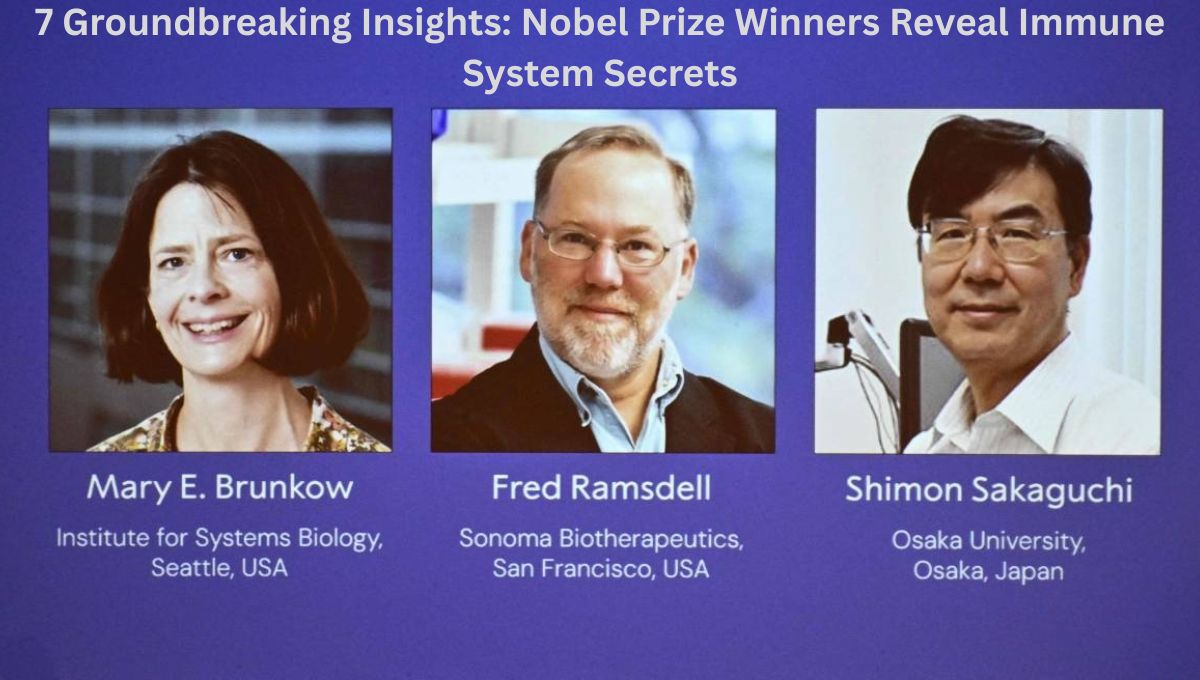
7 Groundbreaking Insights: Nobel Prize Winners Reveal Immune System Secrets – Regulatory T-cells and their impact on autoimmune disease and cancer therapies. The 2025 Nobel Prize in Physiology or Medicine has been awarded to Shimon Sakaguchi of Japan and US-based researchers Mary Brunkow and Fred Ramsdell for pioneering discoveries that explain how the immune system attacks hostile infections while sparing the body’s own cells.
The laureates share the prestigious prize and a fund of 11 million Swedish kronor (£870,000) for uncovering the critical role of regulatory T-cells, often referred to as the immune system’s “security guards.” These findings have transformative implications for the treatment of autoimmune diseases, organ rejection, and cancer. “Their discoveries have been decisive for our understanding of how the immune system functions and why we do not all develop serious autoimmune diseases,” said Olle Kämpe, chair of the Nobel Committee.
7 Groundbreaking Insights: Nobel Prize Winners Reveal Immune System Secrets
Understanding the Immune System’s Balance
The immune system must maintain a delicate equilibrium: aggressively targeting infections and foreign invaders while preventing damage to the body’s own tissues. This balance, known as immune tolerance, is essential for maintaining health.
White blood cells patrol the body for signs of infection. They rely on receptors generated randomly in over a quadrillion different combinations, enabling them to recognize a vast array of pathogens. However, this randomness inevitably produces cells capable of attacking the body itself.
Until the 1990s, scientists believed the thymus gland eliminated most self-reactive immune cells during maturation. Yet some problematic cells escaped destruction, potentially causing autoimmune diseases such as type-1 diabetes, rheumatoid arthritis, and multiple sclerosis.
The 2025 Nobel Prize recognizes how Sakaguchi, Brunkow, and Ramsdell uncovered regulatory T-cells (Tregs) that patrol the body and disarm immune cells that could attack healthy tissue.
The Pioneering Discoveries of the Nobel Laureates
Shimon Sakaguchi: The Discovery of Tregs
Professor Shimon Sakaguchi, 74, at Osaka University in Japan, first identified regulatory T-cells in mice. By removing the thymus from mice, he induced autoimmune disease. He then demonstrated that injecting immune cells from healthy mice could prevent the disease.
This experiment suggested that a system exists to prevent the immune system from attacking the body. Sakaguchi’s work laid the foundation for understanding immune regulation and the concept of Tregs as essential immune system peacekeepers.
Mary Brunkow and Fred Ramsdell: Linking FOXP3 Gene to Immune Regulation
Mary Brunkow, 64, of the Institute for Systems Biology in Seattle, and Fred Ramsdell, also 64, now at Sonoma Biotherapeutics in San Francisco, expanded on Sakaguchi’s discovery. Studying inherited autoimmune disorders in mice and humans, they identified a gene called FOXP3 crucial for Treg function.
Together, the trio showed that Tregs require FOXP3 for development and functionality, explaining how the body maintains immune tolerance to its own tissues.
“Their pioneering work has revealed how the immune system is kept in check by regulatory T-cells, preventing it from mistakenly attacking the body’s own tissues,” said Professor Annette Dolphin, president of the UK’s Physiological Society.
Real-World Implications of Regulatory T-Cell Discoveries
The discoveries of Tregs have revolutionized immunology and medicine. By understanding how these cells maintain immune tolerance, researchers are now exploring therapies for conditions such as:
- Autoimmune diseases: Boosting Tregs can prevent the immune system from attacking the body, offering potential treatments for type-1 diabetes, multiple sclerosis, and lupus.
- Cancer: Reducing Treg activity can enhance the body’s ability to fight tumors, forming the basis of emerging immunotherapies.
- Organ transplantation: Modulating Tregs may reduce the likelihood of organ rejection.
“The discoveries have laid the foundation for a new field of research and spurred the development of new treatments,” said the Nobel Prize awarding body.
Nobel Laureates React: From Surprise to Delight
The announcement brought a range of reactions, from humble surprise to sheer disbelief.
- Shimon Sakaguchi: Called the win a “happy surprise” and expressed hope that his discoveries will lead to treatable cancer therapies within the next two decades.
- Mary Brunkow: Initially thought the Nobel call was spam and exclaimed, “Don’t be ridiculous!” upon confirmation.
- Fred Ramsdell: Was unreachable as he was on a three-week off-grid hiking trip in the mountains of Idaho, Wyoming, and Montana. He learned of the win hours later through text messages from his wife, Laura O’Neill.
“It never crossed my mind. I certainly didn’t expect to win the Nobel prize,” Ramsdell told the BBC.
Fred Ramsdell: The Off-Grid Nobel Winner
Ramsdell’s remote hiking trip made contacting him a challenge for the Nobel Committee. With his phone in airplane mode, the committee could not reach him. Eventually, he learned of the honor when his wife received dozens of congratulatory messages.
Ramsdell is an immunologist who earned his PhD in microbiology and immunology from UCLA in 1987. He now serves as Chief Scientific Officer at Sonoma Biotherapeutics, a company developing engineered T-cell therapies.
How Regulatory T-Cells Work
Regulatory T-cells are the immune system’s “security guards”. They detect and neutralize self-reactive immune cells, preventing autoimmune reactions.
Mechanism:
- Tregs develop in the thymus.
- FOXP3 gene directs their development and function.
- Tregs circulate through the body, disarming immune cells that could attack healthy tissues.
- Balance: Tregs maintain immune tolerance while allowing robust responses to infections.
These mechanisms are essential for immune homeostasis, and their dysfunction is implicated in autoimmune disease, cancer, and transplant rejection.
Nobel Committee Highlights the Importance
The Nobel Committee emphasized that no advanced technology today functions without understanding quantum mechanics and immune systems. From vaccines to cancer therapies, the implications of Treg research are profound.
“Their discoveries have been decisive for our understanding of how the immune system functions and why we do not all develop serious autoimmune diseases,” said Olle Kämpe, chair of the Nobel Committee.
Impact on Autoimmune Disease Research
Before this discovery, autoimmune diseases were poorly understood and largely untreatable. The work of Sakaguchi, Brunkow, and Ramsdell has led to:
- At least 200 clinical trials worldwide exploring Treg-based therapies.
- Development of drugs aimed at boosting Treg activity in autoimmune conditions.
- Insights into how nutrition and gut microbiome regulate immune tolerance.
“These discoveries have reshaped our approach to medicine, proving that immune tolerance is a dynamic and adjustable process,” explained Dr. Tanmay Majumdar, senior scientist at the National Institute of Immunology, New Delhi.
Nobel Ceremony and Prize Details
The Nobel Prize will be presented on December 10, marking the anniversary of Alfred Nobel’s death. The laureates will receive:
- Gold medals presented by the King of Sweden.
- 11 million Swedish kronor ($1.17 million) in prize money, shared equally among Sakaguchi, Brunkow, and Ramsdell.
This marks the first announcement in the 2025 Nobel Prize season, with Physics, Chemistry, Literature, Peace, and Economics prizes to follow over the coming week.
Also Read: Nobel Prizes 2025: What they are, when the awards are announced
A Legacy of Breakthroughs in Medicine
The trio’s discoveries redefine how autoimmune diseases, cancer, and organ transplantation are approached:
- Tregs provide a mechanistic understanding of immune tolerance.
- FOXP3 gene studies link molecular biology to practical therapies.
- These findings have sparked a new era of targeted immunotherapies.
“True scientific progress begins when someone dares to question the familiar and investigates what we think we already understand,” said Dr. Anurag Agarwal, dean of the Trivedi School of Biosciences at Ashoka University.
Nobel Prize Winners: Shaping the Future of Medicine
- Shimon Sakaguchi: Identified Tregs in mice and demonstrated their role in preventing autoimmune disease.
- Mary Brunkow: Mapped FOXP3 gene function in humans and mice.
- Fred Ramsdell: Linked FOXP3 mutations to immune dysregulation and therapeutic potential.
Their work has already influenced hundreds of research programs worldwide, guiding efforts in cancer immunotherapy, autoimmune disease management, and transplantation medicine.
The Human Side: Reactions from Laureates and Colleagues
The announcement of the Nobel Prize has sparked excitement across the scientific community:
- Jeffrey Bluestone, co-founder of Sonoma Biotherapeutics, praised Ramsdell for his transformative contributions.
- Japanese Prime Minister Shigeru Ishiba personally congratulated Sakaguchi, inquiring about timelines for clinical applications.
- Colleagues highlight the work’s profound impact on understanding immune balance and human health.
The Road Ahead: Applications of Treg Research
Researchers are leveraging the discoveries of 2025 Nobel laureates to:
- Develop precision therapies for autoimmune disorders.
- Enhance cancer immunotherapy by modulating Treg activity.
- Improve transplantation outcomes through immune regulation.
- Explore microbiome-immune system interactions for long-term disease prevention.
The research continues to inspire innovation, demonstrating that fundamental discoveries in physiology can lead to life-saving medical advancements.
Conclusion: A Transformative Achievement
The 2025 Nobel Prize in Physiology or Medicine celebrates the pioneers who revealed the immune system’s regulatory mechanisms. By uncovering regulatory T-cells and FOXP3, Shimon Sakaguchi, Mary Brunkow, and Fred Ramsdell have transformed our understanding of how the body defends itself without self-harm.
Their discoveries have already shaped new therapeutic strategies and continue to guide cutting-edge research in immunology, cancer therapy, and autoimmune disease management. In their words, science is not just about discovery—it is about unlocking the mechanisms that sustain life and creating possibilities for future generations.
Also Read: 5 Amazing Facts About 2025 Nobel Physics Winners
Related Posts:
- Nobel Prizes 2025: Major Discoveries in Medicine & Physics
- Chemistry Nobel Prize 2025: Groundbreaking Discoveries
- 5 Amazing Facts About 2025 Nobel Physics Winners
- Donald Trump, Barack Obama React as Joe Biden…
- Joe Biden’s Aggressive Prostate Cancer Diagnosis…

- 7 Heartbreaking Facts About Venezuela's Earthquake Disaster