
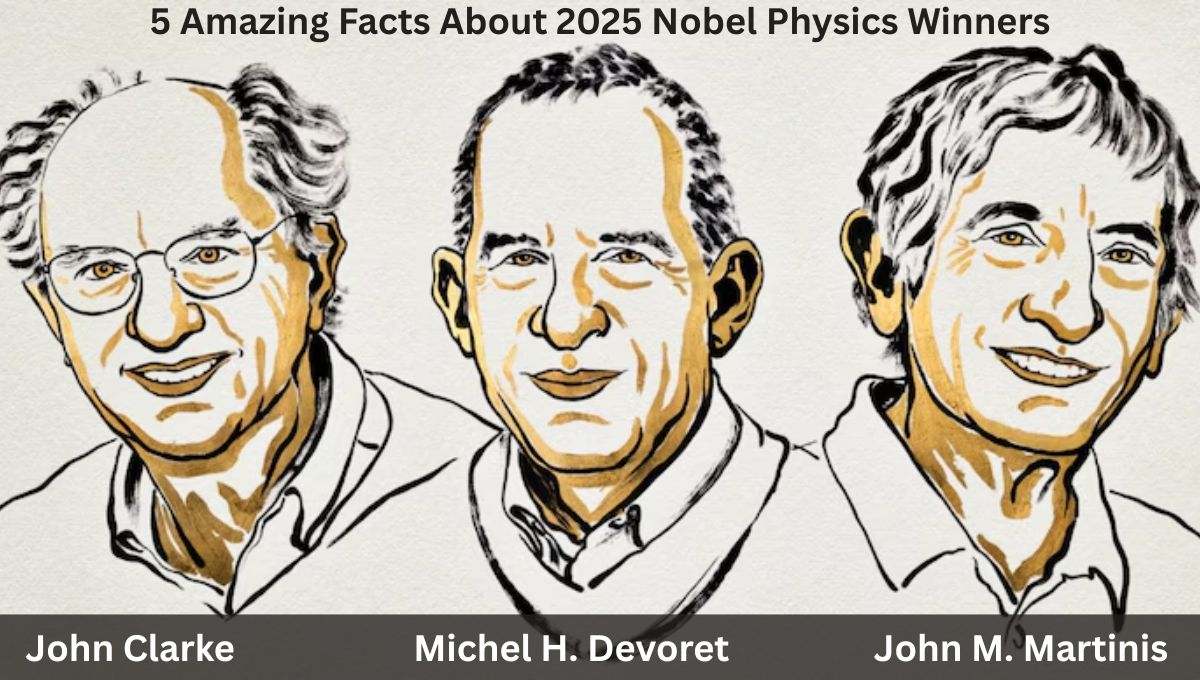
5 Amazing Facts About 2025 Nobel Physics Winners: Their pioneering work in Quantum Mechanics. The 2025 Nobel Prize in Physics has been awarded to John Clarke, Michel H. Devoret, and John M. Martinis for groundbreaking experiments in quantum mechanics that are paving the way for a new generation of ultra-powerful computers. Their pioneering research demonstrates how the bizarre laws of the quantum world can manifest in systems large enough to be held in the hand, a breakthrough that underpins modern quantum computing and advanced technology.
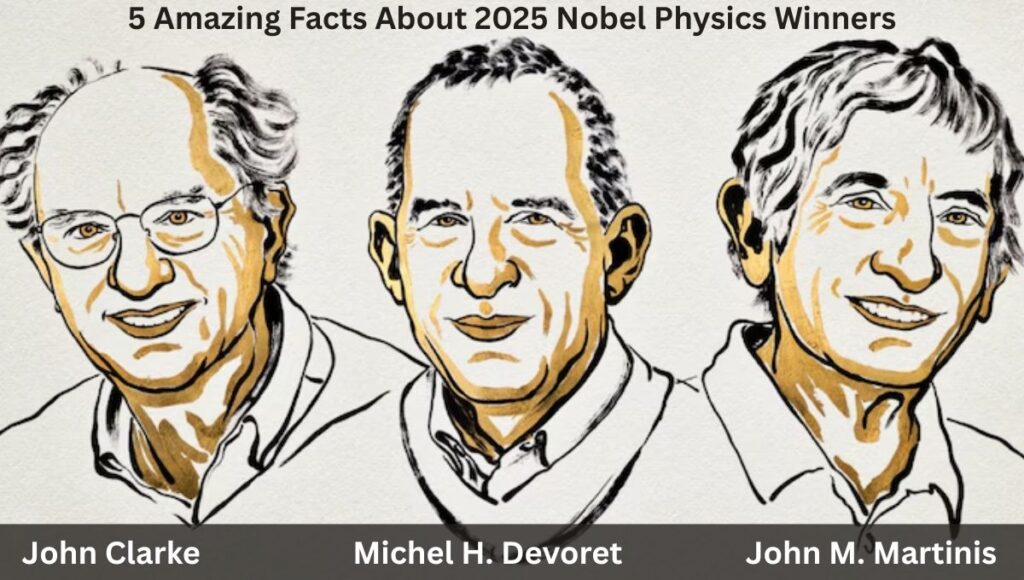
5 Amazing Facts About 2025 Nobel Physics Winners
The Surprise Announcement
The Royal Swedish Academy of Sciences announced the winners at a news conference in Stockholm, Sweden. Professor John Clarke, born in Cambridge, UK, and now at the University of California, Berkeley, described the recognition as “the surprise of my life.”
Michel H. Devoret, born in Paris and currently a professor at Yale University, and John M. Martinis, professor at UC Santa Barbara, join Clarke in sharing 11 million Swedish kronor (£872,000) in prize money.
The Nobel Committee lauded their work for uncovering macroscopic quantum tunnelling and energy quantisation in electric circuits, discoveries that form the foundation for quantum computers and other high-tech applications.
Also Read: From Zebra-Striped Cows to Pizza-Loving Lizards: Inside the 2025 Ig Nobel Prizes
From Tiny Circuits to Powerful Computers
In the 1980s, the three physicists conducted a series of experiments using Josephson junctions — tiny electrical circuits made of superconductors separated by an insulating layer. Their goal: to explore whether the strange phenomena of quantum mechanics could appear in systems beyond the microscopic world.
They observed two extraordinary effects:
- Quantum Tunnelling: Electrons in the circuit could “tunnel” through barriers, something classical physics would deem impossible.
- Energy Quantisation: The circuits absorbed or released energy in discrete steps, mimicking the behaviour of individual atoms.
These findings demonstrated that quantum mechanical principles can operate in macroscopic, human-scale systems, making it possible to engineer practical quantum devices.
Why This Discovery Matters
Quantum mechanics governs the behaviour of matter and energy at subatomic scales. However, until Clarke, Devoret, and Martinis’ work, quantum effects were thought to be limited to microscopic systems.
Their experiments bridged this gap, showing that macroscopic quantum phenomena could be controlled and measured. This insight is critical for:
- Quantum computers – ultra-fast machines capable of solving problems impossible for classical computers.
- Quantum cryptography – for highly secure communication networks.
- Quantum sensors – for precise measurements of magnetic fields, gravity, and even brain activity.
Professor Lesley Cohen of Imperial College London said, “Their work has laid the foundations for superconducting qubits, one of the main hardware technologies for quantum computing.”
The Technology Behind the Discovery
Josephson Junctions and Superconductors
At the heart of the experiment were Josephson junctions — superconducting circuits where trillions of electrons act collectively as a single quantum entity. Ordinarily, electrons cannot pass through an insulating barrier.
Yet the trio observed quantum tunnelling, proving that electrons could bypass the barrier in controlled, predictable ways. This principle underpins the quantum chips used in today’s experimental quantum computers. In simple terms, what once existed only in theory can now be engineered and applied in the real world.
From Tabletop Experiments to Modern Devices
The Nobel Committee highlighted that the trio’s experiments laid the groundwork for technologies now embedded in everyday life:
- Mobile phones and computers rely on quantum effects for data storage and processing.
- Fiber optic networks leverage principles of quantum mechanics for fast, secure communication.
- Josephson junctions enable the development of cutting-edge quantum processors.
A Historical Perspective
The discoveries in 1985 echo the thought experiments of Erwin Schrödinger, who famously imagined a cat both alive and dead in a quantum superposition. Clarke, Devoret, and Martinis demonstrated that such quantum effects could be scaled up and controlled in circuits visible to the naked eye.
Experimental ingenuity from four decades ago has now set humanity on the path toward quantum supremacy — a state where quantum computers outperform classical computers in practical tasks.
The Winners’ Personal Stories
- John Clarke (UK/USA) – Based at UC Berkeley, Clarke expressed amazement at the prize. “We had not realized in any way that this might be the basis of a Nobel Prize,” he said.
- Michel H. Devoret (France/USA) – Chief scientist at Google’s Quantum AI lab and professor at Yale University, Devoret continues to advance quantum hardware for fault-tolerant computing.
- John M. Martinis (USA) – Former Google researcher who led the team achieving quantum supremacy in 2019, now co-founder of the quantum computing startup Qolab.
Alphabet CEO Sundar Pichai congratulated the trio, emphasizing their role in paving the way for error-corrected quantum computers.
Implications for the Future
The trio’s research provides a practical framework for quantum technology, moving quantum mechanics from theory to application. Their work:
- Proves that macroscopic quantum effects can be engineered.
- Enables the development of scalable quantum computers.
- Forms the basis for quantum sensors with unprecedented precision.
- Paves the way for secure quantum communication networks.
As Jonathan Bagger of the American Physical Society noted, “They showed that you can elevate quantum mechanics to apply to the observable, human-scale world.”
A Nobel Prize for the Modern Era
The 2025 Nobel Prize in Physics not only honours Clarke, Devoret, and Martinis but also marks a turning point in human understanding of the quantum world.
Their experiments bridge the gap between the microscopic and macroscopic, proving that quantum mechanics is not confined to the theoretical realm.
Previous winners illustrate the diversity of breakthroughs recognised in physics:
- 2024 – Geoffrey Hinton and John Hopfield, AI and machine learning
- 2023 – Pierre Agostini, Ferenc Krausz, Anne L’Huillier, attosecond physics
- 2022 – Alain Aspect, John Clauser, Anton Zeilinger, quantum mechanics
- 2021 – Syukuro Manabe, Klaus Hasselmann, Giorgio Parisi, complex systems
This year’s laureates demonstrate that quantum physics is alive and relevant, directly impacting our technology, security, and computing power.
How Quantum Tunnelling Works
Imagine pushing a ball up a hill. Classical physics predicts it will either roll back or over the top. Quantum mechanics, however, allows the ball to appear on the other side of the hill without ever climbing it. This is the essence of tunnelling, and Clarke, Devoret, and Martinis observed it in circuits containing trillions of electrons.
At the same time, the circuit only absorbed energy in discrete amounts – called energy quantisation – just like electrons in atoms. Together, these phenomena form the basis of quantum computing hardware.
The Practical Impact on Technology
The Nobel-winning research has influenced:
- Quantum Computers: Using superconducting qubits derived from Josephson junctions.
- Flash Memory and Tunnel Diodes: Applying quantum tunnelling for data storage.
- Quantum Sensors: Ultra-precise instruments for medical imaging, geology, and fundamental physics.
Every modern mobile device and advanced computer is indirectly influenced by the principles demonstrated by the 2025 Nobel laureates.
Industry Recognition
Sundar Pichai highlighted the trio’s ongoing impact on Google’s quantum computing research. Michel Devoret continues to lead hardware innovation, while Martinis focuses on startup-driven quantum solutions.
Clarke remains an academic pillar at UC Berkeley, mentoring the next generation of quantum engineers. Pichai called their achievements “incredible progress” and emphasized their role in enabling error-corrected quantum computers, which represent the future of computing.
Conclusion: Quantum Physics in Your Hands
The 2025 Nobel Prize in Physics celebrates more than just the laureates. It highlights the tangible power of quantum mechanics, showing that the once-mystical rules of the subatomic world can be harnessed to create real-world technologies.
John Clarke, Michel H. Devoret, and John M. Martinis have proven that quantum phenomena aren’t limited to laboratories—they can be engineered, scaled, and applied, opening the door to a future of ultra-powerful computing, secure communication, and scientific innovation.
This award is a reminder that curiosity, persistence, and ingenuity can take humanity from theoretical puzzles to transformative technologies that change the world.
Also Read: Susumu Kitagawa, Richard Robson and Omar Yaghi win Nobel Prize in Chemistry 2025
Related Posts:
- Nobel Prizes 2025: Major Discoveries in Medicine & Physics
- Chemistry Nobel Prize 2025: Groundbreaking Discoveries
- 7 Groundbreaking Insights: Nobel Prize Winners…

- From Zebra-Striped Cows to Pizza-Loving Lizards:…

- Dramatic Moments Behind Trump’s Gaza Peace Push and…

- 7 Shocking Reasons FIFA’s Peace Prize for Trump…
