

7 Explosive Revelations Inside Trump’s Secret 28-Point Russia-Ukraine Peace Plan sparking global alarm and fierce political debate. A confidential 28-point Russia-Ukraine peace plan linked to former U.S. President Donald Trump has surfaced through a series of leaks, diplomatic sources, and media reports.
The proposal—described as “historic” by some advisers and “dangerously pro-Kremlin” by critics—outlines a sweeping roadmap to end the two-year-old war. It includes territorial concessions, NATO rollback measures, sanctions relief pathways, and an unprecedented Ukraine neutrality pact.
While Trump’s advisers deny that the document represents formal policy, multiple sources across U.S., European, and Ukrainian channels confirm that versions of the plan have circulated quietly within diplomatic networks since October. What’s emerging is a blueprint that could radically reshape Eastern Europe, global security, and America’s geopolitical posture.
This article compiles all available details, cross-referenced reporting, policy analysis, and political reactions into a comprehensive explainer of the alleged 28-point plan—what it offers, what it demands, and why it has triggered intense debate from Kyiv to Washington to Brussels.
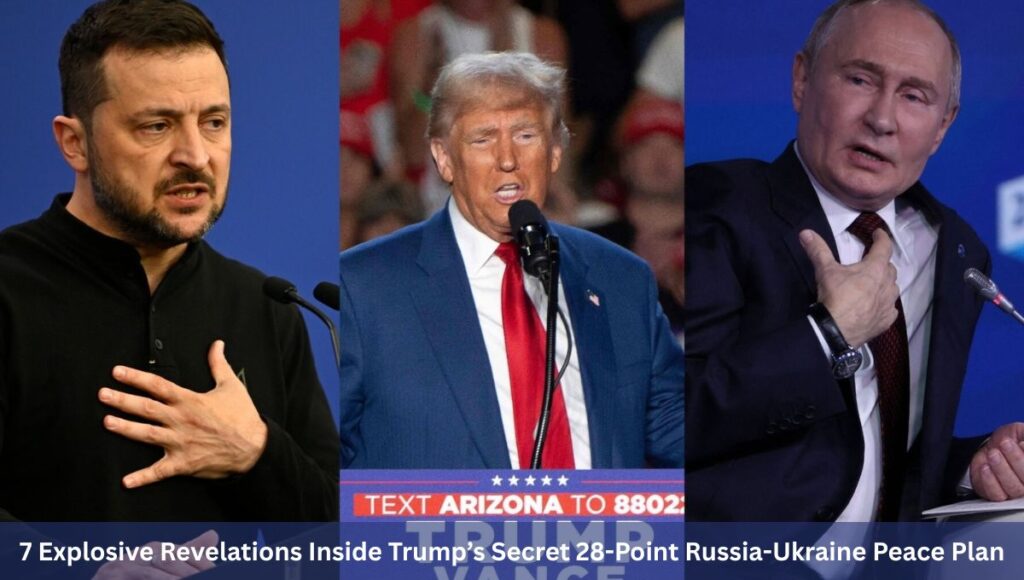
7 Explosive Revelations Inside Trump’s Secret 28-Point Russia-Ukraine Peace Plan
What the 28-Point Plan Claims to Achieve
According to documents reviewed by multiple media outlets and diplomats, Trump’s Russia-Ukraine peace plan seeks to accomplish six core objectives:
- A rapid ceasefire within 24–48 hours
- A permanent territorial settlement between Russia and Ukraine
- The formalisation of Ukraine’s neutrality
- A security architecture replacing NATO’s role in Ukraine
- Sanctions relief for Russia conditioned on compliance
- A multinational reconstruction and demilitarisation program
Supporters call it “the fastest way to stop the killing.” Critics call it “a reward for aggression.”
Let’s break down each key section of the alleged plan.
1. A Rapid Ceasefire & Frozen Conflict Framework
The first points of the plan reportedly revolve around immediate cessation of hostilities, including:
- A 24-hour ceasefire window
- International monitors deployed along new lines
- Prohibition of further Ukrainian attacks on Russian-held territory
- Suspension of long-range Western weapons use
This model mirrors earlier ceasefire proposals Russia pushed at various stages of the war. Analysts argue that an immediate freeze would lock in Russian territorial gains, making any future reversal nearly impossible without NATO intervention.
Supporters counter that every day the war continues, Ukraine loses more territory, infrastructure, and citizens, and a freeze may be preferable to prolonged conflict.
2. Territorial Concessions at the Heart of the Plan
One of the most explosive elements concerns Ukraine’s borders.
Several versions of the leaked documents reference:
Recognition of Russian Control Over Occupied Regions
This includes:
- Crimea
- Donetsk
- Luhansk
- Zaporizhzhia
- Kherson (parts)
In certain drafts, Russia would keep the areas it currently controls; in others, referendums would be held under “international supervision.” Ukrainian officials reject both approaches as unconstitutional and illegitimate.
A Demilitarised Buffer Zone
Some proposals call for:
- A 20–40 km demilitarised zone
- Prohibition of heavy weapons
- Joint monitoring by the U.S., Turkey, and UN observers
Critics warn this echoes Russia’s long-desired “buffer space” to keep NATO away from its borders.
3. Ukraine Neutrality & NATO Restrictions
The plan reportedly requires Ukraine to adopt strict neutrality, a central demand Russia has insisted upon since 2014.
Key neutrality clauses include:
- Ukraine must not join NATO
- Ukraine may retain limited defensive forces
- No foreign military bases permitted
- No long-range Western missile systems
- U.S. training missions replaced by a multinational civilian advisory group
This approach mirrors Cold War Finlandisation, where a state remains independent but limited in defence autonomy.
To many in Kyiv and Brussels, it feels like a forced geopolitical downgrade. But Trump allies argue NATO membership for Ukraine is “never going to happen anyway,” and the war will not end without neutrality.
4. Sanctions Relief for Russia Linked to Compliance
Another major section outlines sanctions relief, tied to:
- Verified ceasefire compliance
- Withdrawal of certain Russian units
- Prisoner exchanges
- Cooperation on grain corridors
- Nuclear safety guarantees at Zaporizhzhia plant
Critics say this is effectively rewarding Russia. Supporters counter that sanctions relief is the only real leverage to extract concessions from the Kremlin.
5. Security Guarantees without NATO
Perhaps the most controversial section involves replacing NATO integration with an alternate system.
A New “U.S.-Led Security Compact”
This compact would include:
- U.S., Turkey, Poland, UK, and possibly Israel
- Long-term commitments for:
- Infrastructure protection
- Cyber defence
- Intelligence sharing
- Border monitoring
Military Aid Restructured into Non-Lethal Support
This includes:
- Anti-drone systems
- Radar and surveillance
- Air-defence shielding but with strict range limits
European diplomats worry this would create an ambiguous, untested security model lacking NATO’s deterrence power.
6. A Massive Reconstruction Package for Ukraine
The plan includes a multi-hundred-billion-dollar reconstruction framework, funded by:
- U.S. private sector
- EU partners
- Frozen Russian assets (controversial but mentioned)
- Middle Eastern sovereign wealth funds
- International financial institutions
Projects include:
- Power grid repair
- Port rebuilding
- Housing, roads, rail, hospitals
- Investment zones for tech and industry
- A “Marshall Plan-style” economic rescue
Some diplomats see this as an attempt to sell the plan by promising financial stability even as territorial concessions are made.
7. Putin’s Calculated Acceptance & Kyiv’s Outrage
The Kremlin’s Reaction
Reports from AFP, FT and other agencies suggest Russian officials have shown interest in early versions of the plan. It aligns with several long-term objectives Moscow has pushed since the invasion began.
Ukraine’s Reaction
Kyiv calls the plan:
- “A capitulation document”
- “A gift to Putin”
- “A violation of Ukraine’s sovereignty”
Officials warn that:
- Ukraine cannot sign away territory
- Neutrality leaves Ukraine vulnerable
- Russia would violate any agreement
- Sanctions relief undermines deterrence
Zelensky advisers argue that the only acceptable peace must include:
- Full territorial restoration
- Reparations
- War crimes accountability
- Security guarantees equal to NATO-level protection
The U.S. Political Dimension: Election Tremors
The emergence of the 28-point Trump Russia Ukraine peace plan comes at a critical moment in U.S. politics.
Trump Campaign’s Response
Advisers insist:
- No final policy exists
- Trump wants peace “not surrender”
- Plans circulating are “just options”
However, insiders admit Trump believes:
- The war should end quickly
- Europe must carry more defence burdens
- The U.S. should push Ukraine to negotiate
Biden Administration’s Reaction
Officials warn that any peace plan requiring Ukraine to surrender territory:
- Encourages aggression globally
- Undermines international law
- Rewards invasion as a viable strategy
European Reactions: Alarm Bells from NATO Capitals
Major European powers are unnerved by the concessions in the plan:
- Poland fears a shift in U.S. security priorities
- Baltic states say neutrality for Ukraine threatens their own safety
- Germany & France worry about sanctions relief too early
- UK sees the plan as “strategically lopsided”
NATO leadership remains firm that:
- Ukraine chooses its own security path
- No major power may dictate borders
- Territorial concessions undermine collective defence principles
Why This Plan Matters Even If Not Official Policy
Even though Trump has not endorsed the leaked proposal publicly, the mere circulation of such a document matters because:
- It signals what a potential Trump administration could pursue
- It shapes Russian expectations
- It influences Ukrainian defence planning
- It impacts European strategic calculations
- It shifts market and energy forecasts
- It realigns diplomatic bargaining positions
In geopolitics, trial balloons test reactions before policies are announced—and this balloon has drawn global attention.
Key Strengths & Weaknesses of the 28-Point Plan
Strengths (Supporters’ View)
- Ends the war quickly
- Saves Ukrainian lives and infrastructure
- Freezes further Russian expansion
- Brings global economic stability
- Reduces defence spending burden on the U.S.
- Starts reconstruction immediately
Weaknesses (Critics’ View)
- Forces Ukraine to surrender territory
- Rewards Russian aggression
- Undermines NATO
- Creates a weak, neutral Ukraine
- Leaves Europe more vulnerable
- Relies on Russian compliance—historically unreliable
The Bottom Line—A Peace Plan That Redraws Europe
Trump’s leaked 28-point Russia-Ukraine peace plan is more than a diplomatic blueprint; it is a radical reimagining of Europe’s post-Cold War security order. It seeks to end the war through concessions, neutrality, and geopolitically risky compromises that favor speed over principle.
Whether or not Trump adopts it formally, the document has triggered:
- Outrage in Kyiv
- Alarm in European capitals
- Interest in Moscow
- Fierce debate in Washington
The stakes are enormous. This plan—if ever implemented—could freeze the deadliest European war since World War II, but at a cost that reshapes alliances, borders, and global power for decades. For now, it remains a controversial, unofficial, but highly influential glimpse into how one man’s return to the White House could rewrite the future of the Russia-Ukraine conflict.
Also Read: EU Leaders Delay €140 Billion Plan to Use Frozen Russian Assets for Ukraine’s Defense
Also Read: Ukraine told to accept cash-for-land deal with Putin
Related Posts:
- 5 Powerful Highlights as Trump Lands Second Nobel…

- Dramatic Moments Behind Trump’s Gaza Peace Push and…

- Can the EU and NATO Impose Tariffs on India and…

- Trump’s 2025 Gaza Peace Plan Signing and Historic…

- 7 Shocking Reasons FIFA’s Peace Prize for Trump…

- Trump’s 20-Point Gaza Peace Plan Gains Urgent Global…
