EU Leaders Delay €140 Billion Plan to Use Frozen Russian Assets for Ukraine’s Defence but vow stronger support for Ukraine. European Union leaders on Thursday agreed to continue supporting Ukraine’s financial and military needs but stopped short of releasing €140 billion in frozen Russian assets to help Kyiv defend against Moscow’s invasion.
The long-awaited decision came after Belgium raised legal and financial concerns over the use of Russian central bank funds held in Brussels-based clearing house Euroclear, delaying approval until December.
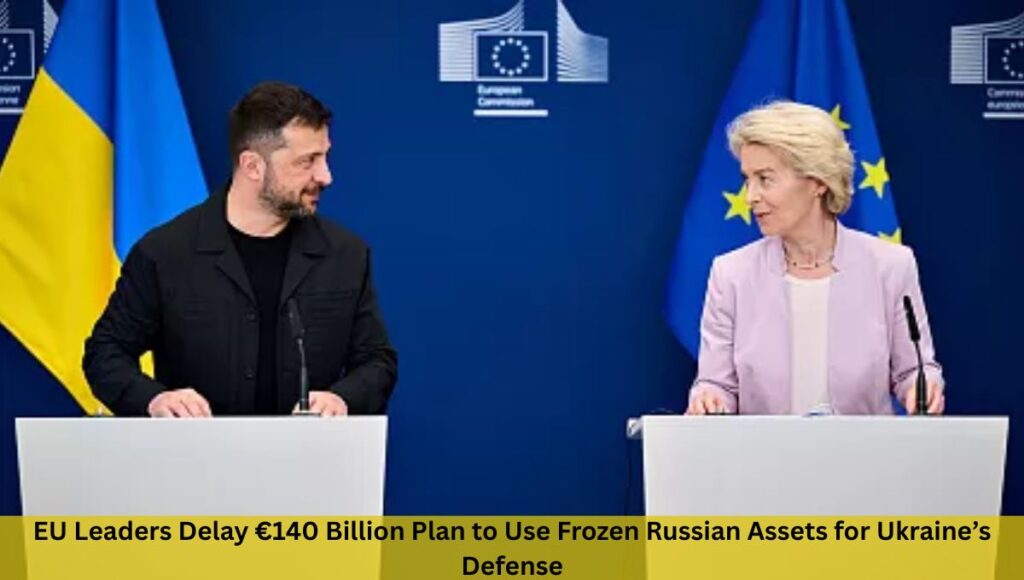
EU Leaders Delay €140 Billion Plan to Use Frozen Russian Assets for Ukraine’s Defense
Brussels Summit: Support Promised, but No Green Light for Asset Use
The high-stakes EU summit in Brussels brought together heads of state to discuss how to fund Ukraine’s ongoing war effort, now entering its fourth year.
Despite optimism before the meeting, leaders were unable to overcome objections from Belgium, which hosts the vast majority of the frozen Russian reserves.
Instead of approving the so-called “reparation loan” proposal, the final statement asked the European Commission to explore “options for financial support based on an assessment of Ukraine’s financing needs.”
“Russia’s assets should remain immobilised until Russia ceases its war of aggression against Ukraine and compensates it for the damage caused by its war,” the declaration stated.
While the plan remains stalled, European Council President Antonio Costa emphasized that EU nations have “committed to ensure that Ukraine’s financial needs will be covered for the next two years.”
“Russia should take good note of this,” Costa warned. “Ukraine will have the financial resources it needs to defend itself.”
€140 Billion at Stake: What the Plan Proposes
Under the current EU proposal, around €200 billion in Russian central bank assets were frozen across Europe after Russia launched its full-scale invasion of Ukraine in February 2022. Most of these assets — roughly €140 billion — are held at Euroclear in Belgium.
The European Commission’s plan envisions borrowing against matured funds within Euroclear and then lending that money to Ukraine. The loan would be repaid only if Russia pays reparations after the war.
The 27 EU member states would guarantee repayment to Euroclear in case Moscow successfully challenges the legality of the move in international courts.
This mechanism, supporters say, would allow the EU to fund Ukraine without technically confiscating Russian state assets — a legal grey area that has caused hesitation among more cautious member states.
Belgian Objections and Legal Uncertainty
Belgian Prime Minister Bart De Wever was the loudest critic at the summit, calling the plan “uncharted territory” and warning that it could lead to major litigation.
“Can this plan be legal? That is a very good question… There are no clear answers,” De Wever said. “We will, in any case, be buried in litigation. That seems like a certainty.”
Belgium fears that if Russia sues Euroclear for asset seizure, the Belgian government could be left financially exposed. De Wever insisted that his country needs “solid guarantees” from all EU states to share the liability if lawsuits arise.
He also pushed for other member states to commit to freezing Russian assets within their own borders, not just those located in Belgium.
The European Commission President Ursula von der Leyen acknowledged the complexity of the issue:
“This is a topic that is certainly not trivial. It’s very complex. It was also very clear there are points to be clarified.”
Zelenskyy Welcomes Continued Support but Urges Action
Ukrainian President Volodymyr Zelenskyy, who attended the Brussels summit as a guest, praised EU leaders for reaffirming financial support but urged them to act swiftly on the frozen asset plan.
“Anyone who delays the decision on the full use of frozen Russian assets is not only limiting our defence but also slowing down the EU’s own progress,” Zelenskyy said.
He added that a large portion of the funds would be used to purchase European-made weapons, which would also strengthen the bloc’s own defence industry.
Zelenskyy expressed optimism that “political support” among European capitals for the idea of using Russian funds remains strong, even if implementation faces delays.
US Sanctions Pressure Moscow — and Complicate Talks
The Brussels meeting came just hours after US President Donald Trump announced sweeping sanctions on Russia’s two largest oil companies — Rosneft and Lukoil — marking Washington’s toughest move yet against Moscow since Trump’s return to office.
The sanctions, targeting Russia’s oil exports, are designed to cut off key revenue streams funding the Kremlin’s war effort. Trump said the sanctions were necessary to “force Russia to agree to an immediate ceasefire.”
However, the decision also overshadowed the planned Trump–Putin summit, which was set to take place in Budapest. Trump later confirmed that the meeting was “shelved indefinitely,” citing “a lack of progress in diplomatic talks.”
“Every time I speak to Vladimir, I have good conversations and then they don’t go anywhere,” Trump said, referring to his Russian counterpart.
In Moscow, President Vladimir Putin downplayed the sanctions, describing them as an “unfriendly act” but claiming they would not significantly hurt the Russian economy.
“They will have certain consequences, but they will not affect our economic well-being,” Putin said. “No self-respecting country ever does anything under pressure.”
Also Read: 7 Powerful Measures: Trump Sanctions Russian Oil Giants After Nuclear Drills
London Summit: Starmer and Allies Push for Missiles and Asset Use
The following day, British Prime Minister Sir Keir Starmer hosted the “Coalition of the Willing” summit in London, where European and NATO leaders — including Zelenskyy and NATO chief Mark Rutte — discussed new ways to intensify support for Ukraine.
Starmer urged Europe to “move faster” in releasing Russian assets and boost long-range missile deliveries to Kyiv.
“There was absolute clarity during the meeting that progress on using frozen Russian assets must come to fruition within a short timetable,” he said.
Starmer also welcomed the EU’s latest sanctions package and urged leaders to align their efforts with US and UK restrictions on Russian oil exports.
Dutch Prime Minister Dick Schoof called for closer coordination between the EU, UK, and US, saying Europe should “follow British and US sanctions on Russian oil firms.”
Danish Prime Minister Mette Frederiksen echoed that sentiment, insisting that “a solution on how to use the Russian assets must be found before Christmas Eve.”
Zelenskyy’s Push for Long-Range Missiles
Ukraine’s president also used the London gathering to renew his plea for long-range Tomahawk missiles, which Kyiv believes are crucial to striking deep inside Russian-held territory and limiting Moscow’s ability to produce and transport weapons.
Trump, however, has refused to approve the missile transfer, calling the Tomahawk system “highly complex” and unsuitable without at least a year of training.
NATO Secretary General Mark Rutte confirmed the issue remains “under review by the president” and stressed that the decision “rests entirely with the United States.”
Ukraine’s military has already used British Storm Shadow and French SCALP missiles, but Tomahawks would offer longer range and precision, potentially shifting battlefield dynamics.
How the Frozen Assets Scheme Would Work
The European Commission’s proposed mechanism is designed to balance legality with practicality:
- Frozen Russian central bank assets (mainly at Euroclear) remain immobilized.
- The EU borrows against matured profits generated by those assets.
- The borrowed amount — around €140 billion — is loaned to Ukraine.
- Ukraine repays only if Russia pays reparations.
- If not, EU taxpayers guarantee repayment to Euroclear.
This approach avoids direct confiscation of Russian sovereign wealth — a move many legal experts say could breach international law — while still channeling the funds to Kyiv’s benefit.
Belgium’s demand for joint liability guarantees and legal clarity from all 27 EU states has become the main roadblock to implementation.
France, the US, and the ‘Buy European’ Debate
France has taken a strong position that any funds from Russian assets used for Ukraine should primarily go toward purchasing European-made defence equipment, bolstering the continent’s own industry.
The European Commission supports this approach, seeing it as a way to strengthen Europe’s defence autonomy.
However, several member states argue Kyiv should be free to spend the funds where needed, including buying American weapons, which could help maintain US engagement.
Observers note that keeping Donald Trump on board may prove critical to the West’s united front. As one EU diplomat put it, “If some of the funds are spent on American weapons, it becomes easier to keep Washington aligned.”
Russia’s Reaction: Legal and Political Threats
Moscow has condemned the EU’s plan, describing it as an “illegal confiscation of property.” Russian Foreign Ministry spokeswoman Maria Zakharova warned that “any confiscatory initiatives from Brussels will inevitably result in a painful response.”
Putin echoed those remarks, warning that “the EU is playing with fire” by considering asset transfers that could trigger “serious retaliatory steps.”
Analysts believe Russia could retaliate by seizing Western assets in its territory or challenging the EU in international courts, which could drag on for years.
China Weighs In
Beijing has also voiced opposition to the EU’s sanctions expansion. A Chinese Commerce Ministry spokesperson said the latest measures, including sanctions on three Chinese companies involved in buying Russian crude, “seriously undermine the overall framework of China–EU economic and trade cooperation.”
China, along with India and Turkey, remains one of Russia’s largest energy customers, partially offsetting Western sanctions. However, increasing restrictions from Washington and Brussels could test these countries’ ability to navigate between trade interests and geopolitical pressure.
Looking Ahead: December Decision and Continued Uncertainty
EU leaders agreed to revisit the frozen assets issue at their December summit, where the European Commission is expected to present new legal options for channeling the funds.
Until then, the bloc will continue providing budgetary support and military aid through existing mechanisms, including the European Peace Facility.
Legal experts warn that unless the EU finds a watertight legal framework, Belgium’s objections could persist, stalling the plan well into 2026.
For now, Zelenskyy has chosen to focus on the positives. “Europe has shown that it stands by Ukraine,” he said in London. “But we must turn promises into action. Every day of delay costs lives.”
Conclusion: Europe Balances Law, Politics, and War
The EU’s struggle to unlock Russian funds underscores the delicate balance between political will, legal risk, and strategic necessity.
While leaders in Brussels and London reaffirmed solidarity with Ukraine, the inability to act decisively reflects internal divisions and the broader uncertainty about how far Europe is willing to go to make Russia pay.
As the war grinds on and Western unity is tested, December’s summit could prove pivotal — not just for Ukraine’s financial survival, but for the credibility of Europe’s commitment to defending its democratic values.
Also Read: Explainer: Europe’s internal war on the Russia–Ukraine conflict