7 Explosive Reasons Russia Is Suing European Banks Over Frozen Assets as the EU opts for a €90 billion loan for Ukraine. Russia’s Central Bank has sharply escalated its confrontation with Europe’s financial system, announcing it will seek damages from European lenders over the freezing and potential use of Russian sovereign assets to support Ukraine.
Thank you for reading this post, don't forget to subscribe!In a statement released Thursday, the Bank of Russia said it would pursue compensation in Russian arbitration courts for what it described as the “unlawful” immobilization and use of its assets held in European financial institutions. The damages sought, the regulator said, would correspond to both the full value of the frozen funds and the profits Russia claims it has lost as a result.
The move underscores the growing legal, financial, and geopolitical fallout from the West’s decision to freeze nearly €210 billion in Russian central bank assets following Moscow’s full-scale invasion of Ukraine in 2022.
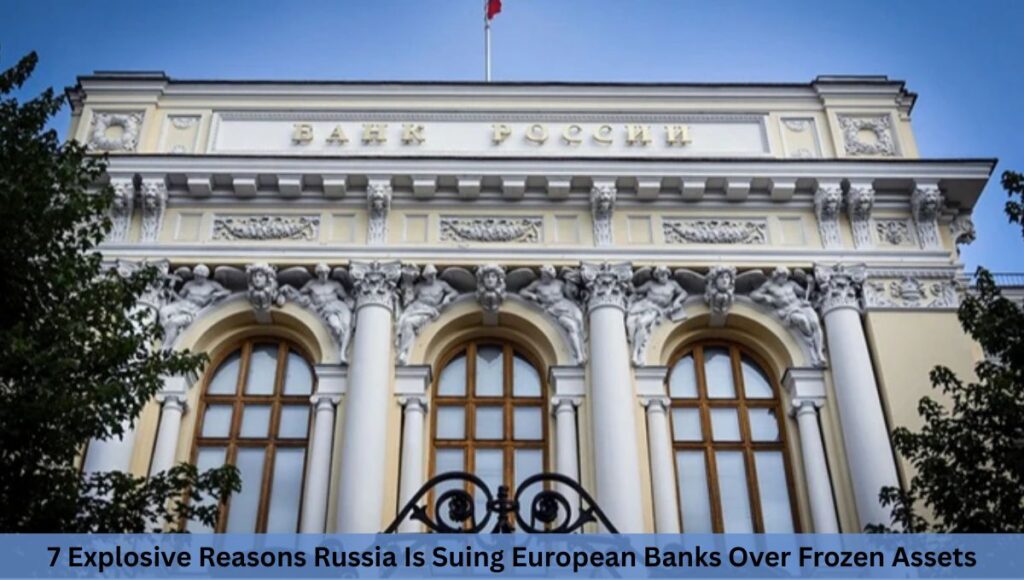
7 Explosive Reasons Russia Is Suing European Banks Over Frozen Assets
What Russia’s Central Bank Is Demanding
According to the central bank’s statement, its legal action will target European banks involved in holding or managing Russian sovereign assets that were frozen under EU sanctions.
“These damages will correspond to the value of the assets unlawfully blocked and used, as well as the resulting lost profits,” the bank said, without naming specific lenders.
The announcement follows a lawsuit filed last week in a Moscow arbitration court seeking damages equal to the €185 billion held at Euroclear, the Belgium-based securities depository that controls the bulk of Russia’s immobilized assets. A preliminary hearing in that case is scheduled for January 16.
Russia’s message is clear: any attempt by Europe to turn frozen reserves into a funding source for Ukraine will come at a legal and financial cost.
Why Frozen Russian Assets Matter
Since the start of the war, Western governments have frozen an estimated €289.5 billion in Russian assets. Of this total, the European Union holds approximately €209 billion, making it by far the largest custodian of Russia’s immobilized sovereign wealth.
Belgium alone accounts for about €180 billion, mostly parked at Euroclear.
Other major holders include:
- France: €19 billion
- Germany: €200 million
- Luxembourg: €10 billion
- Sweden: €10,000
- Cyprus: Less than €100 million
Outside Europe, significant amounts are held by Japan, the UK, Canada, Switzerland, and the United States. These assets were initially frozen as part of sanctions designed to isolate Moscow financially.
But as the war dragged on and Ukraine’s funding needs ballooned, European policymakers began debating whether the money could be actively used.
The EU’s Abandoned Plan to Use Russian Assets
At the heart of the dispute was a controversial EU proposal to borrow against frozen Russian assets and use the proceeds to fund Ukraine.
Under the plan, the EU would have raised money using the immobilized reserves as collateral, issuing a so-called “reparations loan” worth €90 billion. Ukraine would only have to repay the loan if Russia later agreed to pay war reparations.
Supporters argued the plan was morally justified and legally defensible. Ukraine’s reconstruction costs are estimated at more than $524 billion, and many European leaders believed Russian assets should play a role in paying for the damage caused by Moscow’s invasion.
However, the proposal ran into fierce resistance.
Why Europe Dropped the Frozen-Assets Strategy
The EU ultimately abandoned the reparations-loan plan after weeks of intense negotiations and mounting concerns over legal exposure and Russian retaliation.
Belgium’s Legal Alarm Bells
Belgium, which hosts Euroclear, emerged as the plan’s most vocal opponent. Prime Minister Bart De Wever warned that using frozen assets without ironclad legal guarantees could expose Belgium to massive financial liabilities.
If Russia succeeded in court, Belgium could be left owing billions of euros. De Wever demanded binding guarantees from all EU member states to share the risk—guarantees that several countries, including France and Italy, were unwilling to provide.
“Mere oral promises are not enough,” De Wever told the Belgian parliament.
Russian Legal Counteroffensive
Russia’s central bank lawsuits only hardened opposition. Brussels officials feared that even discussing the plan might trigger asset seizures in retaliation, particularly against European companies still operating in Russia.
Belgian officials estimate Moscow could seize up to €17 billion in Euroclear clients’ assets still held within Russian jurisdiction.
The €90 Billion Loan: Europe’s Plan B
With the frozen-assets option blocked, EU leaders agreed instead to provide Ukraine with a €90 billion loan funded through joint borrowing.
The loan will cover roughly two-thirds of Ukraine’s expected financing gap over the next two years and is backed by the EU budget. Hungary, Slovakia, and the Czech Republic were granted exemptions to secure unanimous approval.
European leaders framed the decision as a necessary compromise to preserve unity. “Had we left Brussels divided today, Europe would have walked away from geopolitical relevance,” De Wever said.
Putin’s Warning of ‘Severe Consequences’
Russian President Vladimir Putin personally weighed in on the issue during his annual press conference, describing any use of frozen Russian assets as “robbery.”
“But why can’t they carry out this robbery?” Putin asked rhetorically. “Because the consequences could be severe for the robbers.”
Putin has repeatedly argued that seizing sovereign assets would undermine trust in the global financial system, particularly in the euro zone, where many countries store their reserves.
He warned that once such a precedent is set, it could be replicated under various political pretexts, destabilizing international finance far beyond the Ukraine conflict.
Europe’s Fear of Retaliation
European banks and governments are acutely aware that Russia still has leverage.
Several major lenders maintain exposure to the Russian market:
- UniCredit (Italy): €3.5 billion in stranded capital
- Raiffeisen (Austria): $2.9 billion in revenue from Russia last year
More than 2,300 foreign companies continue operating in Russia, even as nearly 1,900 have withdrawn since 2022.
Economists warn that Moscow could redirect funds from frozen “type-C” accounts into its budget, providing a revenue stream at a time when Russia is running deficits and increasing defense spending.
The Broader Sanctions Landscape
Russia is not the only country whose assets have been frozen by the EU, though its case is unique in scale.
The EU has imposed asset freezes on entities and individuals across at least 31 countries, including Venezuela and Syria. However, in most cases, sanctions target oligarchs, officials, or specific companies—not central bank reserves.
The US and UK maintain similar regimes. Washington has almost fully frozen the assets of governments including Russia, Iran, North Korea, and Cuba, while the UK has sanctioned individuals and entities linked to 22 countries.
Russia’s situation stands apart because of the unprecedented scale of its immobilized sovereign reserves.
Russia’s Economy Under Pressure
While Russia has avoided economic collapse, the strain is growing. Sanctions have drained more than half of the country’s rainy-day reserves. Oil and gas revenues have slumped, growth has slowed, and the budget deficit has widened.
To fund the war, Moscow has issued a record 7.9 trillion rubles ($98 billion) in domestic debt this year, surpassing even pandemic-era borrowing levels. The central bank’s lawsuits can therefore be seen as part of a broader strategy to protect remaining financial resources and deter further Western escalation.
What This Means for Ukraine
For Kyiv, the EU’s decision provides immediate relief but leaves long-term questions unresolved. President Volodymyr Zelenskyy welcomed the loan agreement, calling it a vital guarantee for Ukraine’s financial stability.
However, Ukraine still faces an estimated funding gap of €136 billion over the next two years. Frozen Russian assets remain immobilized for now, but Europe has effectively postponed the question of whether—and how—they might eventually be used.
A Precedent Deferred, Not Resolved
Legal experts say the EU’s choice reflects caution rather than retreat.
By opting for borrowing instead of seizing assets, Europe avoided setting a precedent that could have far-reaching consequences for international law and reserve currencies.
At the same time, Russia’s aggressive legal posture suggests the issue is far from settled. As one EU diplomat put it, “This is not the end of the frozen-assets debate. It’s a pause.”
Conclusion: A Financial Frontline in the Ukraine War
Russia’s decision to seek damages from European banks highlights how the Ukraine war has expanded beyond the battlefield into courtrooms and financial institutions.
For Europe, the €90 billion loan represents a pragmatic compromise designed to preserve unity and avoid legal chaos. For Moscow, lawsuits and threats of retaliation are tools to defend its remaining economic leverage.
The frozen assets—vast, contested, and politically explosive—remain at the center of a struggle that could reshape how wars are financed, sanctions enforced, and sovereignty defined in the modern financial system
Also Read: 7 Explosive Claims: Ex-Pentagon Official Blasts Trump Over India–Russia Shift
Also Read: Russian Central Bank Says It Will Seek Damages From European Lenders