9 Crucial Takeaways from Europe’s Bold $105 Billion Ukraine Loan Gamble amid divisions, US pressure, and Russian threats.
Europe may not have delivered the historic breakthrough many leaders initially hoped for, but as dawn broke over Brussels, one thing was clear:
the European Union had avoided a geopolitical humiliation.
After an all-night summit stretching into the early hours of Friday, EU leaders agreed on a €90 billion ($105 billion) interest-free loan to keep Ukraine’s economy and military functioning through 2027. The deal came with a crucial caveat — Ukraine will not repay a cent until the war ends, and Europe has formally reserved the right to use frozen Russian state assets to fund the loan if necessary.
“It would have been a total disaster,” Belgian Prime Minister Bart De Wever said shortly before 4 a.m.
“Had we left Brussels divided today, Europe would have walked away from geopolitical relevance.”
The agreement, fragile and hard-won, reflects a Europe under pressure:
from Russia’s grinding war, from internal divisions, and from a United States whose commitment to transatlantic unity has grown increasingly transactional.
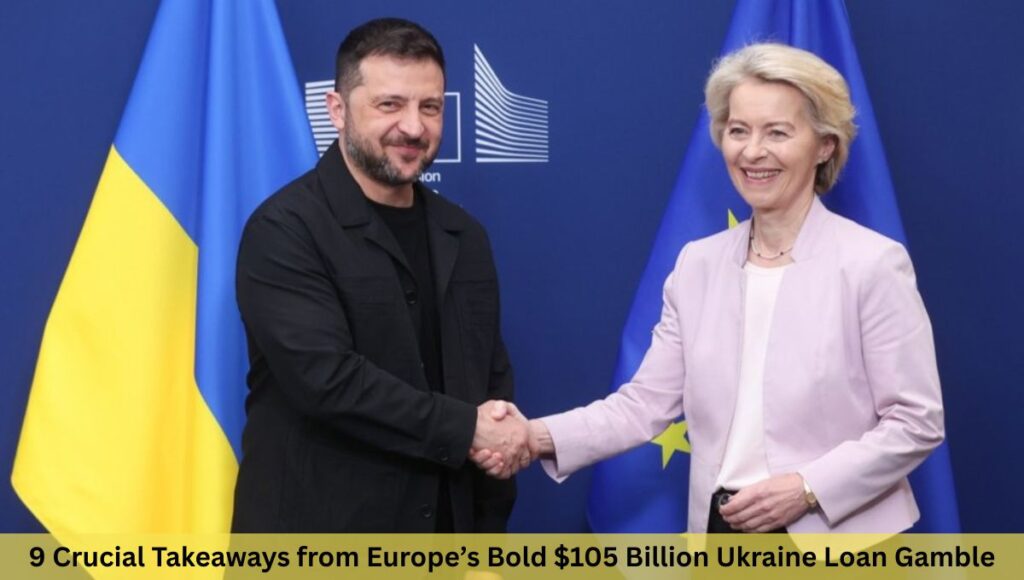
9 Crucial Takeaways from Europe’s Bold $105 Billion Ukraine Loan Gamble
Why the $105 Billion Ukraine Loan Matters
Ukraine faces a stark financial reality. According to the International Monetary Fund, Kyiv risks a $160 billion funding gap over the next two years if external assistance falters.
That shortfall would have had devastating consequences:
- Collapse of basic state services
- Severe cuts to military procurement
- Damage to Ukraine’s drone and missile programs
- Weakened negotiating leverage in peace talks
The EU stepped in to cover roughly two-thirds of that gap, positioning itself as Ukraine’s primary financial lifeline at a moment when US support has grown uncertain.
Ukrainian President Volodymyr Zelensky had warned bluntly that without funding, Ukraine would lack money “for life and weapons.” The loan, he said after the agreement, changes that equation.
“This is significant support that truly strengthens our resilience,” Zelensky wrote on X. “Ukraine has received a financial security guarantee for the coming years.”
A Compromise Born of Division
Why the EU Couldn’t Fully Agree on Russian Assets
The EU failed to secure unanimous approval for directly using frozen Russian sovereign assets as the immediate funding source — a move many saw as a historic but legally risky step.
France’s President Emmanuel Macron had previously warned that confiscating state assets could violate international law. Belgium, where the bulk of the assets are held, raised alarm over financial and legal exposure.
Instead, leaders opted for a strategic compromise:
- The loan is approved now
- Ukraine pays nothing until the war ends
- The EU reserves the right to tap Russian assets later
- The European Commission is mandated to explore mechanisms
European Council President Antonio Costa framed the decision as a warning to Moscow.
“You have not achieved your objectives in Ukraine,” he said. “Europe stands with Ukraine — today, tomorrow and as long as necessary.”
What Are the Frozen Russian Assets — and Where Are They?
Since Russia’s full-scale invasion of Ukraine in 2022, Western nations have frozen approximately $300 billion in Russian sovereign assets.
Key figures:
- €210 billion held in the EU
- €185 billion managed by Belgium-based clearing house Euroclear
- Roughly €176 billion already converted into cash as bonds matured
Under EU sanctions, the capital remains Russian property — but the interest generated does not belong to Moscow.
Until now, the EU has used interest income to fund limited aid to Ukraine. The new loan dramatically expands that ambition.
How the EU’s Reparations Loan Would Work
The Financial Engineering Behind the Plan
The European Commission has designed a mechanism that avoids outright confiscation — a crucial legal distinction.
Step by step:
- Russian cash remains immobilised
- Euroclear invests it in EU Commission zero-coupon bonds
- Ukraine receives loan tranches as needed
- Repayment occurs only after Russia pays war reparations
This allows Ukraine to spend now instead of waiting years — or decades — for compensation.
The EU estimates €165 billion is realistically available once existing G7 obligations are accounted for.
Who Carries the Risk?
This is the question that nearly sank the deal.
Belgium, which hosts Euroclear, fears:
- Russian retaliation
- Legal claims if assets are returned prematurely
- Damage to Europe’s financial credibility
Belgian PM De Wever demanded binding guarantees that his country would not shoulder the burden alone.
“Mere oral promises are not enough,” he warned parliament.
To reduce risk, EU governments agreed on December 12 to freeze Russian assets indefinitely, eliminating the chance that a single dissenting state could force their release during six-monthly renewals.
Russia Strikes Back — In Court
Moscow has responded with legal warfare.
On Monday, Russia’s central bank filed a lawsuit against Euroclear, seeking damages equivalent to the frozen assets plus lost profits — over $225 billion, according to Russian filings. The Kremlin has described the EU’s plans as “theft” and warned of retaliation.
Potential Russian responses include:
- Seizing EU corporate assets still in Russia
- Restricting exports of nickel, aluminum, and fertilizers
- Escalating financial pressure on European firms
A preliminary court hearing is scheduled for January 16, 2026.
Hungary’s Orban: ‘It’s a Dead End’
Hungarian Prime Minister Viktor Orbán, Russia’s closest ally within the EU, insisted the frozen-assets plan would never pass. “It’s over,” he told CNBC. “There is no sufficient support behind it.”
Hungary has repeatedly blocked EU financial mechanisms requiring unanimity, arguing it is acting “for peace.” But EU foreign policy chief Kaja Kallas rejected that framing.
“We haven’t seen any willingness from Russia to seriously talk about peace,” she said.
“Putin is banking on us to fail.”
The United States Factor: A Fractured Alliance
The EU summit unfolded against a backdrop of deteriorating transatlantic trust.
US President Donald Trump recently branded European leaders “weak,” while a leaked US-backed peace plan proposed:
- Investing $100 billion of frozen Russian assets
- Under US-led reconstruction efforts
- With profits flowing back to Washington
European leaders were outraged at the prospect of US control over assets held on European soil.
European Commission President Ursula von der Leyen called the moment “Europe’s independence moment.”
“The world has become dangerous and transactional,” she said. “Europe must be responsible for its own security.”
Why This Loan Strengthens Ukraine’s Hand
Zelensky made clear the funding deal was about more than survival — it was about leverage.
Without it:
- Ukraine’s drone industry would suffer
- Long-range strikes on Russian infrastructure would shrink
- Peace talks would tilt decisively toward Moscow
“We are more confident at the negotiating table if we have these assets,” Zelensky said.
The loan secures Ukraine’s resistance — and its negotiating position — for at least two more years.
A Message to Moscow — and to Washington
For Europe, the deal was about credibility.
Facing:
- Russian battlefield pressure
- US impatience for a quick peace
- Internal political fragmentation
Failure would have sent a dangerous signal — that Europe could not act decisively when stakes were highest.
As analyst Tom Keatinge of the Royal United Services Institute noted:
“The Russians work day and night to fragment Europe — and they are better at it than Europe is at remaining cohesive.”
This time, Europe held.
What Happens Next?
Key milestones ahead
- Commission develops legal framework for asset use
- Ukraine receives loan tranches through 2026–27
- Russian legal retaliation unfolds
- US-led peace talks continue, possibly in Miami
The loan does not end the war — but it buys time, resilience, and autonomy.
Why This Is a Turning Point for Europe
This was not just about Ukraine.
It was about:
- Europe’s role as a security actor
- Its financial sovereignty
- Its ability to act without Washington
As dawn broke in Brussels on the longest night of the year, Europe emerged bruised — but standing.
For Kyiv, it means survival.
For Moscow, a warning.
For the world, a sign that Europe is no longer willing to drift.
Also Read: 7 Crucial Security Guarantees Ukraine Wants After Dropping NATO Bid
Also Read: EU leaders will loan 90 billion euros to Ukraine, but fail to agree to use frozen Russian assets
Related Posts:
- In 8 Moves, EU Targets China-Linked Refineries and…

- Rare Earth Export Curbs 2025: U.S. Threatens China…

- 7 Powerful Measures: Trump Sanctions Russian Oil…

- 5 Major Takeaways from the US Supreme Court's…

- Afghanistan–Pakistan War 2025: Inside the 48-Hour Ceasefire

- 7 Heartbreaking Facts About Venezuela's Earthquake Disaster