Intensifying pressure on Israel, Belgium to Recognise Palestine at UN General Assembly and Imposes 12 Sanctions on Israel. Belgium has become the latest Western country to announce it will formally recognise the State of Palestine during the upcoming United Nations General Assembly (UNGA) in New York this September. Alongside recognition, Brussels will also impose 12 wide-ranging sanctions on Israel, escalating international pressure amid the ongoing Israel-Gaza war.
Foreign Minister Maxime Prevot, who also serves as Belgium’s Deputy Prime Minister, declared on Tuesday that the recognition move was taken “in light of the humanitarian tragedy unfolding in Palestine, particularly in Gaza.”
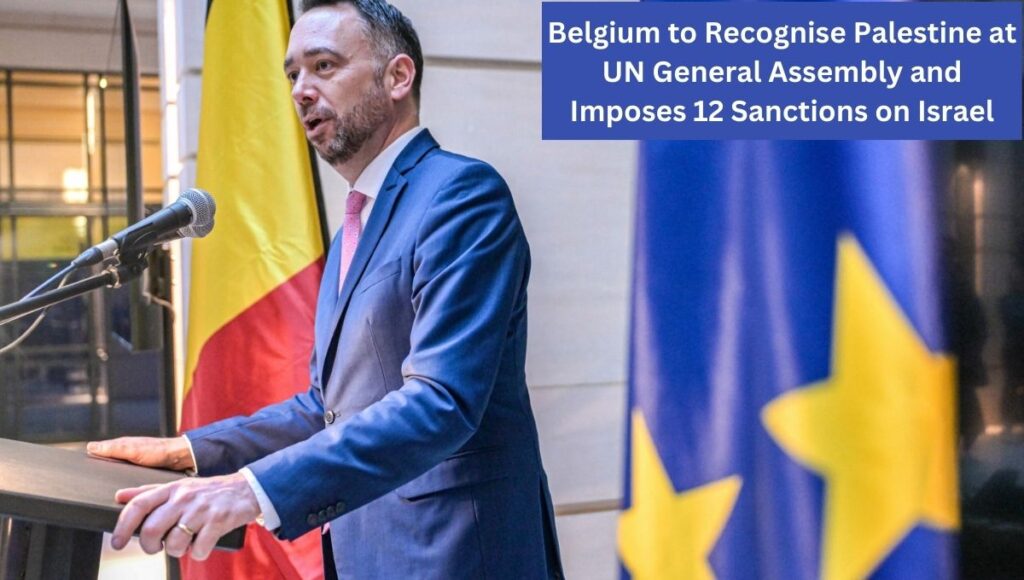
Belgium to Recognise Palestine at UN General Assembly and Imposes 12 Sanctions on Israel
Belgium’s Recognition of Palestine
Prevot wrote on X (formerly Twitter):
“Palestine will be recognised by Belgium at the UN session! And firm sanctions will be imposed against the Israeli government.”
He stressed, however, that Belgium’s recognition of Palestine would be administratively formalised only once the last Israeli hostage held in Gaza has been released and Hamas no longer plays a political role.
This conditional recognition mirrors earlier debates in Belgium’s coalition government, where Prime Minister Bart De Wever of the Flemish nationalist party argued that recognition must be tied to strict requirements.
Belgium’s step adds momentum to a growing movement in Europe and beyond, with several Western nations pledging to recognise Palestinian statehood during the UNGA session.
The 12 Sanctions Against Israel
Belgium’s announcement is not limited to diplomatic recognition. Prevot confirmed that 12 firm sanctions will be imposed on Israel. These include:
- Ban on importing products from Israeli settlements in the occupied West Bank.
- Review of public procurement policies with Israeli companies.
- Restrictions on consular assistance for Belgian citizens living in illegal settlements.
- Potential judicial prosecutions for crimes linked to settlement activity.
- Overflight and transit bans for certain Israeli aircraft and individuals.
- Designation of two far-right Israeli ministers and several violent settlers as persona non grata.
- Hamas leaders barred from entering Belgium.
According to Prevot, these measures target both Israeli settlement expansion and extremist actors within the conflict, while simultaneously condemning Hamas terrorism.
European and Western Momentum
Belgium’s decision comes just weeks after French President Emmanuel Macron announced that France would recognise Palestine at the UN meeting.
France and Saudi Arabia are also set to co-host a high-profile gathering on Palestinian recognition on September 22, ahead of the UNGA session.
Other countries, including Australia, Canada, and the United Kingdom, have pledged to recognise Palestine this month, while New Zealand, Finland, Portugal, and Malta are actively considering similar moves.
As of April 2025, 147 countries representing about 75% of UN member states already recognise Palestinian statehood.
Israel and US Reaction
The announcement has been met with anger in Israel. Prime Minister Benjamin Netanyahu has consistently rejected Palestinian statehood and vowed to continue expanding military operations in Gaza.
Israel’s far-right finance minister Bezalel Smotrich previously warned that for every country recognising Palestine, a new illegal settlement would be established in the occupied West Bank.
Smotrich is one of the Israeli ministers already sanctioned by Australia, Canada, Norway, New Zealand, and the UK.
The United States also strongly opposes unilateral recognition of Palestine. Secretary of State Marco Rubio called France’s earlier announcement a “reckless decision” that “serves Hamas propaganda.”
The Trump administration has since confirmed it will deny visas to Palestinian officials attending the UNGA in New York, further escalating tensions.
The Humanitarian Crisis in Gaza
Belgium’s decision comes against the backdrop of a deepening humanitarian disaster in Gaza.
Since October 2023, Israel has carried out a sustained military assault on Gaza following Hamas’s surprise attack that killed 1,200 Israelis and took over 250 hostages.
As of September 2025, Gaza’s death toll stands at 63,459 killed and 160,256 injured, according to health officials.
On August 22, a UN-backed monitor confirmed that famine has already begun in northern Gaza, with starvation expected to spread across central and southern regions by the end of September.
UN Special Rapporteur Francesca Albanese has urged countries to impose sanctions and an arms embargo on Israel, stressing that recognition of Palestine should be tied to accountability for violations of international humanitarian law.
Belgium’s Broader Stance on Israel and Palestine
Belgium has taken a particularly proactive role in recent months.
- In July, Belgian prosecutors referred a war crimes complaint against two Israeli soldiers to the International Criminal Court (ICC).
- Prevot announced that Belgium will continue to support Palestine’s reconstruction and will push for broader European Union sanctions on Hamas.
- At the same time, Belgium emphasises a zero-tolerance policy toward antisemitism, making clear that support for Palestine cannot translate into antisemitic rhetoric or glorification of terrorism.
This dual approach positions Belgium as both a critic of Israel’s settlement policy and a cautious mediator against extremist violence.
Divisions Within the European Union
Belgium’s recognition has highlighted divisions inside the European Union.
At a meeting of EU foreign ministers in Copenhagen last week, several countries including Ireland, Spain, and Luxembourg pushed for stronger sanctions against Israel, while others, including Germany and Hungary, opposed the idea.
This reflects the EU’s long-standing struggle to present a united foreign policy stance on the Israeli-Palestinian conflict.
What Recognition Means at the UN
By announcing recognition at the United Nations General Assembly, Belgium and other Western states are aligning with the New York Declaration, a joint diplomatic initiative co-led by France and Saudi Arabia.
The declaration seeks to revive the long-stalled two-state solution, envisioning a Palestinian state living peacefully alongside Israel, with East Jerusalem as its capital.
However, Israel and the United States argue that such recognition undermines peace negotiations and emboldens militant groups.
Despite these objections, momentum for recognition continues to grow, with increasing numbers of Western states joining the 147 countries that already acknowledge Palestinian sovereignty.
Looking Ahead
Belgium’s decision marks a significant escalation in Europe’s stance on the Israel-Palestine conflict.
By combining diplomatic recognition with concrete sanctions, Brussels is sending one of the strongest signals yet from a Western government that Israeli settlement expansion and Gaza’s humanitarian catastrophe cannot be ignored.
The upcoming UN General Assembly session, beginning September 23, will serve as a critical moment:
- Multiple Western nations are expected to formalise recognition of Palestine.
- France and Saudi Arabia will co-chair a meeting on Palestinian statehood.
- Israel and the US will face mounting diplomatic isolation.
For Palestinians, recognition brings symbolic legitimacy. For Israel, it signals growing frustration in the West over its conduct in Gaza and the West Bank. For Belgium, it marks a historic turning point in its foreign policy.
Conclusion
Belgium’s recognition of Palestine at the UN General Assembly paired with 12 sanctions on Israel adds new weight to global efforts to revive the two-state solution.
While recognition will only be finalised under specific conditions, Brussels has placed itself at the forefront of Europe’s response to the war in Gaza. As more Western nations follow suit, the international landscape around Palestinian statehood and Israel’s war in Gaza may be entering a decisive new chapter.
Also Read: France to Recognize Palestine at UN: A Diplomatic Earthquake Ahead of September Summit
Also Read: UN chief: Israeli-Palestinian conflict at ‘breaking point,’ urges push for two-State solution
Related Posts:
- Trump Unveils 21-Point Gaza Peace Plan at UNGA: Arab…
- Trump Official Assaulted by ‘Deranged Leftist’ at…

- US Revokes Visas of Palestinian Officials Ahead of…
- In 8 Moves, EU Targets China-Linked Refineries and…

- Trump’s 20-Point Gaza Peace Plan Gains Urgent Global…

- Trump Pushes Gaza Peace Plan: Israeli Exit, Arab…