Anna Chapman — Putin’s Glamorous 43-Year-Old Spy Returns as head of Moscow’s new Museum of Russian Intelligence. Fifteen years after her dramatic arrest in New York, Anna Chapman — once branded Russia’s most glamorous spy — is back in global headlines.
The 43-year-old former agent, deported to Moscow in a Cold War-style spy swap, has resurfaced with a prestigious new role: heading the Museum of Russian Intelligence, a state-backed project reportedly linked to President Vladimir Putin’s Foreign Intelligence Service (SVR).
Her appointment has reignited curiosity about her mysterious past, her connections to Russian power circles, and her remarkable transformation from captured spy to public figure. Here are the key details of Anna Chapman’s extraordinary story.
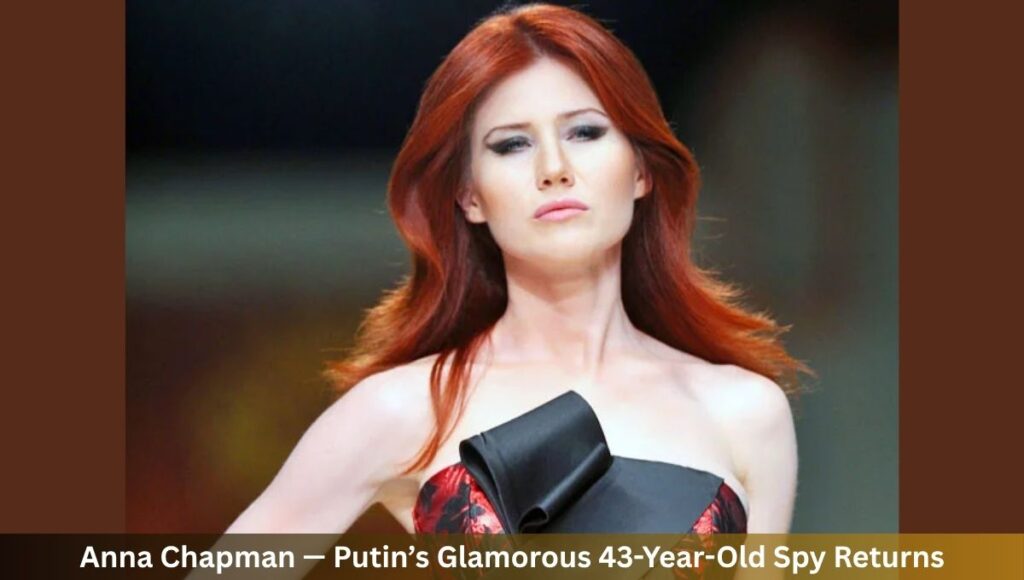
Anna Chapman — Putin’s Glamorous 43-Year-Old Spy Returns
1. From Volgograd to London — The Making of a Spy
Anna Chapman was born Anna Kushchenko in Volgograd (then Stalingrad), into a family steeped in Soviet diplomatic tradition. Her father, Vasily Kushchenko, served in the Soviet Union’s diplomatic corps, reportedly stationed in Kenya during her childhood — an early link to global politics.
Educated at the Peoples’ Friendship University of Russia, one of Moscow’s elite institutions, she earned a degree in economics and quickly proved herself ambitious and cosmopolitan.
In 2001, while at a Moscow nightclub, she met Alex Chapman, a British psychology student. They married within five months, and Anna moved to London. The marriage lasted only four years, but it gave her British citizenship — and, unknowingly, a foothold in Western society that would later draw attention from intelligence services.
Her ex-husband later described her as “secretive” and “connected to Russian friends,” while Chapman’s 2024 memoir Bondianna paints him as violent and controlling. She insists her patriotism and passion for Russia ultimately shaped her destiny.
2. Recruited in London — The Birth of a Secret Agent
According to Chapman’s memoir, she was recruited by a London-based Russian operative known only as Kirill. He allegedly recognized her exceptional networking skills and tested her loyalty to Russia during a flight to Moscow.
After psychological and aptitude assessments, she was reportedly inducted into the Russian Foreign Intelligence Service (SVR) — the post-Soviet successor to the KGB.
Chapman claims she underwent spycraft training involving surveillance, communication encryption, and social infiltration. “I was a real-life female James Bond,” she wrote. “Charm, confidence, and intelligence were my weapons.”
Although many of her dramatic stories remain unverified, Western officials acknowledge she was a deep-cover agent capable of moving effortlessly through elite social circles.
3. The New York Operation — A Spy in the City
By 2009, Chapman had relocated to New York City, posing as a real estate entrepreneur. Her lifestyle — penthouse apartment, designer clothes, and exclusive parties — concealed her true mission.
Behind the glamorous façade, she was part of a Russian sleeper cell operating under Operation Ghost Stories, a decade-long FBI counterintelligence probe targeting deep-cover Russian operatives in the U.S.
According to the FBI, Chapman and nine others lived “illegally,” cultivating connections with influential Americans and policy insiders. Surveillance footage later showed her using a laptop in a Manhattan store to transmit encrypted data to her Russian handler.
Her downfall came in June 2010, when an undercover FBI agent posing as a Russian operative handed her a fake passport. Instead of delivering it to her contact, Chapman took it to the police — a move that triggered her arrest.
Frank Figliuzzi, then Assistant Director of FBI Counterintelligence, said Chapman’s group was “on the verge of reaching high-level policy networks.” The arrests ended one of the most sophisticated espionage operations since the Cold War.
4. A Cold War-Style Spy Swap — Chapman Returns to Moscow
Just two weeks after her arrest, Chapman was part of a historic spy swap between the U.S. and Russia — the largest since 1986.
On July 8, 2010, she and nine other Russian spies were traded for four Western agents imprisoned in Russia. The exchange took place dramatically on the tarmac at Vienna International Airport, symbolizing a brief thaw in U.S.–Russia relations.
Upon her return, Chapman was treated as a national hero. She appeared on talk shows, walked Moscow red carpets, and was embraced by the pro-Putin youth wing of the United Russia Party.
Her striking red hair and poised demeanor made her a pop culture icon — part spy, part celebrity. Russian media dubbed her the “Red Sparrow” and “Bond Girl of the Kremlin.”
5. Reinvention in Russia — From Spy to Media Star
Following her return, Anna Chapman capitalized on her fame. She hosted a television show about international intrigue, modeled for magazines, and became a social media influencer with a carefully curated, patriotic persona.
Her Instagram and television appearances depicted a blend of glamour, loyalty, and mystique. She often appeared in fur-lined outfits, photographed amid snowy landscapes or elegant interiors — projecting an image of confidence and control.
She even authored motivational pieces about “faith, femininity, and love for the motherland,” aligning herself with Putin’s conservative nationalism. Rumors circulated that she became a mother to a son, though she has kept her personal life strictly private.
By the mid-2010s, she had evolved from a captured spy into a symbol of Russian resilience and feminine strength — a role that fit neatly into the Kremlin’s modern propaganda narrative.
6. The Memoir — ‘Bondianna: To Russia With Love’
In 2024, Chapman published her memoir, Bondianna: To Russia With Love, reigniting fascination with her past. The book blends confession, fiction, and self-mythologizing in equal measure.
She portrays herself as a real-life female 007, describing how she used her looks, charm, and intellect to move among the world’s elite. In one passage, she writes:
“Nature had generously endowed me with the necessary attributes — a slim waist, a full chest, a cascade of red hair. All I needed was to emphasize it — with simple yet elegant clothes and confidence.”
The book also recounts her recruitment, espionage training, and arrest but omits sensitive operational details. Critics view it as part autobiography, part patriotic storytelling, designed to rebuild her public image and reinforce her loyalty to Putin’s Russia.
Still, Bondianna became a bestseller in Russia and stirred debate abroad about how modern espionage blends with celebrity culture.
7. A New Mission — The Museum of Russian Intelligence
Now, Anna Chapman has returned to prominence with a role that seems tailor-made for her. She has been appointed Director of the Museum of Russian Intelligence, a new institution near Gorky Park in Moscow, reportedly registered under the SVR.
The museum will celebrate the “history and achievements” of Russian espionage — from Soviet-era KGB operations to modern intelligence missions. Sources say the project is overseen by Sergey Naryshkin, the current SVR chief and one of Putin’s closest allies.
The appointment of Chapman — now using the alias Anna Romanova — underscores Russia’s effort to glamorize its intelligence legacy amid heightened tensions with the West.
Observers see it as a symbolic act: a woman once expelled from the United States for espionage now curating Russia’s official story of its spies.
Why Anna Chapman Still Captivates the World
Anna Chapman’s story encapsulates the evolution of espionage in the 21st century — where intelligence, media, and image converge. She is both a relic of Cold War rivalry and a reflection of modern geopolitical theater.
Her trajectory from London socialite to New York spy, and from FBI detainee to Putin-linked cultural figure, mirrors the blurred line between power, propaganda, and celebrity in modern Russia.
Whether seen as a loyal patriot or a carefully managed symbol, Chapman remains an enduring enigma — an embodiment of Russia’s sophisticated approach to information, identity, and soft power.
Conclusion — A Spy Reimagined
Fifteen years after her arrest, Anna Chapman’s transformation is nearly complete. She no longer hides in the shadows; instead, she presides over a museum celebrating the very craft that once exposed her.
Her appointment carries symbolic weight: Russia’s intelligence community reasserting pride in its agents, and Vladimir Putin reaffirming control of the narrative. As tensions persist between Moscow and Western capitals, Chapman’s story reminds the world that espionage is not only about secrets — it’s also about image, influence, and enduring mystique.
Also Read: The Most Famous Hacker Girls Ever: Anna Chapman and the Illegal Program
Also Read: Leaked FSB Memo Exposes China as a ‘Silent Enemy’ in Russia’s Eyes
Related Posts:
- 7 Shocking Facts: 600+ Artefacts Stolen in UK Museum Heist

- 8 Crown Jewels Stolen in a Shocking $102 Million…

- 5 Alarming Failures: Water Leak Hits Louvre Weeks…

- 5 Key Takeaways as Zohran Mamdani Wins Historic New…

- Ukraine and Russia Conduct Largest Prisoner Swap of…

- 9 Explosive Developments in Iran–US Crisis as Ships…