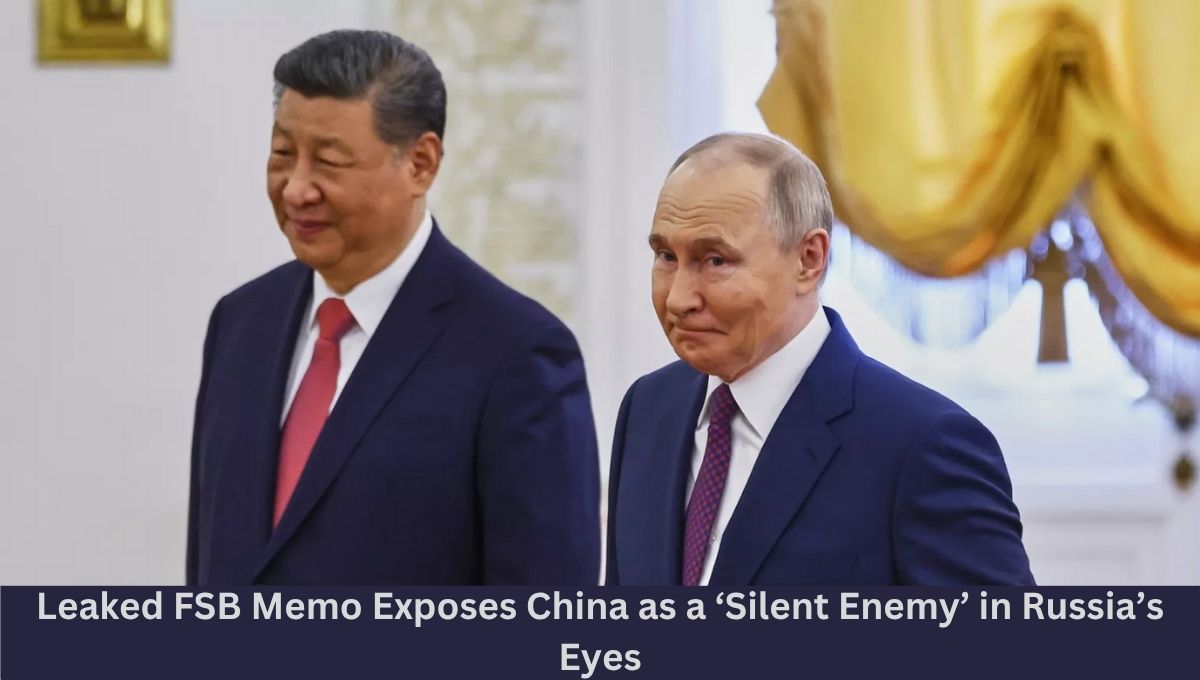
Russian Leaked FSB Memo Exposes China as a ‘Silent Enemy’ in Russia’s Eyes. A leaked intelligence report from Russia’s Federal Security Service (FSB) has revealed a startling rift between Moscow and Beijing, despite their public alliance. The eight-page document, verified by six Western intelligence agencies and first reported by The New York Times, labels China not as an ally but a “serious threat” to Russia’s national security.
The FSB memo, obtained by hacker group Ares Leaks, underscores deep internal mistrust within the so-called “no-limits” partnership touted by Russian President Vladimir Putin and Chinese leader Xi Jinping. It portrays China as actively recruiting Russian scientists, monitoring military operations in Ukraine, and eyeing territorial influence in the Russian Far East and Arctic.
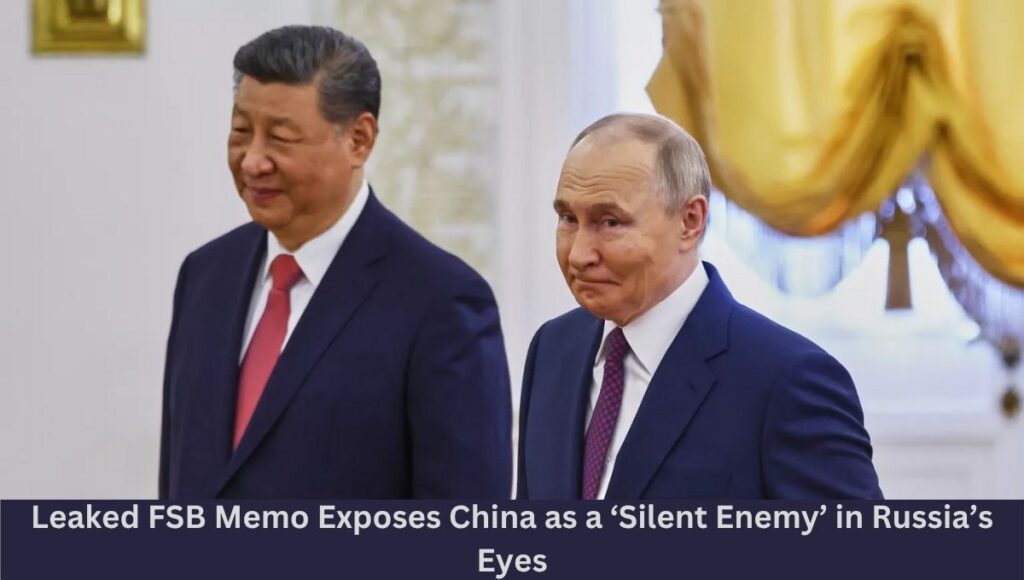
Leaked FSB Memo Exposes China as a ‘Silent Enemy’ in Russia’s Eyes
FSB: China Is Actively Targeting Russian State Secrets
Contrary to the public image of unity, the leaked document paints Chinese intelligence operations as aggressive and escalating. The FSB accuses Beijing of targeting Russian scientists, journalists, and businesspeople—particularly those with access to classified information or military technology.
According to the memo, China has been using personal relationships, including marriages to Russian nationals, to infiltrate sensitive institutions. These efforts are reportedly being carried out through Chinese universities, mining companies, and cultural exchanges—many of which are viewed as covert intelligence fronts.
This revelation throws the strategic Russia China relations narrative into question. What appears as geopolitical solidarity on the surface may, in fact, be a high-stakes intelligence tug-of-war.
China Spying on Ukraine War: Battlefield as a Learning Ground
One of the most explosive claims in the FSB report is that Chinese agents are closely observing Russia’s military operations in Ukraine. The purpose? To study NATO-supplied weapons and understand Western battlefield tactics.
The FSB believes that China sees Ukraine as a “live testing ground” to inform its own military planning—especially in anticipation of a possible conflict over Taiwan. The Chinese focus reportedly includes drone warfare, aerospace capabilities, and cyber countermeasures.
Beijing’s keen interest in the war not only reflects opportunism but also strategic positioning, raising alarm bells among Russian security officials already overwhelmed by Western scrutiny.
Espionage in the Arctic: A New Front in Russia-China Tensions
The FSB memo further alleges that China is conducting covert operations in the Russian Arctic, a region of growing geopolitical importance. Using research stations and mining firms as a cover, Chinese operatives are allegedly collecting intelligence on Russia’s Arctic infrastructure, including military deployments and shipping routes.
China’s increasing presence in the Arctic is framed in the report as part of a long-term plan to secure dual-use infrastructure civilian assets with potential military applications. This development adds a new layer of complexity to Russia’s strategic posture in a region it considers a critical national interest.
Territorial Worries: Vladivostok and the Far East Under Scrutiny
Another shocking detail in the FSB document is concern over China’s “ideological groundwork” for future territorial claims. Russian intelligence officials are reportedly alarmed by Chinese academic research into ancient Chinese settlements in areas like Vladivostok territory that once belonged to the Qing Dynasty and was ceded to Russia in the 19th century.
In 2023, Beijing even released maps labeling Russian cities with historic Chinese names, stoking fears of creeping revanchism. The FSB fears this academic activity is a strategic soft-power move that may pave the way for future diplomatic or even territorial disputes.
Entente-4: Moscow’s Hidden Counter-Espionage Plan
Perhaps most telling is the mention of Entente-4, a secret counterintelligence operation launched just three days before Russia’s invasion of Ukraine in February 2022. Named after the historical Franco-Russian alliance, Entente-4 was designed to combat growing Chinese influence in Russia’s defense, scientific, and academic sectors.
The program marked a silent but strategic pivot in Russia’s internal security priorities. While the Kremlin was focused outward on NATO and the West, it was also watching its eastern “partner” with growing suspicion.
A Climate of Paranoia: Mutual Espionage Between Allies
The leaked memo also reveals that mistrust is mutual. Chinese intelligence is said to subject its operatives returning from Russia to polygraph tests and tight surveillance. Over 20,000 Russian students studying in China are under suspicion, particularly those involved in relationships with Chinese citizens.
According to the FSB, these students and expatriates are prime targets for recruitment. In response, Russian intelligence has reportedly initiated face-to-face interrogations with those working in Chinese firms or research centers, fearing that they may be unwitting conduits for sensitive state secrets.
A Marriage of Necessity: Strategic Alliance or Liability?
Despite these tensions, Russia remains deeply dependent on China for economic survival. Since the Ukraine invasion, China has bought discounted Russian oil, provided key technology components, and kept financial links open when the West severed ties.
But the FSB leak suggests that Russia’s reliance on China may be a strategic liability. As Alexander Gabuev from the Carnegie Russia Eurasia Center notes, “Putin believes that he can go much deeper into this Chinese embrace. It’s not risk-free, but it is worth it.”
This growing dependence, however, is now complicated by the knowledge that behind the facade of friendship, both nations may be preparing for a long-term rivalry.
Ares Leaks: A Geopolitical Bombshell
The explosive report was leaked by Ares Leaks, a cybercrime group that has previously published sensitive state documents. After being authenticated by The New York Times and six Western intelligence agencies, the memo is now considered one of the most significant breaches of Russian internal intelligence in years.
The leak has not only exposed China’s alleged espionage activities but also Russia’s secret acknowledgment of the risks in its alliance with Beijing. It’s a stark reminder that strategic relationships often mask hidden fault lines and that alliances born of necessity rarely last without trust.
Conclusion: A No-Limits Partnership with Hidden Limits
The FSB memo shatters the carefully cultivated image of Russia China relations as “unshakable.” Instead, it reveals a volatile, covert rivalry masked by diplomacy and mutual dependency.
As the world watches the Ukraine war unfold and tensions rise over Taiwan and the Arctic, this leak sends a clear message: even the closest authoritarian regimes are not immune to espionage, mistrust, and strategic calculation. In geopolitics, handshakes may make headlines but behind closed doors, it’s the spies who tell the truth.
Also Read: US Lawmakers Target China and India with Proposed 500% Tariffs Over Russian Oil Trade