
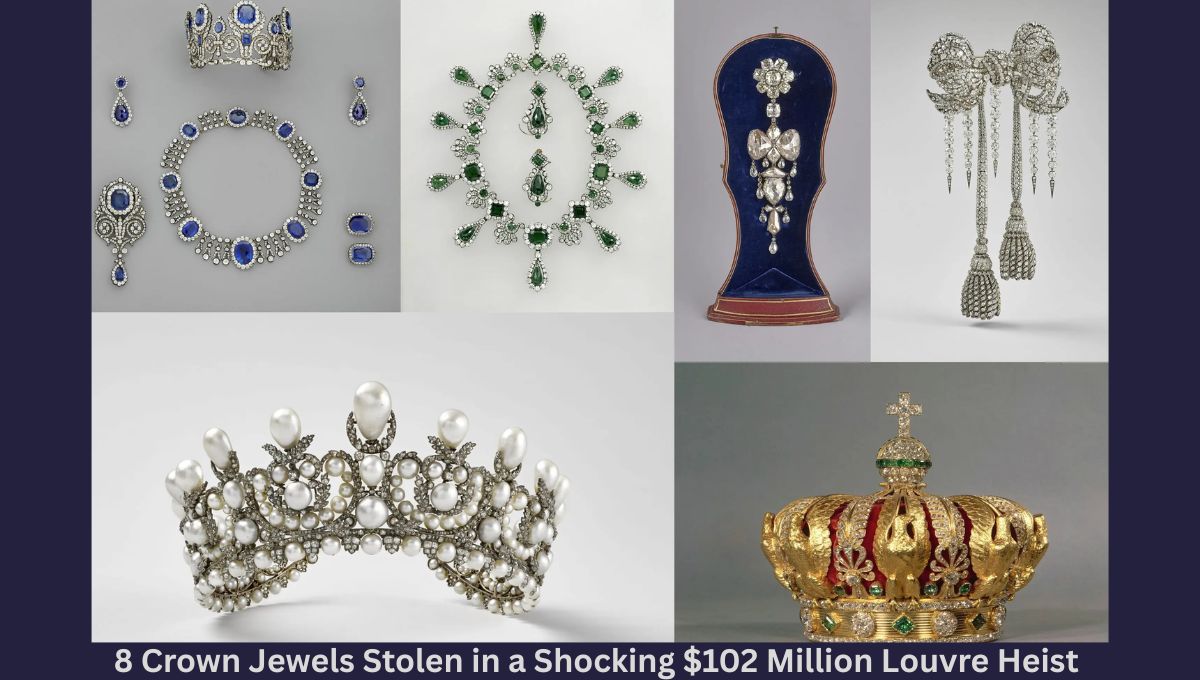
8 Crown Jewels Stolen in a Shocking $102 Million Louvre Heist in broad daylight. The world was left stunned after one of the boldest museum robberies in recent history unfolded at the Louvre Museum in Paris, where four thieves executed a four-minute daylight heist on Sunday morning, stealing eight priceless French crown jewels worth €88 million ($102 million). The brazen crime has reignited a fierce debate about museum security in France and sparked an international hunt for the perpetrators.
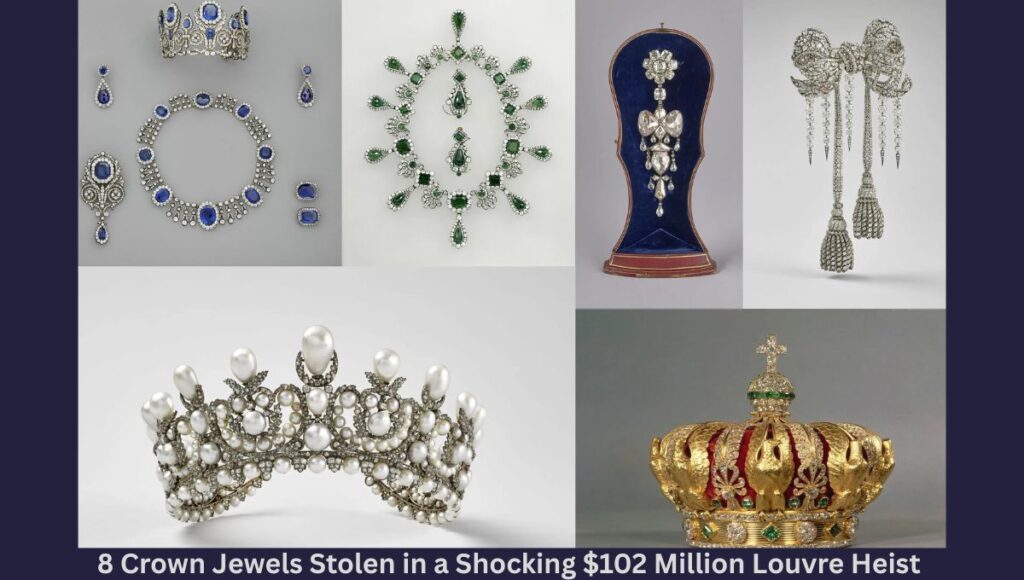
8 Crown Jewels Stolen in a Shocking $102 Million Louvre Heist
The $102 Million Crown Jewel Heist: What Happened at the Louvre
At approximately 9:30 a.m. local time, just half an hour after the museum opened to the public, four masked robbers arrived at the Galerie d’Apollon, home to France’s crown jewels.
Using a vehicle-mounted mechanical lift, they scaled a balcony near the River Seine and cut through a first-floor window with power tools.
Once inside, the thieves threatened guards, smashed open two reinforced glass display cases, and snatched eight royal jewels — some dating back to Napoleon Bonaparte’s era.
They then fled on two scooters waiting outside, disappearing within minutes.
French police confirmed that the entire operation lasted less than eight minutes.
What Was Stolen: A Glimpse of France’s Lost Royal Treasures
Authorities confirmed that the robbers targeted the museum’s most valuable royal jewellery collection. Among the items stolen were:
- A sapphire diadem, necklace, and single earring linked to 19th-century queens Marie-Amélie and Hortense
- An emerald necklace and earrings once belonging to Empress Marie-Louise, Napoleon’s second wife
- A reliquary brooch
- Empress Eugénie’s diadem and her large corsage-bow brooch, a 19th-century imperial masterpiece
Each piece is adorned with hundreds of diamonds, emeralds, and sapphires — collectively representing both immense material and immeasurable historical value.
The Value: €88 Million — But Priceless to France
Paris prosecutor Laure Beccuau announced the estimated value at €88 million ($102 million). Speaking to RTL Radio, she emphasized that the financial estimate “does not reflect the historical damage caused by the theft.”
“The wrongdoers who took these gems won’t earn 88 million euros if they have the very bad idea of disassembling these jewels,” Beccuau warned. “We can only hope they don’t destroy them without rhyme or reason.”
Officials noted that the pieces were not insured, as is common for state-owned collections, since “the state acts as its own insurer.”
Also Read: Stolen Louvre jewels were not insured, French government says
Inside the Robbery: How the Thieves Pulled It Off
A meticulously planned operation
According to French investigators, the heist displayed professional precision and timing. The gang arrived in a truck with an attached crane, climbed to the Apollo Gallery’s balcony, and cut through a window using industrial grinders.
Within four minutes, they located and looted two specific display cases, both housing Napoleonic-era jewels.
A broken alarm and missing cameras
A preliminary report revealed that one-third of rooms in the gallery had no CCTV coverage, and the local alarm system was malfunctioning at the time.
The wider museum alarms, however, did activate, prompting staff to evacuate visitors immediately.
Culture Minister Rachida Dati confirmed that the robbers were seen moving “calmly” and “methodically”, suggesting they were seasoned criminals. “They knew exactly where to go,” she said.
Police Investigation: 100 Investigators and a National Manhunt
Initially led by a 60-member team, the investigation has since expanded to around 100 officers under the direction of prosecutor Beccuau.
Authorities are analyzing fingerprints, DNA evidence, and CCTV footage from nearby streets and highways.
Four suspects are being hunted, and investigators believe they are part of an organized crime syndicate operating within or beyond France.
“Either they acted for a sponsor,” Beccuau said, “or to obtain precious stones for money laundering operations.”
The Louvre’s director, Laurence des Cars, is expected to testify before the French Senate’s culture committee to address growing questions over museum security.
Could the Stolen Jewels Be Sold? Experts Say It’s Unlikely
Experts warn that the thieves will struggle to sell the intact jewels due to their fame and traceability. However, there is fear that they could be dismantled or melted down for their raw materials — diamonds, emeralds, and gold.
Dutch art detective Arthur Brand told the BBC:
“I fear the jewels may already be long gone — broken up into hundreds of parts.”
Estimated resale value: A fraction of their worth
According to Tobias Kormind of 77 Diamonds, the gemstones could fetch up to £10 million ($13.4 million) if broken down.
Large diamonds alone might be worth £500,000 each, though this represents a tiny fraction of their historical value.
Jewellery historian Carol Woolton said the robbers “cherry-picked” the most important gems but likely dropped Empress Eugénie’s crown, which was later found damaged near the escape route.
Organized Crime and “Cultural Terrorism”
Art crime experts believe the heist mirrors the 2019 Dresden Green Vault robbery, where thieves stole 21 diamond treasures worth €113 million. Many of those gems were later recovered, but some remain missing.
Laura Evans, an art crime historian, described the Louvre robbery as “cultural terrorism executed with military-style precision.”
“This was not about exploiting weaknesses,” Evans explained. “It was about using force — blunt, industrial power — in broad daylight.”
Authorities found two grinders, a blowtorch, gloves, gasoline, and a walkie-talkie at the scene, along with Empress Eugénie’s damaged crown, suggesting the thieves abandoned it during their escape.
Why the Louvre Was Targeted
The Louvre Museum, the most visited museum in the world, houses more than 35,000 artworks, including the Mona Lisa. Experts suggest it is a “soft target”, balancing public accessibility with security.
Remigiusz Plath from the International Council of Museum Security explained:
“Museums must let people experience art up close. But that makes them vulnerable. You’re inches away from priceless objects — and a few minutes of brute force can destroy centuries of heritage.”
This vulnerability has already been exploited multiple times. In recent months, thieves stole €9.5 million worth of porcelain from a museum in Limoges and gold nuggets worth $1.5 million from Paris’s Natural History Museum.
France’s Political and Cultural Outcry
The Louvre heist has ignited national outrage.
President Emmanuel Macron called it “an attack on our history.”
National Rally leader Jordan Bardella called it “an intolerable humiliation.”
Marine Le Pen described it as “a wound to the French soul.”
As one French heritage expert said,
“What was stolen belonged to all of us. These jewels were part of France — a symbol of our monarchy, our history, our pride.”
Comparing Past Louvre Thefts
The Louvre’s long history is marked by spectacular thefts:
1911 – The Mona Lisa Heist
Italian handyman Vincenzo Peruggia famously stole Leonardo da Vinci’s Mona Lisa by hiding overnight inside the museum and walking out with the painting under his coat. It was recovered two years later.
1940s – Nazi Looting
During World War II, museum director Jacques Jaujard secretly evacuated 1,800 crates of art to the countryside to prevent Nazi looting.
1990 – The Renoir Theft
Pierre-Auguste Renoir’s Portrait of a Seated Woman was stolen, and small jewellery items also vanished.
But none of these incidents compare in scale, planning, or daylight audacity to the 2025 Louvre crown jewel robbery.
Can the Jewels Ever Be Recovered?
Art recovery experts are skeptical. “The gems are likely already dismantled,” said Brand. However, he noted that rewards and global tracking databases, like Interpol’s Cultural Heritage Crime Unit, could aid recovery if the jewels resurface intact.
Interpol confirmed that the stolen Napoleonic crown jewels have been added to its global database.
Still, time is running out. Once melted or recut, identifying the gems becomes nearly impossible.
The Louvre’s Response and Future Security Upgrades
The Louvre Museum defended its security measures, stating that the display cases were upgraded in 2019 to meet modern standards. However, critics argue that infrastructure decay and outdated alarms made the museum vulnerable.
France’s New Renaissance Project, backed by President Macron, aims to redesign and reinforce the Louvre’s security, at a cost of €700–800 million. The plan now takes on new urgency.
A Worrying Escalation in Museum Heists
Experts warn that the Louvre robbery marks a new chapter in art crime — a shift from stealing paintings to looting raw-value objects.
Unlike stolen artworks, which are easily identifiable, jewels can be melted, recut, or sold anonymously.
“This isn’t just theft,” said Evans. “It’s the destruction of cultural history for profit. And it’s escalating.”
France Mourns Its Lost Heritage
For millions of French citizens, the Louvre’s crown jewels were not just royal ornaments — they were fragments of national identity.
Jeweller Alexandre Leger summarized the collective grief:
“Someone didn’t just steal jewels from the Louvre — they stole a piece of France.”
Conclusion: A Nation’s Race Against Time
As the 100-strong investigation team scours Paris and beyond, France faces a painful question:
Can it recover its stolen history, or are the crown jewels of the Louvre lost forever? The thieves may have taken only eight objects — but what they truly stole was the heritage, pride, and spirit of a nation.
Also Read: France’s Political Crisis 2025: Macron’s Next Move
Related Posts:
- 7 Astonishing Twists in the $100 Million Louvre…

- $102-Million Louvre Heist: 7 Key Twists from Arrests…

- 5 Alarming Failures: Water Leak Hits Louvre Weeks…

- 7 Shocking Facts: 600+ Artefacts Stolen in UK Museum Heist

- 9 Shocking Facts Behind Germany’s €30 Million…

- 7 Key Insights as Daylight Saving Time Ends — What…
