7 Alarming Signals: Pakistan Forced to Sell PIA Under IMF Pressure amid looming economic collapse. Pakistan has taken one of the most dramatic economic decisions in its modern history — to sell its loss-making national carrier, Pakistan International Airlines (PIA), under strict conditions imposed by the International Monetary Fund (IMF).
Thank you for reading this post, don't forget to subscribe!This move, scheduled for a live-broadcast bidding process on December 23, 2025, represents the country’s biggest privatisation attempt in nearly two decades and highlights just how deep Pakistan’s economic crisis has become. Four bidders, including the powerful army-linked Fauji Fertiliser Company Limited, have been shortlisted.
The privatisation of PIA is a key structural benchmark of Pakistan’s $7 billion IMF bailout programme, and the country’s future loan disbursements now depend directly on completing the sale. Pakistan, already the IMF’s fifth-largest debtor, has survived on loans, rollovers and emergency bailouts.
With its economy on the brink of systemic collapse, the sell-off of PIA has become more than a commercial decision — it has become a symbol of Pakistan’s financial desperation and institutional fragility.
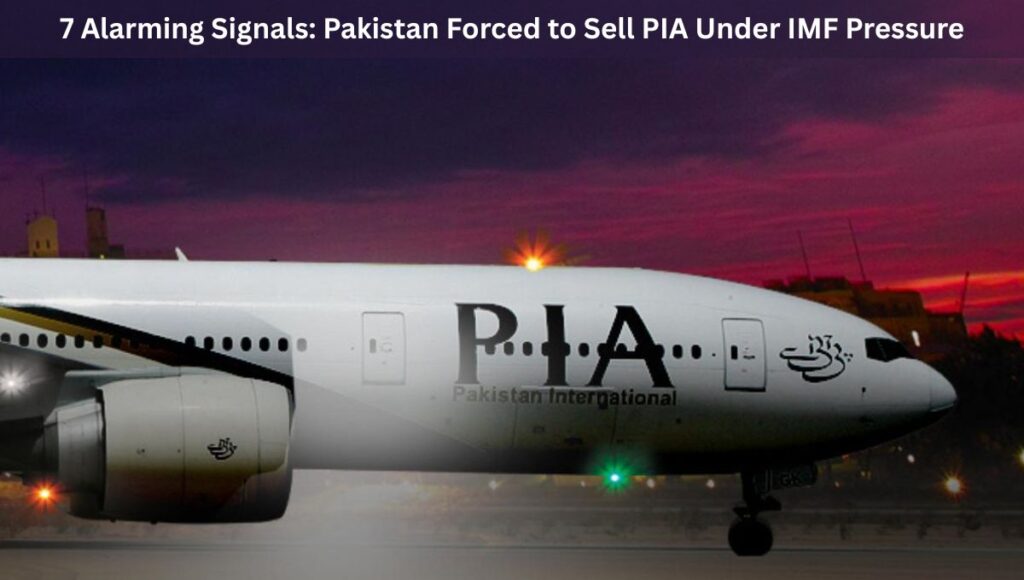
7 Alarming Signals: Pakistan Forced to Sell PIA Under IMF Pressure
Pakistan Sets December 23, 2025, for PIA’s Live-Broadcast Auction
Prime Minister Shehbaz Sharif confirmed that PIA’s bidding will take place on December 23, 2025, and the entire event will be broadcast live nationwide. This unprecedented transparency measure aims to reassure the IMF, investors and the Pakistani public that the sale will be free of corruption and political manipulation.
Sharif told corporate representatives and pre-qualified bidders during a meeting in Islamabad that his government is committed to restoring PIA’s lost prestige while ensuring that the privatisation process adheres to international standards of merit and transparency.
“PIA’s bidding will take place on December 23 and will be broadcast live on all media,” Sharif announced, stressing that the Pakistan government is “ensuring transparency and merit” in the entire process.
This will be Pakistan’s first major privatisation in nearly 20 years, and arguably the most politically sensitive one.
The Four Shortlisted Bidders for PIA
Pakistan’s Privatisation Commission has pre-qualified four bidders for the stake sale of 51–100% of PIA, including full management control. The shortlisted bidders are:
Lucky Cement Consortium
One of Pakistan’s most powerful business groups, bringing major industrial and financial muscle to the table.
Arif Habib Corporation Consortium
A leading investment and industrial conglomerate, in partnership with Fatima Fertilizer, The City School, and Lake City Holdings.
Air Blue Limited
A private Pakistani airline and a long-standing competitor of PIA.
Fauji Fertiliser Company Limited (FFC)
The most controversial bidder, as it is part of the vast military-run Fauji Foundation, which controls enormous real-estate, industrial and commercial assets across Pakistan.
The presence of Fauji Fertiliser has deepened concerns about the Pakistani military further expanding its economic footprint at a time when Pakistan is already grappling with questions over “military dominance” in governance, business and policymaking.
Military Influence Behind Fauji Foundation and Asim Munir’s Role
Although Field Marshal Asim Munir, Pakistan’s Army Chief and arguably the country’s most powerful figure, does not sit directly on the Foundation’s board, his influence is unmistakable.
The army chief appoints the Quartermaster General (QMG) — a permanent member of the Foundation’s Central Board of Directors (CBD). Through such institutional structures, the Pakistani army maintains decisive influence over the Foundation’s business decisions and long-term strategy.
In Pakistan, where the military wields enormous control over politics and the economy, the Fauji Foundation’s participation in the PIA bidding has amplified concerns about increasing “military-commercial dominance.” Critics argue that the privatisation might simply transfer PIA from a government burden to a military-controlled entity.
Why the IMF Forced Pakistan to Privatise PIA
Pakistan’s ongoing $7 billion IMF loan programme—approved in September 2024—requires strict reform measures. One of the most urgent conditions is the privatisation of loss-making state-owned enterprises (SOEs), especially PIA.
The IMF Executive Board is scheduled to meet on December 8 to release a fresh $1.2 billion tranche ($1 billion EFF + $200 million climate financing). However, future disbursements explicitly depend on the completion of the PIA sale.
Pakistan’s reliance on IMF bailouts has been historic:
- More than 20 IMF loans since 1958
- Fifth-largest debtor to the IMF
- Economy near collapse in 2023
- Heavy defence spending continues despite financial stress
Pakistan increasingly takes loans just to refinance past loans — a dangerous cycle that economists call a “perpetual debt trap.”
PIA — From National Pride to Burden
Once a symbol of modernity and excellence, Pakistan International Airlines was among the top Asian carriers and was known for its famous tagline “Great People To Fly With.” Today, PIA has become synonymous with:
- chronic mismanagement
- massive debt
- corruption
- political interference
- safety failures
- operational inefficiencies
The airline’s accumulated losses run into billions, and it has become a major burden on Pakistan’s national budget.
In October 2024, PIA had only 16 operational aircraft, while 17 planes were grounded due to technical problems, lack of maintenance and budget constraints.
How Fake Pilot Licences Shattered PIA
PIA’s most catastrophic collapse came in 2020, when the aviation minister shockingly admitted that more than 30% of Pakistani pilots held fake or questionable licences. The revelation created global alarm and exposed deep-rooted corruption within the Civil Aviation Authority.
Immediate consequences of the scandal
- 262 pilots grounded
- EU banned PIA flights (EASA ban)
- UK and US followed with similar bans
- Loss of billions in revenues from international routes
The scandal destroyed confidence in Pakistan’s aviation sector and permanently damaged PIA’s global reputation. The restrictions remain among the biggest reasons the airline has been unable to recover financially.
The 2020 Karachi Air Crash Deepened the Crisis
On May 22, 2020, PIA Flight 8303 crashed while attempting to land in Karachi, killing 97 passengers and crew. Investigators linked the tragedy to severe operational lapses, pilot errors and systemic safety failures.
The crash triggered:
- sweeping safety audits
- forced groundings
- costly inspections
- emergency repairs
- international scrutiny
PIA, already financially paralyzed, had to divert scarce funds into crisis response and compliance, accelerating its descent into insolvency.
Overstaffing, Nepotism and Political Interference
One of PIA’s hidden problems was chronic overstaffing. Reports suggest that the airline had one of the highest employee-to-aircraft ratios in the world — nearly three to four times global industry standards.
Political appointments, nepotism, union pressures and corruption created an inflated workforce consuming enormous financial resources.
By some estimates, PIA’s losses exceeded PKR 200 billion after the pilot scandal and operational disruptions. Combined with poor management and lack of independence, PIA became an unmanageable liability.
Pakistan’s Economy on the Brink — Why PIA Privatization Is Critical
Pakistan’s economic crisis is among the worst in its history. Some key indicators include:
- Foreign exchange reserves depleted
- High defence spending amid shrinking revenues
- Inflation touching record highs
- Unemployment rising
- IMF dependence at historic levels
- Debt repayments exceeding national revenues
The privatisation drive, including the sale of PIA, is part of a broader IMF-mandated reform programme to reduce Pakistan’s fiscal burden. The government targets Rs 86 billion in privatisation proceeds this year.
Privatisation Minister Muhammad Ali told Reuters:
“For PIA, in the last round of bidding, 15% of the proceeds were going to the government, with the rest staying within the company.”
However, a previous attempt to sell PIA in 2024 failed when a bidder offered only Rs 10 billion — far below the government’s expectations.
Political and Public Reactions — A Divided Country
The PIA sale has triggered heated debate across Pakistan.
Supporters argue:
- PIA is a financial drain
- IMF conditions leave no choice
- Privatisation will restore efficiency
- New management may revive international routes
Opponents argue:
- Sale of national assets undermines sovereignty
- Military-linked bidders could tighten army’s economic hold
- Workers may lose jobs
- Foreign entities (though barred from majority control) could influence policies indirectly
Labour unions have already threatened nationwide strikes, warning that the privatisation will “destroy livelihoods.”
What Happens After PIA’s Sale?
If the December 23 bidding goes as planned, Pakistan will achieve a major IMF benchmark and unlock future loan disbursements. Investors will gain control of:
- PIA’s fleet
- Landing rights
- Assets and infrastructure
- Routes
- Management
The government hopes the new operator will:
- restore international operations (especially Europe and UK)
- bring modern fleet management
- reduce losses
- rebrand the airline
- improve safety standards
Prime Minister Sharif has promised that PIA will “once again live up to its tradition of being ‘Great People to Fly With.’” Whether this promise materialises will depend largely on the new owners and whether Pakistan can maintain a stable political and economic environment.
PIA’s Fall Mirrors Pakistan’s Own Collapse
PIA’s downfall was not triggered by one event — it was a slow, painful breakdown caused by decades of systemic failure. The same can be said of Pakistan’s broader economic collapse.
Both suffered from:
- weak governance
- political interference
- corruption
- lack of accountability
- institutional decay
- militarisation of decision-making
- chronic financial mismanagement
As analysts often remark: “PIA is Pakistan — and Pakistan is PIA.” The privatisation now underway is far more than a sale — it is a test of whether Pakistan can restructure its foundations and reverse years of decline.
Conclusion: An Auction That Will Shape Pakistan’s Future
On December 23, 2025, Pakistan will attempt to rewrite the future of its national airline. But the sale of PIA is more than a business transaction — it is a reflection of a nation cornered by debt, survival imperatives and global financial pressures.
Whether this privatisation becomes a turning point or another chapter in Pakistan’s long economic struggle will depend on:
- who wins the bid
- how the new management reforms PIA
- whether political and military interference continues
- Pakistan’s ability to implement IMF-mandated reforms
One thing is certain:
The world will be watching as Pakistan auctions off one of its most iconic national assets.
Also Read: 7 Key Developments as Pakistan Senate Passes Sweeping Amendment Expanding Military Powers
Also Read: Why IMF pressure forced Pakistan to privatise PIA: Inside economic rescue plan
Related Posts:
- Gita Gopinath to Step Down as IMF’s No. 2 Official in August

- 3 Explosive Conditions Iran Sets to End War with US…

- 9 Explosive Signals as Trump Targets Cuba’s Oil…

- Pakistan Opens Mining to US, China & Russia Amid…
- 9 Explosive Signals Behind the US Carrier Move as…
- 9 Explosive Claims as Trump Says US Winning Iran War