
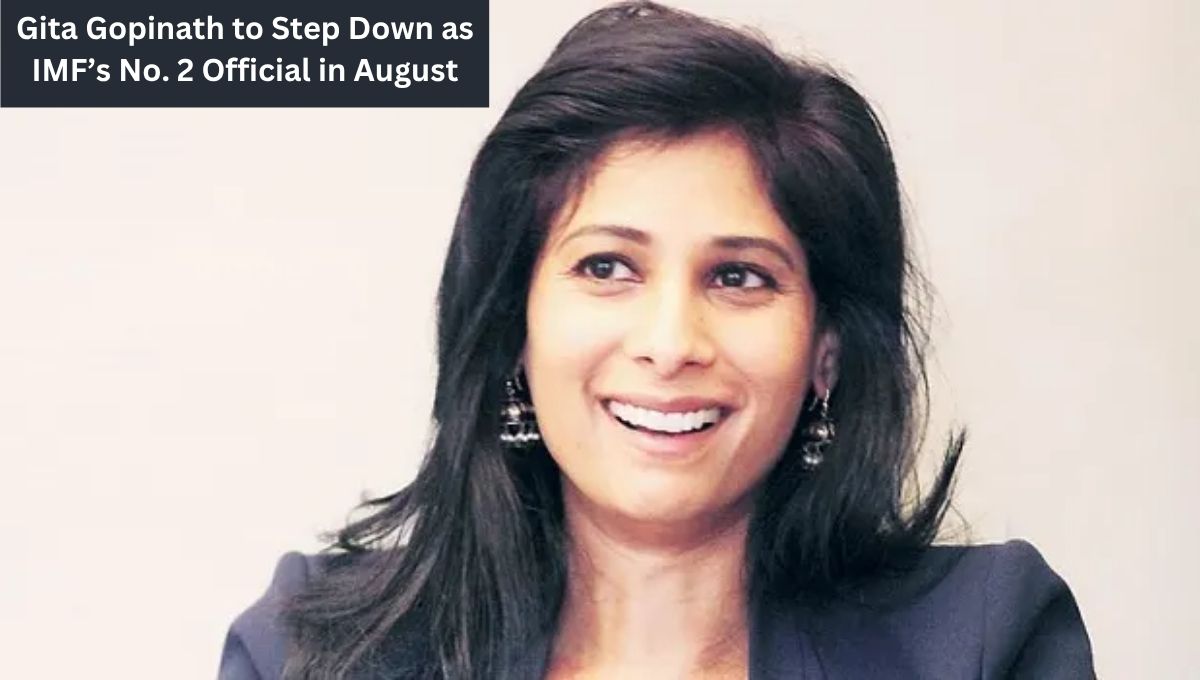
In a significant shake-up at the top levels of the International Monetary Fund (IMF), Gita Gopinath to Step Down as IMF’s No. 2 Official in August. The Fund’s First Deputy Managing Director, Gita Gopinath, will officially step down in August 2025. Her departure, confirmed by the IMF on Monday, brings an end to a historic tenure marked by a pandemic, geopolitical crises, and profound shifts in the global economic order.
Gopinath, an Indian-born U.S. citizen, had previously served as IMF Chief Economist before being promoted to the Fund’s second-highest position in 2022. She will now return to Harvard University as the inaugural Gregory and Ania Coffey Professor of Economics, marking a return to her academic roots.
Gita Gopinath to Step Down as IMF’s No. 2 Official in August
Why Is Gita Gopinath Leaving the IMF?
According to the IMF’s official statement, Gita Gopinath is stepping down voluntarily to resume her academic career at Harvard University, where she previously taught for over a decade.
While her current term at the IMF was set to continue, she chose to exit more than a year early, a decision that reportedly caught some within the organization by surprise.
In her own words, Gopinath described her tenure at the IMF as a “once-in-a-lifetime opportunity,” expressing deep gratitude to both Kristalina Georgieva and Christine Lagarde, the Fund’s past and present Managing Directors.
“I now return to my roots in academia, where I look forward to continuing to push the research frontier in international finance and macroeconomics to address global challenges, and to training the next generation of economists,” she said.
A Trailblazing Tenure at the IMF
Gita Gopinath’s impact at the IMF has been profound. She became the first woman to serve as Chief Economist in 2019 and was later elevated to First Deputy Managing Director the Fund’s No. 2 position in 2022.
During her tenure, she:
- Co-authored the IMF’s COVID-19 Pandemic Plan, setting global vaccination targets at feasible costs.
- Oversaw the World Economic Outlook, maintaining it as the gold standard for global economic forecasting.
- Spearheaded the Integrated Policy Framework (IPF), equipping countries with tools for financial stability.
- Represented the IMF at key international forums, including G7 and G20 summits.
- Helped steer global financial strategy during Russia’s invasion of Ukraine and the resulting shocks.
Kristalina Georgieva, Managing Director of the IMF, offered high praise for Gopinath, calling her a “rare combination of brilliance and humility.”
“Gita steered the Fund’s analytical and policy work with clarity, striving for the highest standards of rigorous analysis at a complex time of high uncertainty and rapidly changing global economic environment,” Georgieva said.
What’s Next for Gita Gopinath?
Gopinath will return to Harvard University’s Department of Economics as the Gregory and Ania Coffey Professor of Economics.
Harvard has already confirmed her appointment and announced that a new set of course offerings under her name will be available beginning next spring.
Her return to Harvard is not just a homecoming it places her at the center of one of the U.S.’s most influential academic institutions at a politically sensitive moment.
The university has come under fire from the Trump administration for resisting demands to alter its governance, admissions, and hiring practices.
While Gopinath’s return to Harvard is purely academic in nature, it also situates her in a politically charged environment amid wider debates about academic freedom, meritocracy, and institutional governance in elite U.S. universities.
A Strategic Opportunity for President Donald Trump
Gopinath’s exit opens up a key international position that the U.S. Treasury traditionally nominates. The First Deputy Managing Director of the IMF is one of the most powerful economic roles in global finance, responsible for shaping the Fund’s responses to fiscal crises, trade disputes, and macroeconomic instability.
President Donald Trump, who returned to office in January 2025, now has a rare opportunity to nominate Gopinath’s successor, effectively reshaping the ideological and strategic orientation of the IMF at a time when his administration is pursuing bold protectionist economic policies and challenging multilateral institutions.
Gopinath had replaced Trump-era nominee Geoffrey Okamoto in 2022. Now, Trump is positioned to once again place a loyalist or ideological ally in one of the world’s most influential financial institutions.
Global Reactions and Future Uncertainty
So far, no official comment has been issued by the U.S. Treasury regarding who might replace Gopinath.
However, the implications of this change will be closely watched by global markets, central banks, and developing countries dependent on IMF assistance.
The IMF’s $1 trillion lending capacity supports nearly 200 member countries, many of whom face balance of payment crises, inflation, and debt vulnerabilities.
The new appointee will play a central role in shaping global responses to these challenges at a time when Trump is aggressively restructuring U.S. trade policy and slashing foreign economic aid.
Meanwhile, Kristalina Georgieva has stated that the IMF will name Gopinath’s successor “in due course,” though the process is likely to be heavily influenced by Washington’s Treasury Department and the Trump White House.
A Legacy of Excellence
Throughout her time at the IMF, Gita Gopinath championed evidence-based policy, international cooperation, and academic rigor.
Her departure represents not only a personal shift but a broader transition in the leadership dynamics of the global economic system.
While her shoes will be hard to fill, her return to academia promises to enrich economic scholarship and mentor future leaders in global finance.
“Gita came to the Fund as a highly respected academic,” Georgieva said, “and admiration for her only grew through her time at the Fund. Her legacy will be long remembered.”
Conclusion: A Departure That Signals Change
Gita Gopinath’s decision to leave the IMF and return to Harvard is both a personal career move and a pivotal moment for global economic governance. With her exit, the Trump administration gains a rare chance to influence the leadership of the IMF and steer it in a new direction aligned with its economic philosophy.
As the world grapples with inflation, war, climate disruptions, and shifting power structures, the next IMF First Deputy Managing Director will wield enormous influence. Gopinath, meanwhile, returns to academia her original passion with a wealth of real-world experience that will undoubtedly shape the next generation of economists.
Also Read: Yulia Svyrydenko Appointed as Ukraine’s First Female Wartime Prime Minister
Related Posts:
- 11 Explosive Reasons Pentagon Cut All Military Ties…

- AAP MP Raghav Chadha Supports Harvard in Fight…

- 5 Shocking Facts About the Harvard Medical School…

- Trump vs. Harvard: Federal Funding Cut Sparks Clash…

- Trump Ends Harvard Feud with $500M Trade Schools Deal

- Harvard’s SEVP Certification Revoked: What This…
