
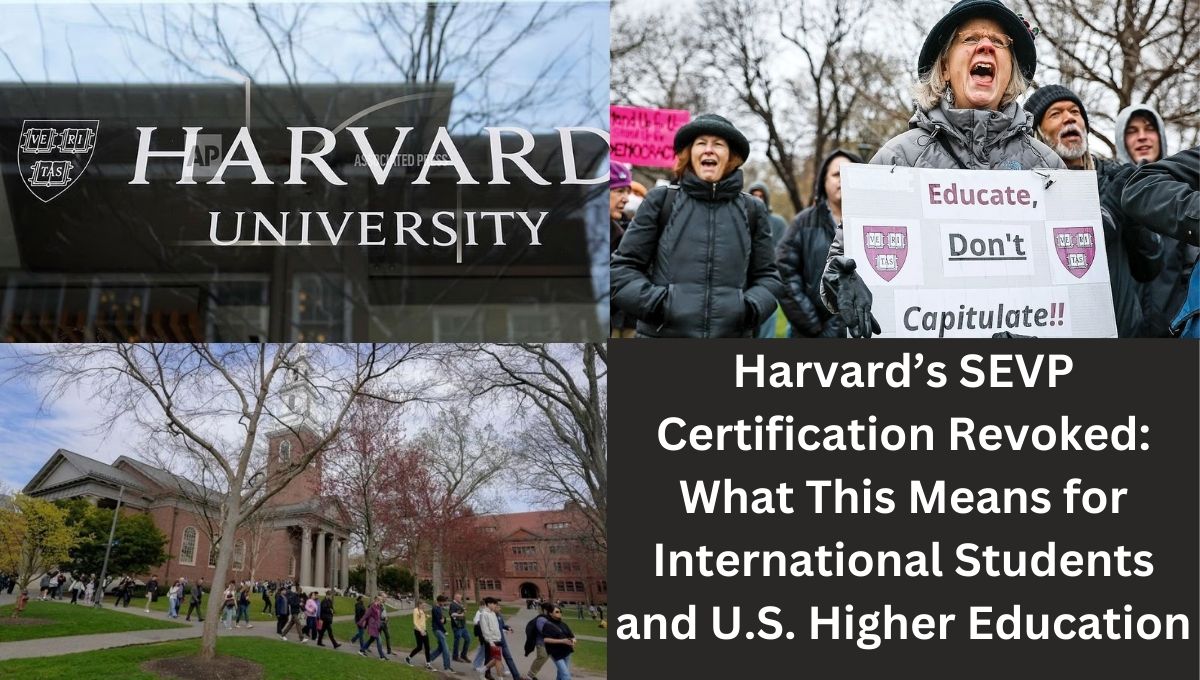
In a historic step Harvard’s SEVP Certification Revoked: What This Means for International Students and U.S. Higher Education. The Trump administration has revoked Harvard University’s Student and Exchange Visitor Program (SEVP) certification, effectively barring the Ivy League institution from enrolling foreign students on F-1 and J-1 visas. This unprecedented move impacts thousands of international students, including nearly 800 from India, and raises significant questions about the future of international education in the United States.
Harvard’s SEVP Certification Revoked: What This Means for International Students and U.S. Higher Education
What Is Harvard’s SEVP Certification and Why Does It Matter?
The Student and Exchange Visitor Program (SEVP) certification allows U.S. universities to enroll international students who require F-1 and J-1 visas.
Harvard, one of the world’s most prestigious institutions, hosts over 10,000 international students and scholars, representing 27.3% of its total student body.
These students contribute not only culturally and academically but also economically especially Indian students, who add an estimated USD 9 billion annually to the U.S. economy through tuition and living expenses.
With the SEVP certification revoked, Harvard is prohibited from enrolling new foreign students, creating turmoil for current and prospective students who depend on this status for their education and stay in the United States.
The 72-Hour Deadline and DHS Conditions
The Department of Homeland Security (DHS), led by Secretary Kristi Noem, has issued Harvard a strict 72-hour deadline to comply with six demanding conditions to regain its SEVP certification.
The demands require Harvard to provide:
- All records on illegal activities involving international students over the last five years.
- Documentation of dangerous or violent behavior by foreign students.
- Records of threats against other students or staff.
- Information on deprivation of rights of classmates or staff.
- Complete disciplinary records of international students.
- Audio or video footage of protests involving international students on campus.
Failure to comply could extend Harvard’s exclusion from enrolling international students, forcing affected students to either transfer or face potential deportation.
Impact on Indian Students and the Global Student Community
forming one of the largest groups of international students on campus. The revocation of SEVP certification disrupts their academic journey and visa status, leaving many in a state of uncertainty.
Ajay Bhutoria, former advisor to President Biden, strongly condemned the DHS’s actions as an intimidation tactic against students involved in activism, particularly targeting the South Asian diaspora.
The broader international student community is equally affected, as they must consider transferring to other SEVP-certified universities or leaving the U.S., disrupting their education and long-term career plans.
Background: The Political Context Behind the Crackdown
This move is the latest escalation in a prolonged standoff between Harvard and the Trump administration. The conflict intensified after Harvard’s then-president Claudine Gay’s congressional testimony about campus protests related to the Middle East conflict, particularly after the October 7 attack on Israel and the Gaza offensive.
The Trump administration accuses Harvard of failing to control anti-Semitic and pro-Palestine demonstrations, criticizing the university’s diversity and inclusion policies as “racist” and “anti-American.”
Since January 2025, President Trump’s administration has increased pressure on Harvard and other elite universities, freezing federal funding and demanding oversight reforms, all while targeting what it describes as “woke ideology.” Harvard has resisted, calling the measures unlawful and retaliatory.
DHS Allegations and Harvard’s Defense
The Department of Homeland Security alleges Harvard has allowed an unsafe campus environment that harbors “anti-American, pro-terrorist agitators” and even claims ties with the Chinese Communist Party.
Secretary Noem emphasized that enrolling international students is a privilege, not a right, and that Harvard’s alleged failure to maintain campus safety justifies revoking its SEVP certification.
Harvard, however, strongly disputes these claims. The university remains committed to academic freedom and international education.
Harvard spokesperson Jason Newton called the revocation “unlawful” and vowed to challenge the decision legally.
Harvard acknowledges concerns about campus safety but views the government’s demands as politically motivated interference.
What Does This Mean for U.S. Higher Education?
Harvard’s SEVP certification revocation sets a concerning precedent for all U.S. universities. It signals heightened federal scrutiny and political interference in university affairs, potentially jeopardizing the academic freedom and autonomy that American higher education relies on.
For international students, especially those from India, this policy introduces significant uncertainty, risking the loss of valuable talent to competing countries like Canada and the UK, which actively court foreign students with less political risk.
Experts warn that the U.S. risks damaging its global leadership in research and innovation by alienating international students the lifeblood of many graduate and doctoral programs.
The Broader Political and Ethical Controversy
Observers note parallels between the government’s crackdown on universities and authoritarian tactics aimed at weakening independent institutions.
By restricting foreign student enrollment and discrediting universities, the administration appears to be undermining pillars of democracy such as free inquiry and academic freedom.
This controversy coincides with heightened scrutiny of President Trump’s private cryptocurrency gala, raising ethical questions about conflicts of interest and political retaliation.
The Road Ahead for Harvard and International Students
To restore its ability to enroll international students, Harvard must comply with the DHS’s extensive documentation demands within 72 hours or face prolonged exclusion from SEVP certification.
Meanwhile, thousands of international students await clarity on their futures.
Many will likely transfer to other universities, but this disruption threatens academic progress and raises concerns about the U.S.’s attractiveness as a global education destination.
Conclusion: A Defining Moment for Academic Freedom and International Education
The Trump administration’s revocation of Harvard’s SEVP certification marks a critical clash between political power and academic independence.
Harvard’s fight to restore its international enrollment underscores the urgent need to protect higher education from political interference, safeguard the rights of international students, and uphold democratic values.
This case will have far-reaching consequences not only for Harvard but also for the future of U.S. higher education and its position in the global academic community.
Also Read: Trump vs. Harvard: Federal Funding Cut Sparks Clash Over Antisemitism, Academic Freedom
Also Read: Harvard’s international students could stay—if 6 conditions are met in 72 hours
Related Posts:
- 5 Major Takeaways from the US Supreme Court's…
- 7 Heartbreaking Facts About Venezuela's Earthquake Disaster

- 7 Powerful Facts About Ayatollah Ali Khamenei’s…

- Trump’s 20-Point Gaza Peace Plan Gains Urgent Global…

- Dramatic Moments Behind Trump’s Gaza Peace Push and…

- Afghanistan–Pakistan War 2025: Inside the 48-Hour Ceasefire
